Abstinence-only Driver's Ed
Don't miss reading this link at McSweeny's. Hilarious.

Loading..



Cerling and Ehleringer over at the University of Utah just published a paper in the online journal "Proceedings of the National Academy of Sciences" describing their new forensic technique, which uses Hydrogen and Oxygen isotope concentrations from local water tables in your hair to determine where you have spend your time.

The two maps here show predicted average hydrogen (top) and oxygen (bottom) isotope levels in human hair across the continental United States -- isotopes that vary with geography because of different isotope levels in local drinking water. The ratios of heavy, rare hydrogen-2 to lighter, common hydrogen -1 are highest in red and orange areas in the top map, and lowest in the blue and darker green areas. The ratios of heavy, rare oxygen-18 to lighter, common oxygen-16 are highest in red and orange areas of the bottom map, and lowest in the blue and darker green areas. Credit: University of Utah
“You can tell the difference between Utah and Texas,” Ehleringer says. But, Cerling adds, “You may not be able to distinguish between Chicago and Kansas City.”
Loading..
Don't miss tonight's Lunar Eclipse. Otherwise you'll have to wait at least three more years to see another one.
Loading..
If you happen to live in the area, and have the slightest interest in fresh-water aquaria, don't miss this amazing store in San Francisco.


Loading..
Hi all,

Loading..

“Rafe Esquith is my only hero.”
—Sir Ian McKellan
“Politicians, burbling over how to educate the underclass, would do well to stop by Rafe Esquith’s fifth grade class as it mounts its annual Shakespeare play. Sound like a grind? Listen to the peals of laughter bouncing off the classroom walls.”
—Time
“Esquith is a modern-day Thoreau, preaching the value of good work, honest self-reflection, and the courage to go one’s own way.”
—Newsday
Loading..
What a technical home run. If you need any more motivation to engage in cool robotics projects, just check out the reaction when the test subject figures out he can feed himself for the first time in 26 years. That's social impact. From the IEEE Spectrum site.

Loading..
Decisions are made by those who show up. So go and cast your vote without delay. Our country's future depends on you.

Without making any specific plugs, let's just say that the Republican party has not been kind to science in the last eight years, and it would be good for this country to realize significant revitalization in those areas. Vote for science and our future!
Loading..


Loading..
A very topical Op-Ed piece from Sunday's San Francisco Chronicle by Intel Chairman Craig Barrett. I liked it so much I include it in its entirety here.
Flagging Economy Needs Science Investments
Sunday, January 20, 2008
"Two years ago, the National Academies published the seminal study on U.S. competitiveness entitled "Rising Above the Gathering Storm." The study identified major shortcomings in U.S. investments in basic scientific research as well as in math and science education for our youngsters. The suggestions contained in this study were immediately picked up by the Democratic House Leadership as their competitiveness strategy and later by President Bush in his State of the Union message under his American Competitiveness Initiative. Legislation in the form of the America Competes Act was passed in the House and Senate in 2007, and it appeared the United States was finally going to move forward after years of neglect to increase investment in math, science and basic research. All parties agreed that our competitiveness in the 21st century was at stake and we needed to act.
So much for political will.
The recent budget deal between Republicans and Democrats effectively flat-funds or cuts funding for key science agencies. Excluding "earmarks," the Department of Energy funding for fiscal year 2008 is up only 2.6 percent, thus losing ground to inflation. The National Science Foundation is up 2.5 percent, with the same result. The National Institute of Standards and Technology is up 11 percent, however the labs where research happens only get 2.3 percent, again losing ground to inflation. Key national laboratories, such as the Fermilab, which focuses on high-energy particle physics research, face the likelihood of hundreds of jobs being lost and the closing of some facilities, helping to shortchange defense research. Predicting the impact of such funding cuts in basic research on future job creation is difficult. Who could have predicted a $300 billion semiconductor industry from the invention of a transistor? But our kids who are heading to college are very smart. They will make their career decisions based on where they see the priorities of our government and economy.
The funding decisions on the America Competes Act took place a few days after Congress passed a $250 billion farm bill. In the eyes of our political leaders, apparently, corn subsidies to Iowa farmers are more important for our competitiveness in the next century than investing a few billion in our major research universities. The president expressed his happiness with the budget and Sen. Harry Reid, the Senate Majority Leader, said, "The president didn't get his priorities, we got ours."
At a time when the rest of the world is increasing its emphasis on math and science education (the most recent international tests - NAEP and PISA - show U.S. kids to be below average) and increasing their budgets for basic engineering and physical science research, Congress is telling the world these areas are not important to our future. At a time when we are failing our next generation of students, politically charged topics such as steroids in Major League Baseball and the destruction of CIA interrogation tapes command instantaneous congressional hearings while the seed corn (no pun intended) of our future is ignored and placed lower in priority than billions of dollars of earmarks.
Perhaps this would all be a moot discussion if we could continue to import the best and brightest minds from around the world to start and staff our next generation of high tech startups. But Washington can't even get that strategy straight, as legal immigration - the process by which bright, highly educated workers immigrate to the United States - is being choked by our inability to control illegal immigration. While the EU has proposed a simplified and expanded program for importing highly educated talent from the rest of the world, we continue to make if more difficult for the same talent to work in the United States, even when some of these knowledge workers have received their education in the United States at partial taxpayer expense.
Where are the voices in Washington to bring reasoned debate and action to these topics? Where are the voices among the presidential candidates to propose solutions to these challenges? What do we elect our political leaders for if not to protect our long-term future?
The United States stands at a pivotal point in our history. Competition is heating up around the world with millions of industrious, highly educated workers who are willing to compete at salaries far below those paid here. The only way we can hope to compete is with brains and ideas that set us above the competition - and that only comes from investments in education and R&D. Practically everyone who has traveled outside the United States in the last decade has seen this dynamic at work. The only place where it is apparently still a deep, dark secret is in Washington, D.C.
What are they thinking? When will they wake up? It may already be too late; but I genuinely think the citizenry of this country wants the United States to compete. If only our elected leaders weren't holding us back.
Craig Barrett is the chairman of Intel."
Loading..



Loading..
Who says encryption is only for mathematicians, geeks, or credit card transactions?

Loading..
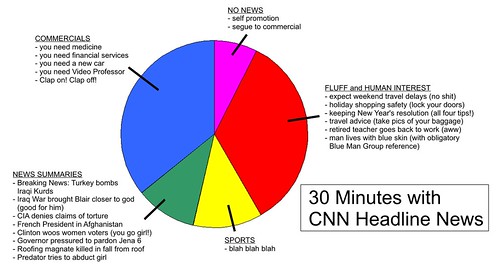
I came across this graphic this morning, which really tells the story of the decline and fall of television news. Check out "30 Minutes with CNN." What is worse, there are other "news" stations that are worse, having mostly replaced factual reporting with talking heads screaming at each other.
Loading..
An important milestone was reached today. Roughly half of the human race has a cellphone account. It's actually somewhat less, since many countries average more than one mobile phone per person, over 3.3 BILLION mobile phone accounts across the globe....but still. Wow. Now to outfit them all with live TV!
Read more here.
Loading..
Sometimes the right picture is worth more than a thousand words. There's a fine art to representing data to clearly illuminate an issue, and this one takes my nomination for the graph of the year. This graphic comparing our government's nutritional recommendations to its actual spending tells the story of money (from lobbyists) over morals.
Loading..
Shelly Batts over at Retrospectacle just turned me on to this great show called Brainiacs. Here are a couple of fine videos starting off with a bit on alkali earth metals. I think Shelly is right, a British accent does lend an air of legitimacy. Kind of. Ahem. Don't try this at home.
Loading..
Loading..
Yes, my favorites are all irreverent, but I just can't resist. Check out the growing collection at the Fine Art Photoshop Contest posted here, where you can also see the un-retouched originals.

Loading..

 Posts
All Comments
Posts
All Comments
Add All the Best Bits to your favorite news reader: