Sunday, November 12, 2006

A Great Hackable Robot: Roomba from iRobot

All you wanna-be robot hackers take note. Tod Kurt's new book on hacking the Roomba robot vacuum cleaner is available for pre-order on amazon.

hr2

It's a great platform with a decent processor and interface, very well-engineered sensors and motor systems, and is relatively cheap for all the hackable robotic excellence it contains. $180 for the robot, and $17 for the book seem like a good deal. The book highlight all sorts of projects including adding a camera and making the robot draw on paper and so on. Every high school should have four or five of these suckers.

Thursday, November 09, 2006

Air Shower Cuts Water Use By 30%

Water conservation is a particularly contentious topic in California what with the farmers battling the city-folk for every drop. And yet I know several otherwise "green" individuals who still revel in their luxurious high-volume "drenching" showers.

I will even admit that when we first moved into our new home, the master bedroom shower head afforded wonderful, though short showers that completely drained our water heater in about 10 minutes. So I did what any good scientist would do. I engaged in an extensive shower-head survey experiment.

It turned out to be a rather depressing exercise. Of the 12 or so shower heads that were available in our immediate area, the contenders generally fell into one of two camps: no flow restrictor and great showering, or great water economy with heads that would blow at you and not really get you wet enough to shower comfortably.

Image of a showerhead tied in a knot.

But now, Australian scientists claim they have solved this uncomfortable trade-off by developing a device that can be inserted into existing shower heads, which fills the water droplet with bubbles of air instead of blowing the air around the droplets.

Developed by a team led by Dr Jie Wu, the aeration device is a small nozzle that fits inside a standard showerhead. The nozzle uses a small Venturi tube – a tube for which the diameter varies, creating a difference in pressure and fluid speed. Air is sucked into the Venturi tube as a result of the partial vacuum created, causing air and water to mix, forming tiny bubbles within the water stream.

“The nozzle creates a vacuum that sucks in air and forces it into the water stream,” Dr Wu says.

“We make the water droplets in the stream hollow and the bubbles expand the volume of the shower stream.”

Small-scale experiments using the aeration device found that people detected no difference in water pressure, sensation, or overall perception of showering.

Sounds great, but I'll reserve judgment until my chill-prone wife approves the technology in her rigorous goose bump test. But I would feel very green indeed, if I could reduce household water consumption by 30%.

Spectacular New Orion Nebula Image

Here is the latest composite image from Hubble and Spitzer, this one of the famous Orion nebula. I love the fact that now, with better instrumentation, it really does look like a giant cloud of gas.

Spitzer/Hubble image of Orion nebula

From the NASA web site:
NASA's Spitzer and Hubble Space Telescopes have teamed up to expose the chaos that baby stars are creating 1,500 light years away in a cosmic cloud called the Orion nebula.

This striking infrared and visible-light composite indicates that four monstrously massive stars at the center of the cloud may be the main culprits in the familiar Orion constellation. The stars are collectively called the "Trapezium." Their community can be identified as the yellow smudge near the center of the image.

Swirls of green in Hubble's ultraviolet and visible-light view reveal hydrogen and sulfur gas that have been heated and ionized by intense ultraviolet radiation from the Trapezium's stars. Meanwhile, Spitzer's infrared view exposes carbon-rich molecules called polycyclic aromatic hydrocarbons in the cloud. These organic molecules have been illuminated by the Trapezium's stars, and are shown in the composite as wisps of red and orange. On Earth, polycyclic aromatic hydrocarbons are found on burnt toast and in automobile exhaust.

Together, the telescopes expose the stars in Orion as a rainbow of dots sprinkled throughout the image. Orange-yellow dots revealed by Spitzer are actually infant stars deeply embedded in a cocoon of dust and gas. Hubble showed less embedded stars as specks of green, and foreground stars as blue spots.

Stellar winds from clusters of newborn stars scattered throughout the cloud etched all of the well-defined ridges and cavities in Orion. The large cavity near the right of the image was most likely carved by winds from the Trapezium's stars.

Located 1,500 light-years away from Earth, the Orion nebula is the brightest spot in the sword of the Orion, or the "Hunter" constellation. The cosmic cloud is also our closest massive star-formation factory, and astronomers believe it contains more than 1,000 young stars.

The Orion constellation is a familiar sight in the fall and winter night sky in the northern hemisphere. The nebula is invisible to the unaided eye, but can be resolved with binoculars or small telescopes.

This image is a false color composite where light detected at wavelengths of 0.43, 0.50, and 0.53 microns is blue. Light at wavelengths of 0.6, 0.65, and 0.91 microns is green. Light at 3.6 microns is orange, and 8.0 microns is red.

Image credit: NASA/JPL-Caltech/STScI

Images from Yesterday's Mercury Transit

For those of you who missed the planetary excitement yesterday, here is a collection of images of Mercury's march across the face of the sun along with equipment and process details.


Howard Esklildsen of Ocala, FL took this image with a
Meade 6-inch telescope capped with a Baader solar filter. The perfectly circular silhouette of Mercury appears at bottom, the ragged expanse of sunspot 923 at top. "It was a great view."
The image “http://www.spaceweather.com/eclipses/08nov06/Adrian1.jpg” cannot be displayed, because it contains errors.
This image was taken by Adrian of San Jose, CA using a Coronado PST.

Wednesday, November 08, 2006

Gas Up Before the Inevitable Price Increase

Now that election day is passed, I expect the Republican administration to re-start the filling of the Strategic Petroleum Reserve, which will inevitably drive up gasoline prices.

Most of the economists I know were a little surprised that the country would stop filling the reserve when the prices were already at a multi-year low and the reserves had been depleted already partly due to the Iraq conflict. But as we now know, politics trumps economics, and they needed any weapon in the run-up to the election. Even then, it looks like the artificially-induced lower gas prices weren't enough to stave off congressional defeat.

The only real question remaining in my mind is when they will open the spigot, given the open-ended nail biters in Virginia and Montana to determine control of the Senate. It wouldn't surprise me if for some reason the SPR intakes remain closed until the election is completely resolved.

Tuesday, November 07, 2006

Avoid Bad Assumptions

Back in the day when I was a high school Physics teacher, I often struggled to decide how much detail and complexity to include in the lessons and laboratory exercises.

One of the critical principles I swore to instill concerns the power of abstraction and how to use it. The idea that one can make a simplified model of a more complicated system in order to illuminate fundamental properties and behaviors is central to the understanding of science and science history, and central to using those models to make useful predictions. I think most people eventually got that part. The real challenge, though, was teaching someone what sorts of things they needed to worry about in making their abstractions, what they could ignore, and how to tell the difference between the two.

So yes, simplifying assumptions are critical to solving complex problems, but if you simplify too much, you are solving a problem that no longer really helps you understand what is happening in the real world. So in teaching those intro Physics classes, I took extensive steps to be sure that the students understood what types of things we ignored when discussing topics such as Newton's laws, and we discussed at length why their lab experiments didn't quite come out as the simplified equations would have predicted. We would even work to improve experiments with things like vacuum chambers and lubricants to reduce troublesome complications like friction specifically so they could understand the abstract mathematical descriptions and where they broke down. Despite the fact that these same principles apply across any human endeavor even outside of science from relationship management to business strategy, students would often ask, "so what does this have to do with my life?"

Well today, with all the current hoopla around returning to the Moon and then heading on to Mars, NASA resurrected some old data that highlighted a catastrophic assumption they had made on prior Lunar missions, so that hopefully, we can re approach the Moon with improved confidence.

You see, back in 1972 during the Apollo 16 mission, the Astronauts launched a small satellite called PSF-2 into a low Lunar orbit (only about 60 km above the Moon's surface) in order to continue extended observations even as the manned mission returned to Earth.

see caption

To make a rather longer story short, the satellite ended up crashing into the moon despite the fact that there was no atmosphere to induce drag that would have eroded the orbit. So what happened?

It turns out that the scientists of the seventies had made a catastrophic assumption that tremendously simplified the orbital path planning calculations to get the spacecraft to the Moon and back. And as long as the command module was in a short-term lunar orbit and cruising all the way from Earth and back (a trip mostly far away from planetary or Lunar mass), there was no noticeable deviation from the planned paths that would indicate any problem with the simplified models. Everything was fine.

But when the tiny satellite was left in a long-term orbit close to the surface of the moon, its actual flight path began to deviate quite substantially from what the simplified model had foretold. Eventually it crashed into the Lunar surface. So, what was the simplification? What happened?

The problem was that the scientists of the day had assumed that the density of the entire Moon was roughly uniform. In retrospect, anyone who has dug a hole would know that earth is composed of loose material, water, pebbles, all of varying density, and it wouldn't we all that much of a stretch to realize that those inhomogeneities might extend to larger scales. But in truth, those deviations from the average density had never been an issue before, because in interplanetary (or earth-to-moon) travel, the distances from the planets were typically large enough, and the durations of orbits short enough, that the simplified models proved quite accurate for those purposes.

It wasn't until a new experiment that "looked" much more closely at the Moon for a longer period was conducted that we discovered that the heretofore ignored "higher-order" effects were indeed relevant. We now know that the Moon is quite lumpy.

"The Moon is extraordinarily lumpy, gravitationally speaking," Konopliv continues. "I don't mean mountains or physical topography. I mean in mass. What appear to be flat seas of lunar lava have huge positive gravitational anomalies—that is, their mass and thus their gravitational fields are significantly stronger than the rest of the lunar crust." Known as mass concentrations or "mascons," there are five big ones on the front side of the Moon facing Earth, all in lunar maria (Latin for "seas") and visible in binoculars from Earth.

The mascons' gravitational anomaly is so great—half a percent—that it actually would be measurable to astronauts on the lunar surface. "If you were standing at the edge of one of the maria, a plumb bob would hang about a third of a degree off vertical, pointing toward the mascon," Konopliv says. Moreover, an astronaut in full spacesuit and life-support gear whose lunar weight was exactly 50 pounds at the edge of the mascon would weigh 50 pounds and 4 ounces when standing in the mascon's center.

see caption
Above: Mascons on the Moon that make its gravitational field so lumpy, as mapped by the Lunar Prospector mission, are shown in orange-red. The five largest all correspond to the largest lava-filled craters or lunar "seas" visible in binoculars on the near side of the Moon: Mare Imbrium, Mare Serenitatus, Mare Crisium, Mare Humorum and Mare Nectaris. Image reference: Konopliv et al, Icarus 150, 1–18 (2001).

"Lunar mascons make most low lunar orbits unstable," says Konopliv. As a satellite passes 50 or 60 miles overhead, the mascons pull it forward, back, left, right, or down, the exact direction and magnitude of the tugging depends on the satellite's trajectory. Absent any periodic boosts from onboard rockets to correct the orbit, most satellites released into low lunar orbits (under about 60 miles or 100 km) will eventually crash into the Moon. PFS-2 released by Apollo 16 was simply a dramatic worst-case example. But even its longer-lived predecessor PFS-1 (released by Apollo 15) literally bit the dust in January 1973 after less than a year and a half.

Original Post at NASA's Bizarre Lunar Orbits.

Friday, November 03, 2006

Mercury Transit in a Nice Notebook

A lot of people ask me what sort of thing would I like to see in a student's laboratory notebook, and this turns out to be harder to describe than you might imagine. Yes, I want to see all the typical experimental setup description, recorded data, and details about experimental method and error analysis sorts of things. But I also like to see some creativity and thought, and maybe a little artistic impression to aid visualization, and links to new creative ideas and perhaps thoughts on the NEXT experiment.....

But there is nothing like a good example. This kid gets an A for his notebook page on the last Mercury transit back in May of 2006.


Original source: Spaceweather

And now you can go make a similar one for the upcoming transit next week on November 8th! Here is an image from the NASA web site that tells you when to be observing, depending on where you are.

see caption

Please note that observing the sun without optical protection or filtering is still as dangerous as ever and can blind you, and that there are proper ways to safely observe the sun, including eclipse glasses, using a pinhole projector, using eyepiece projection through a telescope onto a piece of paper, or directly through a telescope equipped with a solar observation filter.


Make a Very Cool Battery

Sorry, I couldn't resist the ice tray pun. I just love simple and illuminating (yes, another pun) science experiments which don't require any expensive equipment. And you can even recover most of the investment in this one after the students are done with the cash.

From Make Magazine: a Penny and Dime-powered LED.

Img413 1352

287161767 B7A3D45Df0

The simple initial challenge of making a one cell battery with salt water, a dime and a penny can be easily extended to multiple cells in series to generate higher voltage. The LED allows experimentation with polarity. If you have a volt meter, students can measure voltages and design batteries for any number of applications from lighting an LED to powering a motor. They can measure the capacity of the battery, calculate the currents, and experiment with ways to improve the battery performance. (Bigger cells, polished electrodes, bigger multi-penny electrodes.) It's a great open ended exploration: "Okay, now make your battery better!" or, "Okay, now can you make the same battery cheaper?"

Chemistry, Physics, Electrical Engineering and Electronics in one simple and inexpensive activity! Woohoo!

Astronomical Numbers Around a Black Hole

Sometime you run into a number that is just so damn large that it is hard to really comprehend just how big and far reaching that number is. But it is rare that you run into so many of them in one place, specially a place that is describing something real and physically out there and measurable.

MS 0735.6+7421
(click on image to see a high-resolution version)

NASA's recent press release on a "Monstrous Black Hole Blast in the Core of a Galaxy Cluster" simply would not relent. The amazing web of all the staggering numbers involved were tied together with a composite image assembled from instruments on two different spacecraft and an earth-bound radio telescope array. The Hubble Space Telescope's Advances Camera for Surveys was used to take an optical spectrum picture of the cluster of galaxies which are all bound together by gravity and a super-massive Black Hole at its center. More recently, that image was augmented with X-Ray spectrum data from the Chandra Orbiting X-Ray Telescope, and the Very Large Telescope radio sensor array in New Mexico to include the hot interstellar (and intergalactic)gas in such a way that an otherwise invisible blast that spans several GALAXIES has been exposed. Check out all of the astronomical numbers in the NASA release text (I've added the highlights in bold.)

This is a composite image of galaxy cluster MS0735.6+7421, located about 2.6 billion light-years away in the constellation Camelopardus. The image represents three views of the region that astronomers have combined into one photograph. The optical view of the galaxy cluster, taken by the Hubble Space Telescope's Advanced Camera for Surveys in February 2006, shows dozens of galaxies bound together by gravity. Diffuse, hot gas with a temperature of nearly 50 million degrees permeates the space between the galaxies. The gas emits X-rays, seen as blue in the image taken with the Chandra X-ray Observatory in November 2003. The X-ray portion of the image shows enormous holes or cavities in the gas, each roughly 640 light-years in diameter -- nearly seven times the diameter of the Milky Way. The cavities are filled with charged particles gyrating around magnetic field lines and emitting radio waves shown in the red portion of image taken with the Very Large Array telescope in New Mexico in June 1993. The cavities were created by jets of charged particles ejected at nearly light speed from a supermassive black hole weighing nearly a billion times the mass of our Sun lurking in the nucleus of the bright central galaxy. The jets displaced more than one trillion solar masses worth of gas. The power required to displace the gas exceeded the power output of the Sun by nearly ten trillion times in the past 100 million years.
It is simply amazing to me that we can measure and visualize such things directly.

See the original NASA release here.

Wednesday, November 01, 2006

Slow Motion Bullet Impacts

Here's a cool slow-motion YouTube video of a series of object suffering projectile impacts. All you need to take similar photos is a sound trigger for a digital camera, just like for stroboscopic photos, and a high-speed video camera. Let me know if you need pointers to the manufacturers.

The Gas Tax, Hockey Penalties, and Time-outs

I found an interesting chart on the Foreign Policy web site this morning that highlights some of the conflicted logic surrounding US energy and tax policies.

The gasoline tax rate within the US is literally less than one-tenth the comparable tax in Europe while per-capita gas consumption is more than four times higher. The anti-correlation is very illuminating. And while there are clearly many factors driving gasoline consumption relative to Europe such as the very area over which Americans much drive being larger than the average European roaming distance, even a quick glance at the chart shows that if the US is really serious about immediately decreasing the dependency on foreign, there is a very simple policy decision that could have broad and immediate impact, and is probably worth an experiment. The US administration could substantially raise the gasoline tax to a meaningful level, and see what happens.

There is a reasonable likelihood that doubling the effective price of gas could dramatically reduce consumption just through price elasticity alone. For those of you not familiar with retail sales economics, price elasticity is the relationship between the price of goods and the volume of sales at that price. If you lower the price, you sell more (the volume increases), and conversely, if you price goods higher, your sales volume will decrease. So retail sales strategy is all about picking the right price so that your sales price times the volume of sales is maximized (to maximize total revenues). So if the US raises the price of gasoline with an aggressive tax, the sales volume should decrease substantially.

The other effect such a tax levy might induce is that alternative energy sources could immediately become more cost effective relative to gasoline, and that economic advantage combined with simple market forces would likely drive entire energy, automotive and aviation industries to undertake much more accelerated transitions to alternative renewable energy sources and further decrease gasoline consumption.

But of course, there is one giant sector of the US economy that has understandably dug in its heals at the prospect of such a tax. The Oil industry would clearly be decimated if the US's per-capita gas consumption was cut to one-quarter of its current rate, and they have understandably invested hundreds of millions of dollars in lobbying efforts and supportive politicians to vigorously resist the introduction of any tax that would have even the slightest deleterious effect on consumption.

But government is supposed to be about understanding, planning for, and managing the larger-scale and longer-term consequences of suborning the national economy to a single (even an important) special interest. A committed and creative administration could even come up with solutions such as applying the proceeds of such a tax to support the very industries that might suffer through such a transition that is critical to national interests. Imagine if that flood of tax proceeds was directed solely to the energy industry companies for use in transitioning to renewable energy sources? Then Chevron and Exxon/Mobile would have a lot less to complain about. Would they come along willingly? Probably not, because that sort of sea change would put their core business at risk, and even with a generous R&D and new infrastructure tax subsidy they might have to sacrifice some of their record-breaking profits to stay ahead of some smaller and more aggressive companies that are starting from the same level as far as renewable energy investment goes.

But I've always said that you can tell how serious someone is about fixing a problem by how seriously they will impose penalties to change someone's behavior. So far, our efforts at reducing foreign energy dependence strike me as so much lip service. Yes, the analogy is a stretch, but I find the situation strikingly similar to Hockey. The sporting industry's half-hearted testimonials that hockey really is about the sport don't jibe with the fact that purposefully splitting someone's head open with your stick and then taking several swings at someone to start a bench-clearing brawl results in a few minutes in the penalty box. That just strikes me as not all that different from giving your toddler a 3 minute time-out for taking a switch blade to a playing companion. As they say in the Big House, the time must fit the crime. So examining the longstanding lax discipline in hockey, one can only conclude that they aren't all that serious about fixing any problem with the sport and that perhaps they need the sensationalism to draw crowds, as with Circus Maximus at its peak. If someone is really serious about fixing problem behaviors, discipline must be meaningful.

If Brazil can become energy independent in about 12 years through strong government direction, how long should it take the US? When will our government finally begin to lead a concerted effort. I bet we could cut that time in half if we just quadrupled the gasoline tax.

Anyone else have other suggestions or comments?

Tuesday, October 31, 2006

An Alien Sky?

The Astronomy Picture of the Day web site highlighted this photo today of what looks like a daytime sky from another planet.


It was actually taken of our daytime sky using a small refracting telescope; The small crescent is Venus, and the larger one is the moon. Click on the image to see a higher resolution version, and find all the details on how the image was taken here.

Monday, October 30, 2006

More Solar Wind Shows

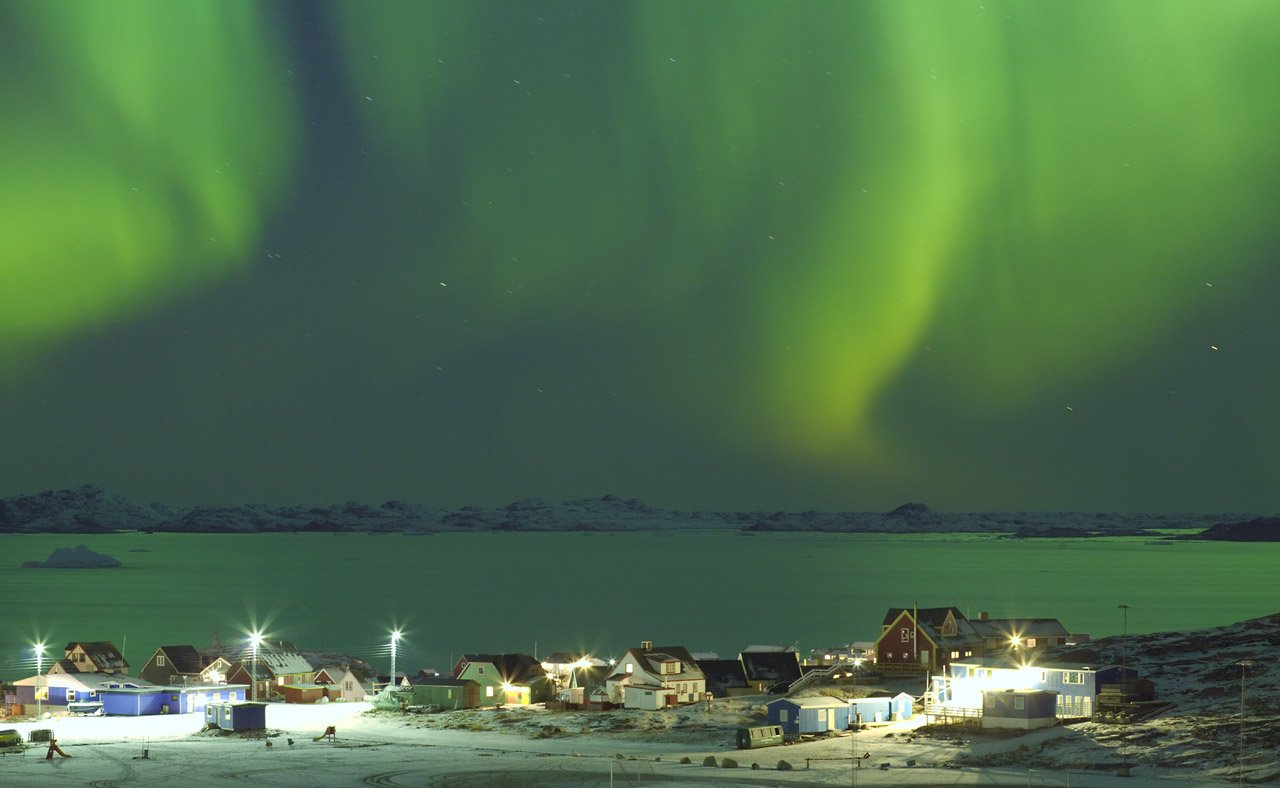
Space Weather had an excellent photo of the auroras over Nuuk Greenland when the solar winds hit the earth's magnetosphere last night.

Friday, October 27, 2006

A Snowflake Closeup

I first found this image on Chet Ramo's Science Musings blog, and just stopped to look at it for a while. (click on the image to view a high resolution version.)


At first glance, it doesn't really look like a snowflake. In actuality, it is an image of several snowflakes of differing conformation (I counted about eight different varieties) that have been sputter coated with platinum at a very low temperature (in order to make them conductive) and then imaged with a Scanning Electron Microscope equipped with a low temperature stage. The resulting gray-scale image formed by the electron beam was then digitally colored just as the old black and white movies have been "colorized" to result in the above "false color" image. Here's a picture of the specific unit that was used to take this image.

Hitachi S-4100 field emission Scanning Electron Microscope
Check out more details on the equipment here, and the original source of the snowflake crystals images here, and here.

Thursday, October 26, 2006

A Stellar Explosion in Progress

Check out the latest Hubble photo showing the same stellar explosion from V838, Monocerotis and its evolution since 2005.

http://imgsrc.hubblesite.org/hu/db/2006/50/images/a/formats/web_print.jpg

From the Hubble Web site: "These are the most recent NASA Hubble Space Telescope views of an unusual phenomenon in space called a light echo. Light from a star that erupted nearly five years ago continues propagating outward through a cloud of dust surrounding the star. The light reflects or "echoes" off the dust and then travels to Earth.

Because of the extra distance the scattered light travels, it reaches the Earth long after the light from the stellar outburst itself. Therefore, a light echo is an analog of a sound echo produced, for example, when sound from an Alpine yodeler echoes off of the surrounding mountainsides.

The echo comes from the unusual variable star V838 Monocerotis (V838 Mon), located 20,000 light-years away on the periphery of our Galaxy. In early 2002, V838 Mon increased in brightness temporarily to become 600,000 times brighter than our Sun. The reason for the eruption is still unclear.


A Great Intro Electronics and Robotics Project

The Make Magazine web site pointed me to this great open house activity that the Electrical Engineering department over at WUSTL put on for potential incoming freshmen. Students could show up and build their own light-activated robot with a few dollars worth of parts in about 30 minutes using absolutely no tools whatsoever. And they got to take their new pet home when they were finished with version 1.0.


Using the paint roller drive wheel vs. motor shaft ratio of diameters as an effective gear reduction is a bit of creative genius. Given that there are only ten or so parts and the instructions are only a page long, I'm thinking this one could be useful even in late elementary school.

Some early prep work was necessary to hot-glue the breadboards to the paint rollers, and perhaps solder the connectors onto the battery leads. But intrepid students could easily figure that part out for a longer classroom activity. I just love this photo from the web site of one student "walking their robot" and leading it with a flashlight.


Get the one-page assembly instructions here and get those kids building robots. Once they've mastered this initial version, begin asking questions like, "okay, now how would you build another version that steers?" or "How would you make it go faster, or climb steeper hills?" or "how big could you make it and how much would it carry?"

What a great beginning.

Diet For Energy Independence

In a paper scheduled to appear in the Engineering Economist, Laura McLay and Sheldon Jacobsen have determined that growing obesity across the US is imposing even more of an economic impact than the often-reported health care costs of treating its side effects such as type 2 Diabetes.

It should come as no surprise to anyone with any Physics background at all that it takes more energy to move more mass around.
"The obesity rate among U.S. adults doubled from 1987 to 2003, from about 15% to more than 30%. Also, the average weight for American men was 191 pounds in 2002 and 164 pounds for women, about 25 pounds heavier than in 1960, government figures show."
Using those weight figured combined with statistics on 2003 driving habits, it is pretty straightforward to conclude that about 39 million gallons of additional fuel are used each year for every pound of average weight increase across the US.

So relative to our svelte 1960 profiles, at a gas price of $3.00 per gallon the US is consuming around an extra $3 billion of oil for automotive fuel a year simply because we are getting fatter. And then there's the issue of airline fuel costs as well, an effect already reported by the CDC.

So if we could just manage to curb our waistlines, we can decrease our dependence on foreign oil. Maybe we could even manage it by driving less and walking more. What a virtuous cycle that would be.


The Economic Value of Education

A government report based on data from the Census Bureau has determined that a bachelor's degree is worth about $23,000 a year, with college graduates earning and average of $51,554 in 2004 compared with $28,645 for those with only a high school diploma. If you carry that yearly salary difference through retirement age, you end up with a total difference of about $1.2M.

High School dropouts earned an average of $19,169 a year, and those with advanced college degrees earned an average of $78,093.

So high school is worth about $502,000

College is worth an incremental $1.2M

Graduate school is worth another $1.4M

It seems like a no-brainer to me, specially when you consider some of my buddies who have turned what they learned into economic engines worth billions of dollars as an up-side. Of course there is a down side, but according to the large-scale statistics, even Joe-average is best served staying in school a little longer.

Nursery Rhyme Cures Speechlessness

Scott Adams, the creator of the famous series of Dilbert cartoons, lost his voice 18 months ago from a condition called Spasmodic Dysphonia, in which that part of the brain which controls the muscles around the vocal cords malfunctions and either shuts down or spasms. No one has ever recovered from this condition before. Adams, however, persisted in experimenting with his remaining speech function for over 18 months of fruitless efforts to finally discover that he could speak normally when rhyming. With a little more concerted effort around the rhyming, he has now almost fully recovered. Read the amazing story here on his blog. It is a fantastic example of the wonders and complexities of the human brain, and a testament to the power of perseverance and open-minded discipline in experimentation and the scientific method.

Tuesday, October 24, 2006

You Can't Handle The Truth!

bizarro.jpg

Where There's Math, There's Fire

I'm always on the lookout for a good screensaver. And mathematically-defined flames just seem too good to pass up. These tasty little bits of eye candy are based on the work of Michael Barnsley from Georgia Tech (One of my freshman calculus instructors, incidentally) who invented Iteratted Function System fractals, which were used by Scott Draves in 1992 to make artificial flames. These examples were made by rajah, and you can see many more examples and animations here and here.


Now you can go and make your own artificial flames with a freeware application called Apophysis that runs on the Windows operating system. Donwload it here. If you'd just like to check out some animations and images, look here.

Art Restoration With Nanotechnology

Nanotechnology has certainly garnered its share of media attention over the last year or so in applications ranging from drug delivery and high-density magnetic recording materials to new LED lighting systems. But yesterday I stumbled across an unexpected application that showed remarkable results; the restoration of antiquities through the removal of resins and salts from paintings, consolidation (reattaching and solidifying) paint on canvas and frescoes, and de-acidification of paper.

The key limitations of the traditional techniques centered around the fact that the cracks and pores in the antique surfaces were too tiny for the materials with macro-sized particles to effectively penetrate. Enter the new techniques for fabricating nano-scale particles of the same treatments.


This is a scanning electron micrograph of a Calcium-hydroxide nanoparticle synthesized through an homogeneous phase reaction at 90 degrees celcius.
These nanoparticles can now enter easily into the tiny pores in the paintings and frescoes and work their chemical and fixative magic without leaving any annoying discoloring films. The effects are remarkable.


Crucifixion by Beato Angelico (15th century, Florence). On the left, pre-restoration images of the wall painting. On the right, apost-restoration image. Desulfatation and consolidation was performed with the Ferroni–Dini method (ammonium carbonate plus barium hydroxide). (Courtesy of Daniela Dini).
Here is a link to the technical paper describing the restorations from which these images were taken. Here are a couple more amazing examples from this web site.


Santa Maria Novella Basilica in Florence, wall paintings by Andrea da Firenze: conservation carried out by means of lime/alcohol dispersions.

The fresco by Pozzoserrato (XVI century) in the Conegliano’s Cathedral after the cleaning with the micellar solution developed ad hoc for this workshop.

Sunday, October 22, 2006

By Your Command

I might actually make one of these in honor of halloween.


The circuit is pretty cimple with just one timer chip and a counter.


All the circuit diagrams and construction advice can be found here on the Evil Mad Scientist Blog.


The Difference Between a Mechanic and an Engineer

In the seventies and eighties, my father used to really enjoy working on our cars. I vividly remember watching him fastidiously cleaning and wiping parts and surfaces as he changed plugs, points, filters, and whatnot. I would tend to flit in and out as he carefully maintained the vehicles, always wearing an unusually clean tan button-down shirt.

I must have been about ten years old when he turned to me as I stood there observing his auto efforts one day and said, "Phillip, do you know the difference between a mechanic and an engineer?"

"An engineer can do the same job, and more, but without getting dirty."

It was then that I noticed the crisp starched crease on the shirt, and the impeccable tan shirt-front. His clothes were spotless despite a couple of hours spent disassembling and reassembling an engine.

I didn't really think much of it at the time, but later learned how that sort of meticulous care, discipline, and forethought led to parts that would mate better and run without grit to wear them, and that disordered problems, leaks, and breaks would stand out more against a clean, well-organized system. Neatly organized tools are easier to find and when handled with care, are less likely to damage parts under repair. A little forethought and advanced planning often save a lot of work, and prevent mistakes that cost time and money (and get your clothes dirty.) Now I use those lessons almost every day.

Dad would LOVE this photo tour of the Volkswagen plant in Dresden. Check out a few photos from this assembly line.


Now compare the German photos above with these North American plants.


Auto Assembly Plant © Arup

Just on the basis of cleanliness and orderliness alone, which car would you anticipate to be more reliable?

The Saddest Place on Earth

I just spent that last few days at Disney Land with my wife, our four year-old daughter, and another family with their own child of three. I hadn't been there for many years and was looking forward to reliving the park through my daughter's eyes. The park itself was fantastic and had been updated significantly with new rides like "Buzz Lightyear's Astro Blaster ride-cum-video game, and some of the old classics like Pirates and the Haunted Mansion still retained their classic touches. Admittedly, commercialism and merchandising have run rampant, with each major ride ejecting joyful consumers directly through shops to run their toddlers through a gantlet of plastic and sweets. The average parent must have to suffer "Daddy, can I get one of these?" at least twice an hour. Sooner or later, everyone must break down under the onslaught. The place really has evolved to become a very efficient machine to separate you from your money while enjoying the process.

But for all that, the rides were fantastic, the food was much improved and better than anyone expected. Everyone had a blast. So far, so good.

But then on the way back to the car, we had to pass one more gantlet, through "Downtown Disney," a rather nice but obviously well-place outdoor shopping mall complete with all the typical name brand chains. Just when I was thinking "how shameless can you get?" I spotted the LEGO store.

I remember thinking, "I can live with all the other crap. They have a LEGO store. THAT one, we can enter. Life is good." You see, LEGOs were a transformative toy for me that unleashed my imagination around the realization that I could build ANYTHING. Spacecraft, moon bases, robots, airplanes, cars, trains, tanks, ... it just went on and on without limit. As I grew up, LEGOs evolved in parallel from the traditional suitcase full of rectangular blocks and simple gears and hinges, to LEGO Technic with cams and struts and beams and pneumatics, and finally to the Mindstorm robotics kits. Later in grad school, I met Mitch Resnick who developed the first "smart bricks" that were the foundations for the Technic and mindstorm kits and thanked him personally. The very name in Danish means "Play well" and in Latin means "I put together." 'nuff said.

So even though my daughter is already pretty well-equipped with an extensive LEGO kit, I was imagining all the cool new things that we were going to be able to build together based on the latest developments out of Denmark. I even ran out ahead of our small group while they were wending their way through the isles of Mickeys and Plutos so I could have some extra time in LEGO nirvana.

What I found, however, quite literally foretells the decline of western civilization. Instead of finding a store filled with great new kits of parts to further propel the imagination, I found a toy store that was almost completely filled with cheap plastic toys. Yes, some of them were kits that you could put together, but for the most part, they were tiny kits with fewer than 30 very specialized parts that could only really be assembled into one or two pre-designed dolls.

Out of a couple hundred yards of shelf space, maybe 4 feet were devoted to less than half a dozen Technic kits (also small specialized versions) and the fantastic new NXT robotics system. Everything else looked something like this:


I remembered reading recently that LEGO had just barely managed to survive a major financial crisis. It would appear that their survival has been buoyed by a transition to selling the crap that most people will buy instead of the transformative tools that, in my opinion, elevated children to explore creativity without limits. It is clear that through a Darwinian process of consumer selection driving survival of the fittest retailer, LEGO has undertaken a forced evolution to supply the market demand for a quick-fix doll to play with immediately at the expense of kits with little instruction that require imagination and creativity. Imagination and industry, it would seem, are becoming commodities in ever shorter supply.

To have this bellwether at Disney Land, a national tourist crossroads, sends a clear signal to me that as a nation, we are becoming less likely to engage our brains and make something. We would rather play with something that is pre-made for us in China, or in Denmark, as the case may be. No wonder the Chinese economy is growing at more than 11% a year while we are stuck below 3% annual growth.

Does that trouble anyone else? It depressed me for the rest of the week.

Wednesday, October 18, 2006

Martian Vistas: Ancient Water Flows and Ice

The ESA's Mars Express spacecraft is sending back an absolute treasure trove of incredible photographic data. Check out these images showing everything from ice trapped in craters, to dried flood planes.

Perspective view of a glacial feature ìn Deuteronilus Mensae
This image taken by the High Resolution Stereo Camera (HRSC) on board ESA's Mars Express, shows a perspective view of a glacial feature located in Deuteronilus Mensae. The image is centred at a 37.92º North latitude and 24.61º East longitude (click on image for high-res version) Credits: ESA/DLR/FU Berlin (G. Neukum)


Residual water ice in Vastitas Borealis Crater
This HRSC image provides a perspective view of residual water ice on the floor of Vastitas Borealis Crater on Mars. The image is centred at 70.17º North latitude and 103.21º East longitude. Credits: ESA/DLR/FU Berlin (G. Neukum)


More details at the ESA site.

Colliding Galaxies: The heart of the Antennae

http://www.universetoday.com/wp-content/uploads/2006/10/2006-1017antenna.jpg
From NASA:
The two spiral galaxies started to interact a few hundred million years ago, making the Antennae galaxies one of the nearest and youngest examples of a pair of colliding galaxies. Nearly half of the faint objects in the Antennae image are young clusters containing tens of thousands of stars. The orange blobs to the left and right of image center are the two cores of the original galaxies and consist mainly of old stars criss-crossed by filaments of dust, which appears brown in the image. The two galaxies are dotted with brilliant blue star-forming regions surrounded by glowing hydrogen gas, appearing in the image in pink.

Sunday, October 15, 2006

Intelligent Design Plank in Iowa Republican Platform

This almost makes me want to cry.

Check out the web page for the Republican Party of Iowa. In particular:
3.4 We support the teaching of alternative theories on the origins of life including Darwinian Evolution, Creation Science or Intelligent Design, and that each should be given equal weight in presentation.
Anyone else know if this regressive disease is present in other state platforms?

300 Million and Counting

From Yahoo:

The Census Bureau projects that America's population will hit 300 million at 7:46 a.m. EDT Tuesday. The projection is based on estimates for births, deaths and net immigration that add up to one new American every 11 seconds.

The estimated 11 million to 12 million illegal immigrants in the U.S. are included in official population estimates, though many demographers believe they are undercounted. The population reached its last milestone, 200 million, in 1967. That translates into a 50 percent increase in 39 years.

During the same period, the number of households nearly doubled, the number motor vehicles more than doubled and the miles driven in those vehicles nearly tripled. The average household size has shrunk from 3.3 people to 2.6 people, and the share of households with only one person has jumped from less than 16 percent to about 27 percent.

"The natural resource base that is required to support each person keeps rising," Replogle said. "We're heating and cooling more space, and the housing units are more spread out than ever before."

The U.S. is the third largest country in the world, behind China and India. The U.S. is the fastest growing of the industrialized nations, adding about 2.8 million people a year, or just under 1 percent. India is growing faster but the United Nations considers it to be a less developed country. About 40 percent of U.S. population growth comes from immigration, both legal and illegal, according to the Census Bureau. The rest comes from births outnumbering deaths.

"It's not the population, it's the consumption that can do us in," said William Frey, a demographer at the Brookings Institution, a Washington think tank. "These are the luxuries we have been able to support until now. But we're not going to be able to do it forever."
Check the Population Clock here.

Friday, October 13, 2006

The Earth From Saturn

Yep, it's that tiny blue dot in between some of Saturn's rings.
Kind of makes you feel a bit smaller, doesn't it?
More at the Cassini Imaging site.

Saturn With a Solar Backlight

Nice photo from the Cassini Spacecraft:

http://www.universetoday.com/wp-content/uploads/2006/10/2006-1011saturn.jpg

More details available on the NASA site.

Thursday, October 12, 2006

Brain-Computer Interface: "Look Ma! No Hands!"

I have long been confident that within my lifetime, there would come a day when we will no longer need keyboards to control our computers. Our minds will be coupled directly to computer systems to control everything from prosthetic limbs and memory and sensory augmentation devices to vehicles in addition to the more pedestrian computer programs such as word processors and spreadsheets. Perhaps a couple of generations down the line, we will be implanting cellular phones transmitters. We will eventually reach out and touch someone with a mere thought.

What I failed to appreciate, however, was that "within my lifetime," which I had optimistically hoped would extend to somewhere past 2040 or so, is starting to look more like "within the next couple of decades."

Eric C. Leuthardt, M.D., an assistant professor of neurological surgery at the WUSTL school of Medicine, and Daniel Moran, Ph.D., assistant professor of biomedical engineering,were able to decode signals from a sensory grid implanted on the surface of a teenager's brain, and train the teen to control (what else?) a video game using only his imagination. (See a video of the truly wired teen here.)

With the increasing use of Functional MRI as a tool to understand cognitive processes, Brain-computer interface technologies are advancing at a staggering rate alongside dramatic improvements in neurosurgery. This latest effort was able to leverage some of the latest neuro-surgery techniques used to treat epilepsy, wherein a thin grid of electrodes is laminated to the actual surface of the brain in order to triangulate the source location from which seizure-inducing brain activity originates.


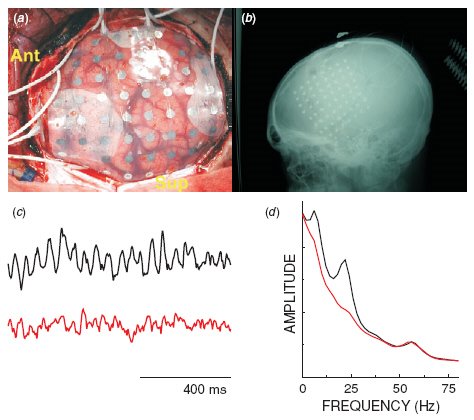
From the original paper Figure 1. Examples of electrode placement and ECoG signals. (a) Intra-operative placement of a 64-electrode subdural array. (b) Post-operative lateral skull radiograph showing grid placement. (c) Raw ECoG signals during control of cursor movement. Black and red traces are from one of the electrodes that controlled cursor movement and are examples for the patient resting and imagining saying the word ‘move’, respectively. (d) Spectra for the corresponding conditions for the final run of online performance.

Leuthardt et. al., with their patient's permission, collected data from the implanted grid and analysed it to decode the motor control signals the brain was sending to move his fingers and tongue.


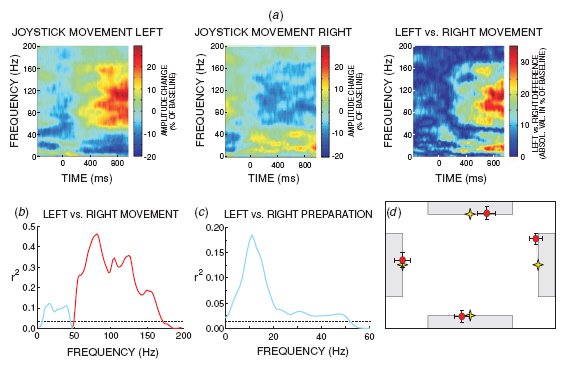
Figure 4 from the original paper shows: ECoG correlations with joystick movement direction before and during movement. (a) Left and center panels: time courses for left and right movements, respectively. Right panel: the absolute value of the difference between left and right time courses. Movement direction is reflected in ECoG across a wide frequency range, including frequencies far above the EEG frequency range. (b) The correlation between the signal shown in (a) and movement direction over the period of movement execution. (c) Correlation for a single electrode location versus the remote reference electrode. The μ rhythm activity predicts movement direction. In (b) and (c), and indicate negative correlation and positive correlation, respectively, with the amplitude of left movement minus right movement. (d) Average final cursor positions predicted by a neural network from ECoG activity are close to the actual average final cursor positions.
After sorting out which signals controlled which movements, they then wired the live brain signals through an artificial neural network simulation that they trained on the sampled data correlated with the cusror moment. The result was a computer program that acts as a translor from the brain's language into more standard electronic signals that were then wired up to the famed original Atari video game, Space Invaders. With a mere 20 minutes of training, the patient immediately learned how to clear two levels using just his mind, which is better than I did the first several times I played the game in the seventies with my own two hands.


Figure 2 from the original paper: ECoG control of vertical cursor movement using imagination of specific motor or speech actions to move the cursor up and rest to move it down. The electrodes used for online control are circled and the spectral correlations of their ECoG activity with target location (i.e., top or bottom of screen) are shown. Grids for patients B, C and D are green, blue and red, respectively. The substantial levels of control achieved with different types of imagery are evident. The three-dimensional brain model was derived from MRI data.
It is really interesting to start thinking about computing problems like wireless interfaces (Bluetooth?), power supplies (capacitive coupling of microwaves far from H2O resonant frequencies?), and cooling (blood?) when it has to be IN YOUR HEAD!

Who's up for really getting wired?

Don't miss the original paper entitled "A brain–computer interface using electrocorticographic signals in humans" and the WUSTL PR page with the live video.

Tuesday, October 10, 2006

Liquid Crystal Bathroom Tiles


Get them at Moving Color: