Showing posts with label Health. Show all posts

Wednesday, November 28, 2007

Our Conflicted Government

Sometimes the right picture is worth more than a thousand words. There's a fine art to representing data to clearly illuminate an issue, and this one takes my nomination for the graph of the year. This graphic comparing our government's nutritional recommendations to its actual spending tells the story of money (from lobbyists) over morals.

Wednesday, September 26, 2007

Man Survives Chair Leg Penetrating Eye and Throat

I don't usually like to post morbid stories, but this one takes the cake as far as medical miracles go.

Hat tip goes to BoingBoing on catching this one.

Here is an MRI image of a fellow who survived having a metal chair leg impale his skill through his eye socket all the way down to his throat. Not only did he survive, it looks like he will keep his vision. He's even forgiven the fellow who threw the chair!


 Ffximage 2007 04 19 Jtskull Wideweb  470X285,0

Thursday, October 26, 2006

Diet For Energy Independence

In a paper scheduled to appear in the Engineering Economist, Laura McLay and Sheldon Jacobsen have determined that growing obesity across the US is imposing even more of an economic impact than the often-reported health care costs of treating its side effects such as type 2 Diabetes.

It should come as no surprise to anyone with any Physics background at all that it takes more energy to move more mass around.
"The obesity rate among U.S. adults doubled from 1987 to 2003, from about 15% to more than 30%. Also, the average weight for American men was 191 pounds in 2002 and 164 pounds for women, about 25 pounds heavier than in 1960, government figures show."
Using those weight figured combined with statistics on 2003 driving habits, it is pretty straightforward to conclude that about 39 million gallons of additional fuel are used each year for every pound of average weight increase across the US.

So relative to our svelte 1960 profiles, at a gas price of $3.00 per gallon the US is consuming around an extra $3 billion of oil for automotive fuel a year simply because we are getting fatter. And then there's the issue of airline fuel costs as well, an effect already reported by the CDC.

So if we could just manage to curb our waistlines, we can decrease our dependence on foreign oil. Maybe we could even manage it by driving less and walking more. What a virtuous cycle that would be.


Nursery Rhyme Cures Speechlessness

Scott Adams, the creator of the famous series of Dilbert cartoons, lost his voice 18 months ago from a condition called Spasmodic Dysphonia, in which that part of the brain which controls the muscles around the vocal cords malfunctions and either shuts down or spasms. No one has ever recovered from this condition before. Adams, however, persisted in experimenting with his remaining speech function for over 18 months of fruitless efforts to finally discover that he could speak normally when rhyming. With a little more concerted effort around the rhyming, he has now almost fully recovered. Read the amazing story here on his blog. It is a fantastic example of the wonders and complexities of the human brain, and a testament to the power of perseverance and open-minded discipline in experimentation and the scientific method.

Thursday, October 12, 2006

Brain-Computer Interface: "Look Ma! No Hands!"

I have long been confident that within my lifetime, there would come a day when we will no longer need keyboards to control our computers. Our minds will be coupled directly to computer systems to control everything from prosthetic limbs and memory and sensory augmentation devices to vehicles in addition to the more pedestrian computer programs such as word processors and spreadsheets. Perhaps a couple of generations down the line, we will be implanting cellular phones transmitters. We will eventually reach out and touch someone with a mere thought.

What I failed to appreciate, however, was that "within my lifetime," which I had optimistically hoped would extend to somewhere past 2040 or so, is starting to look more like "within the next couple of decades."

Eric C. Leuthardt, M.D., an assistant professor of neurological surgery at the WUSTL school of Medicine, and Daniel Moran, Ph.D., assistant professor of biomedical engineering,were able to decode signals from a sensory grid implanted on the surface of a teenager's brain, and train the teen to control (what else?) a video game using only his imagination. (See a video of the truly wired teen here.)

With the increasing use of Functional MRI as a tool to understand cognitive processes, Brain-computer interface technologies are advancing at a staggering rate alongside dramatic improvements in neurosurgery. This latest effort was able to leverage some of the latest neuro-surgery techniques used to treat epilepsy, wherein a thin grid of electrodes is laminated to the actual surface of the brain in order to triangulate the source location from which seizure-inducing brain activity originates.
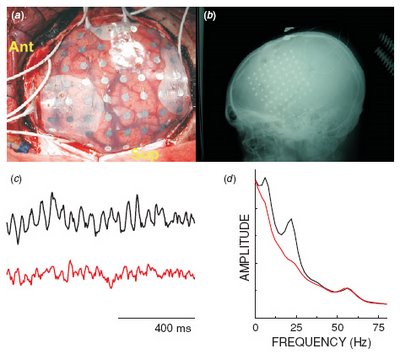

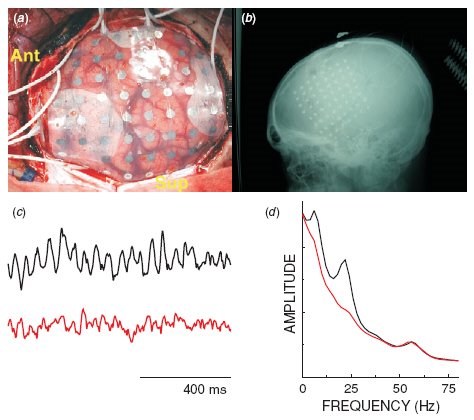
From the original paper Figure 1. Examples of electrode placement and ECoG signals. (a) Intra-operative placement of a 64-electrode subdural array. (b) Post-operative lateral skull radiograph showing grid placement. (c) Raw ECoG signals during control of cursor movement. Black and red traces are from one of the electrodes that controlled cursor movement and are examples for the patient resting and imagining saying the word ‘move’, respectively. (d) Spectra for the corresponding conditions for the final run of online performance.

Leuthardt et. al., with their patient's permission, collected data from the implanted grid and analysed it to decode the motor control signals the brain was sending to move his fingers and tongue.
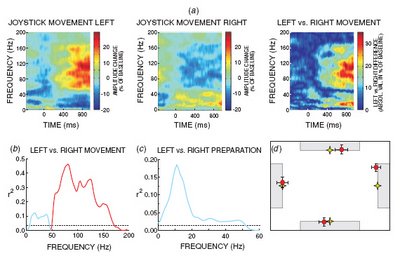

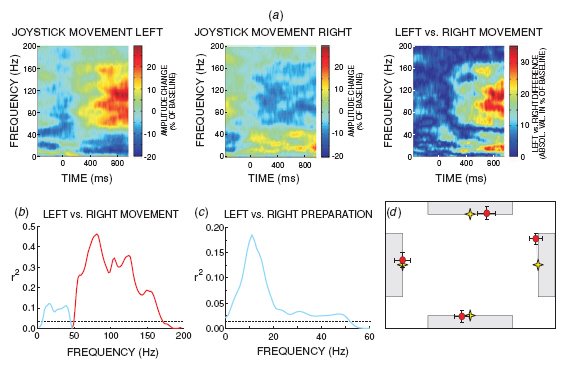
Figure 4 from the original paper shows: ECoG correlations with joystick movement direction before and during movement. (a) Left and center panels: time courses for left and right movements, respectively. Right panel: the absolute value of the difference between left and right time courses. Movement direction is reflected in ECoG across a wide frequency range, including frequencies far above the EEG frequency range. (b) The correlation between the signal shown in (a) and movement direction over the period of movement execution. (c) Correlation for a single electrode location versus the remote reference electrode. The μ rhythm activity predicts movement direction. In (b) and (c), and indicate negative correlation and positive correlation, respectively, with the amplitude of left movement minus right movement. (d) Average final cursor positions predicted by a neural network from ECoG activity are close to the actual average final cursor positions.
After sorting out which signals controlled which movements, they then wired the live brain signals through an artificial neural network simulation that they trained on the sampled data correlated with the cusror moment. The result was a computer program that acts as a translor from the brain's language into more standard electronic signals that were then wired up to the famed original Atari video game, Space Invaders. With a mere 20 minutes of training, the patient immediately learned how to clear two levels using just his mind, which is better than I did the first several times I played the game in the seventies with my own two hands.
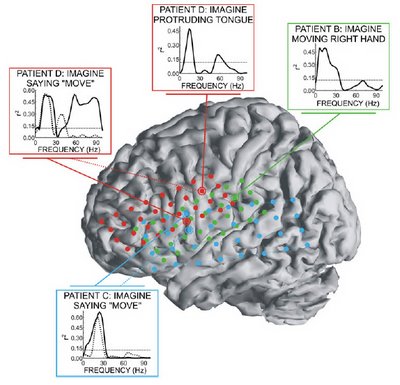

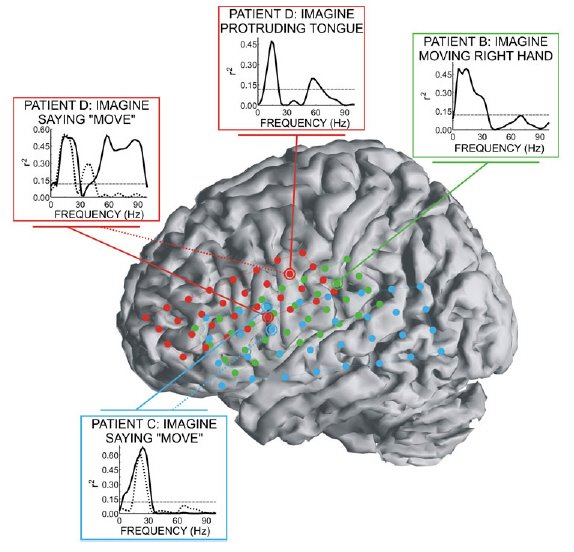
Figure 2 from the original paper: ECoG control of vertical cursor movement using imagination of specific motor or speech actions to move the cursor up and rest to move it down. The electrodes used for online control are circled and the spectral correlations of their ECoG activity with target location (i.e., top or bottom of screen) are shown. Grids for patients B, C and D are green, blue and red, respectively. The substantial levels of control achieved with different types of imagery are evident. The three-dimensional brain model was derived from MRI data.
It is really interesting to start thinking about computing problems like wireless interfaces (Bluetooth?), power supplies (capacitive coupling of microwaves far from H2O resonant frequencies?), and cooling (blood?) when it has to be IN YOUR HEAD!

Who's up for really getting wired?

Don't miss the original paper entitled "A brain–computer interface using electrocorticographic signals in humans" and the WUSTL PR page with the live video.

Tuesday, September 26, 2006

If Only My Biology Teacher Had Drawn This Well

A DaVinci Blackboard Lesson in Multi-Conceptual Anatomy
Check out this blackboard photo of Caryn Babaian's anatomy lesson at Bucks County Community College.

Saturday, September 23, 2006

Visible Gene Expression

Yao and Webb just published an awesome article in Nature vol. 442 that included some incredible photos that resolved the actual activation of a gene in real-time. Webb, a physicist from Cornell, pioneered the multi-photon fluorescence microscopy that made the images possible.

Chromosomes in living cells

The results were stunning. "Within two weeks we had spectacular pictures," said Lis. The images included pictures of the genes (hsp70 genes) that protect flies from the effects of extreme heat. By cranking up the heat, the researchers could activate these genes, and by using fruit flies specifically bred to carry fluorescent proteins on HSF, they could watch the transcription factors in action.

"This is the first time ever that anyone has been able to see in detail, at native genes in vivo, how a transcription factor is turned on, and how it then is activated," said Webb.

I couldn't imagine a more fantastic application of new optical imaging technology than to look into the very fundamental mechanisms of life and actually see them unfold before our eyes.


Wednesday, September 13, 2006

Eight Americas Details

Many of you probably caught the story posted in USA Today about life-expectancy variations across the US. But in my effort to bring science closer to the common man, I would like to recommend everyone check out the actual research paper online. You can find "Eight Americas: Investigating Mortality Disparities across Races, Counties, and Race-Counties in the United States" by Christopher J. L. Murray1,2,3, Sandeep C. Kulkarni2,4, Catherine Michaud2,3, Niels Tomijima3, Maria T. Bulzacchelli3, Terrell J. Iandiorio3, Majid Ezzati1,2* on the Public Library of Science web site.

There are some very interesting details that never made it into the more distributed articles.


journal-pmed-0030260-g001
This graphic depicts County life expectancies by Race and Sex.
A) Life expectancy at birth for black males and females. Only counties with more than five deaths for any 5-y age group (0–85) were mapped, to avoid unstable results.

(B) Life expectancy at birth for white males and females.

Just the distribution of Blacks in America is interesting alone, not to mention the life expectancy variations. This next graph shows the results of a clustering analysis that was able to detect 8 broad clusters of citizenry that displayed common health statistics.


journal-pmed-0030260-g002


Here is how Life expectancy by sex has evolved.


journal-pmed-0030260-g003

Quite an interesting disparity emerges. Then the authors go on to explain the ten leading risk factors,

journal-pmed-0030260-g007


Most of which are controllable. And when you factor in the effect of violence and health care coverage....the picture becomes much clearer.


journal-pmed-0030260-g005

Probability of Death between the Ages of 15 and 59 y in the Eight Americas


(A) Probability of death between the ages of 15 and 59 y in the eight Americas from all causes.

(B) Probability of death between the ages of 15 and 59 y in the eight Americas after deleting deaths from homicide and HIV.


journal-pmed-0030260-g006

Health Care Coverage


Most of the major issues highlighted in the study are under our control, if we can just apply some collective action and education.

Thursday, September 07, 2006

Evolving Germs

For anyone that still harbors doubts about the validity of evolutionary theories, just stay away from South Africa and your ignorance shouldn't hurt you immediately. For the rest of us Darwinists, our most recent vindication is rather unfortunate.

The World Health Organization is now organizing an urgent meeting because a new Drug-resistant strain of Tuberculosis has EVOLVED to such an extent that it is virtually untreatable with any commonly available medication. Worse, it has already been transmitted worldwide.

Now, after a sprinkling of cases across the globe, a particularly virulent outbreak has arisen in South Africa. "This deadly strain of tuberculosis has killed 52 of 53 people infected in the last year in South Africa," the World Health Organization said on Friday, calling for improved measures to treat and diagnose the bacteria.

"The strain was discovered in Kwazulu-Natal, and is classified as extremely drug-resistant. Drugs from three of the six second-line medicines, used as a last line of defense against TB, proved useless against the new strain.

"We are extremely worried about the issue of extreme drug resistance," said Paul Nunn, coordinator of the WHO's drug resistance department. "If countries don't have the diagnostic capacity to find these patients, they will die without proper treatment."

"Drug resistance is a common problem in TB treatment, but the new strain appears particularly virulent: 52 of the 53 patients infected all died within about three weeks of being tested for drug resistance.

The real problem we face is that everyone in the medical community fully expects the germ to continue in its evolution, and if the WHO fails to contain its spread, we could find ourselves regressing back to the equivalent of the pre-anti-biotic era with no effective way to treat a very deadly disease.

My mother has been warning me for years not to use bactericidal soaps and cleansers in the house in order to avoid breeding "super-bugs." Then again, she was always a Darwinist. I'm so proud of her.

Image and details from www.futura-sciences.com

Saturday, September 02, 2006

Living Cell Visualizations

Harvard University recently commissioned XVIVO's animation studio to develop realistic computer graphics animations of biological processes for instructional purposes. Some of their first work was presented at Siggraph 2006. Check out "The Inner Life of the Cell" In the meantime, here are some stills from the mini-movie. High cool.

The Inner Life of the Cell (image #1)

The Inner Life of the Cell (image #2)

Pit-crew Tactics in the Operating Room

Tom Kelley, the General Manager of IDEO, recently gave a talk in London about one of the themes from his new book, "The Ten Faces of Innovation." He discussed one of the faces, the cross-pollinator, who "can create something new and better through an unexpected juxtaposition of seemingly unrelated ideas or concepts" and often innovates "by discovering a clever solution in one context or industry, then translating it successfully to another."

Ferraridocs

The example he gave was that of a group of emergency room doctors who took lessons from the planning and precision tactics of the Ferrari Formula One race team. Now an Italian newspaper, Il Giomale reports that a surgical team from a British Hospital actually reached out to the Italians. As reported in LunchoverIP:

"The post-operation phase is probably the most sensitive, and until a couple of years ago it was chaotic: there was a lot of noise, everyone moved around with no coordination with the others: we've totally redesigned our way of working", he says. The Ferrari people filmed the doctors at work, then dissected the images with them. "For years we've been convinced that we were doing things pretty well, but seeing the tape it was shocking to notice our lack of coordination", says Nick Pigott of the intensive-care unit.

The Ferrarists gave suggestions on people's training, disposition, synchronization, and how to codify effective and time-saving procedures. Elliott told the journalist that the cross-pollination "has transformed the intensive-care unit in a center of silent precision" where "the complications of operations have been substantially reduced".

Friday, September 01, 2006

Time is Money

David Coulter, a Harvard economist, has examined mortality and healthcare statistics to determine that there have been significant extensions to life-expectancy over the past forty years, but that the healthcare costs to support longer life spans are growing even faster.

In his paper due to be published tomorrow in the New England Journal of Medicine, Coulter reports that someone who reaches the age of 65 can expect to spend an average of $158,549 on healthcare over their lifetime. But this investment has increased a whopping 13.8 times (when adjusted for inflation) since 1960 when the costs would have amounted to $11,495. What does it buy the hopeful 65 year-old? Less than four more years. Today's new retiree can now expect to live another 18 year instead of 14.4 years on average.

And while it might seem callus to discuss diminishing returns when thinking about life extension, there will clearly come a point when the additional spending for extreme measures will not significantly improve a patient's quality of life or material extend life expectancy despite the investment. Tough decisions abound.

The study also points out that part of the driver for these cost increases might be that hospitals and insurance agencies have the wrong incentives. They are paid for their efforts and not for their results. So there is a strong incentive to perform a myriad of tests and expensive treatments of dubious benefit.

After running a couple of high-tech companies, I have come to appreciate that the alignment of incentives is THE most important tool to ensure proper results. I suspect rather broad changes would ensue if we could amend Medicare to compensate the healthcare industry based on how the patient does and how long they live, rather than on how much money they spend dancing around the patients.

Preventive medicine and lower cost treatments that demonstrate material benefits would abound, and more people could die peacefully in their homes surrounded by family when extreme intensive measures in hospitals would only provide limited benefits. And our economy would likely benefit as well.

Saturday, August 19, 2006

Sometimes I Just Love My Country

Just when I'd pretty much given up on the scientific close-mindedness of the current republican administration, I stumbled across this article in Forbes that reminded me of the power of the US economic engine, and how business leaders with foresight can still help stave off national disaster, even without government support.

Those of you who have read my earlier rants on the Stem Cell issue know that I am distraught over the fact that our government has not only abandoned one of the most promising avenues of medical research to emerge in the last century, but has gone so far as to actively stifle those activities with a presidential veto of the recent bi-partisan bill to support expanded Stem Cell research.

Well thank goodness previous administrations didn't stifle the most promising lines of development a couple of decades ago so that Microsoft, KB Home, Bloomberg, Dolby, Oracle, EBay, and Intel could all get large enough that their founders, many of them republicans, could personally bankroll enough research to keep US Stem Cell investigations going despite the government attack.

Hopefully the rich guys with a little foresight can keep the efforts going till we have a more technologically oriented administration in office.

Take the Pain away Doctor. Turn on the TV!

If any of you have ever tried to tear your child away from their favorite cartoon, this next report won't be any surprise.

A recent study performed on 69 Italian kids aged seven through twelve showed that children having blood drawn by a syringe experienced "50% less pain" when watching television than they did when being comforted by their mothers, and "70% less pain" than if they were left alone without other stimulus or comfort.

Carlo Bellieni, the article's author, said, "The power of television is strong and it can be harmful for children if it is stronger than the force made by the mother to distract children. I believe that this power must be controlled and reduced."

And he hasn't even tested video games yet.

Sunday, August 13, 2006

How Blood Vessels Form in Embryos

"Developmental biology: The hole picture"

What's the best way to make a tube? Roll up a sheet? Hollow out a solid rod? Some innovative movies show how the problem is tackled during the development of blood vessels in embryos. Check out this incredibly cool movie from the journal Nature's web site that actually shows the formation of blood vessel structures from the merging of bubbles.

Keith Mostov and Fernando Martin-Belmonte are the authors of the article from the July 27th 2006 Issue of Nature on page 363.

Mosquito Magnets?

Whenever assaulted by that annoying high-pitch whine of a mosquito fly-by, I've recently taken to gesturing vaguely towards my wife and whispering to the orbiting insect, "..pst...hey buddy, she's tastier." I meant it as a joke, but as it happens, my wife might really be tastier to a mosquito. According to this article on WebMD, one in 10 people are "highly attractive to mosquitoes." The chemical attractants include high concentrations of either steroids or cholesterol or uric or lactic acid on the skin. (and that is after being drawn from over 50 meters away by carbon dioxide and motion.

I think I'll make sure to take my wife along on my next backpacking or canoeing trip!