
Showing posts with label Education. Show all posts

Tuesday, April 01, 2008

MA Regional First Championships

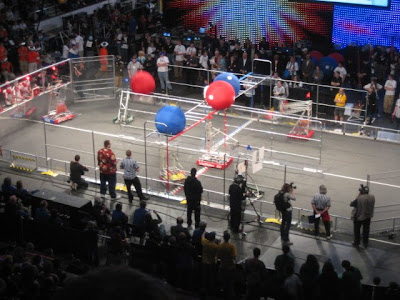
During my trip to Boston last week for the National Science Teacher's Association conference (more on that later) I totally lucked out in also catching the FIRST Robotics League Northeastern Regional Championships. If you haven't been to one, you simply must go. As remarkable as this sounds, there is almost certainly one in your area. It was AWESOME. There were more than 7,000 people in attendance in the Agganis Arena at Boston University to see the real deal, professionally produced and run, very well-organized, with pro announcers, cameramen and lighting.


Over forty teams of high school students were running robots that they built from nothing inside of 6 weeks to accomplish a VERY complicated challenge. They were so FANTASTIC that I am going to run out of superlatives before getting to the end of this post. The very idea that this organization has grown since 1992 to reach more than 13,000 schools across the US, and that there are 41 REGIONAL competitions before the upcoming late April finals in Atlanta is just incredible. Better yet, FIRST has clearly been very successful in perpetuating and growing a model that is self-sustaining, with many teams having competed for several years, with former FIRST team members returning to mentor their old team or going on to start new ones.

I managed to arrive just in time to watch the contest start up for the final day with a performance by the Blue Man Group, followed by the grand entrance of Woodie Flowers, the legendary MIT professor who founded FIRST, and before that was the originator of the famous MIT 2.70 and 6.270 robotics contests. Check out how these people LOVE him as he enters the arena using an interesting MIT spin-out technology called the Atlas Ascender (a self-contained box that allows rapid ascent as well descent.)


Woodie Rappelling - Boston Regional 2008.


The day began with the quarter-finals matches and I stayed through the final. The designs were quite varied, with the older more experienced teams (you could tell from the low team numbers below 100 that were granted years ago) clearly demonstrating that years of experience really helps in refining robust approaches to complicated problems. That said, even the rookie teams showed great creativity and incredible dedication and teamwork. Check out these photos of several of the robots.


The matches were real nail-biters with cheering and chants that rivaled any football game I had ever attended (except maybe the Chelsea Tottenham match in London). To see this leve of excitement and adulation usually reserved for sports and entertainment celebrities unleashed on students for engineering and innovation just warmed my heart. Something has been made right in the world.


Everyone I spoke with loved the experience and couldn't even imagine failing to participate next year. And as Steve Wozniak, one of the FIRST luminaries said, "There are lots of prizes and awards, and only one of them is for winning." Their hearts and minds are certainly in the right place.

Find out about your local FIRST events and sign up however you can, as a participant. mentor, coach, parent, whatever. You won't regret it.

Sunday, March 30, 2008

Sneaking Out of the House to Build Robots

My favorite story from the whole FIRST Northeastern Regional competition was revealed in the delivery of the "Woodie Flowers" award. Woodie, you see, is the MIT professor who founded FIRST with Dean Kamen of Segway fame, after starting the legendary 2.70 and later 6.270 robotics contests at MIT. In many ways, Woodie was responsible for my attendance at MIT, just as he has now been responsible for inspiring tens of thousands of aspiring technologists across the US through FIRST.

So in thanks and recognition, the Woodie Flowers Award is granted to the team mentor at each regional and final First contest that best exemplifies Woodie's spirit of contribution, teamwork, and inspiration.


Woodie Flowers and Elizabeth Carruthers

This year's recipient, Elizabeth Carruthers from the Columbus School for Girls, had a great story. As a high school student, her parents weren't all that supportive of the time and energy that FIRST demanded, so she had to sneak out of the house to work on her team's FIRST robot.

She was so committed to the program and her teammates, that when her parents caught her sneaking out, she told them that she was just going to "parties with her friends," which turned out to be okay with them. You see, they wanted her to be socially well-adjusted, and feared seeing their daughter turned into a nerd.

Given that she has now gone on to a technical undergraduate program, and returned to mentor her old high school's FIRST team (an all-girl's team, at that) into the regional finals, (a remarkable accomplishment that takes MANY more skills in communication and leadership and interpersonal relationships than just the technical ones) I'd say she's VERY well adjusted!

Congrats, Elizabeth. Our nation need more inspirations like you.

Sunday, March 23, 2008

Most Children Left Behind

Just last week, I had a chance to hear a presentation by Alfie Kohn, one of the more (in)famous progressive education proponents, on the perils of emphasizing achievement and performance over engagement in a subject. Besides being an enthusiastic and engaging speaker, Alfie made a number of great points that really resonated with me regarding the damage a national obsession with standardized testing and assessment has wreaked on the quality of education at large. (We coincidentally follow most of Kohn's recommendations in how we operate the WISE labs and programs...)

His central point on this topic was that by focusing so much school and parental attention on HOW students are doing instead of on WHAT they are doing and WHY, the very effort assessment has a now reasonably well proven effect of focusing the student's attention on external validation from teachers and grades instead of on the actual subjects under study. The result, according to the many cited research articles, is that students lose intrinsic motivation and interest in the very subjects around which we really hope to instill a lifelong love of learning. It didn't take much effort to extend the notions not only to grades and class rank, but even further to parenting techniques and practices as well.

And of course, the "No Child Left Behind" legislation, already the whipping boy of education Illuminati nationwide, took a severe beating in the process. One of my favorite moments in his talk was when he impersonated our current President and Senator Ted Kennedy complete with accents in their "misguided support in passing the law." It didn't take much looking around online to find pretty strong independent evidence in support of what Mr Kohn has been saying for years on this topic. My favorite articles came from Rice University and the NY Times.

The Rice/UT study was particularly sobering, not just for its striking revelations surrounding the duplicity of the Texas public school system's reporting, but because it was this very public school system's approach that was used to promote and establish the model for the national NCLB legislation. In the study entitled "Avoidable Losses: High Stakes Accountability and the Dropout Crisis" McNeil, Coppola, and Radigan of Rice University basically stripped the clothes right off the emperor.

Until recently, the GOP held out the "Texas Miracle" program as a model for national education reform with improving scores and an astonishingly low dropout rate of less than 3%. According to this paper, however, when researchers actually investigated how many high school students actually graduated within 5 years (not even the hoped for four-year tenure) the answer was a horrifyingly low 33%. Yes, 33%. I'll say it again, because I didn't believe it the first two times I read it either. Fewer than 33% percent of entering public high school students in Texas graduate within 5 years.

Needless to say, this doesn't quite match up with the public accounting of dropout rates the state has been touting for the last few years. When challenged, the state sheepishly admitted,

"The discrepancy between the official dropout rates, in the 2 to 3 percent range, and the actual rates can be attributed to the state's method of counting, which does not include students who drop out of school for reasons such as pregnancy or incarceration or declare intent to take the GED sometime in the future."
Duh. As if they didn't know that their purposefully and carefully chosen metric diverged so widely from the stated goals of the program. "Oh. You mean you want us to count ALL the dropouts?" And the real results?

"A new study by researchers at Rice University and the University of Texas-Austin finds that Texas' public school accountability system, the model for the national No Child Left Behind Act (NCLB), directly contributes to lower graduation rates. Each year Texas public high schools lose at least 135,000 youth prior to graduation -- a disproportionate number of whom are African-American, Latino and English-as-a-second-language (ESL) students.

By analyzing data from more than 271,000 students, the study found that 60 percent of African-American students, 75 percent of Latino students and 80 percent of ESL students did not graduate within five years. The researchers found an overall graduation rate of only 33 percent.

"High-stakes, test-based accountability doesn't lead to school improvement or equitable educational possibilities," said Linda McSpadden McNeil, director of the Center for Education at Rice University. "It leads to avoidable losses of students. Inherently the system creates a dilemma for principals: comply or educate. Unfortunately we found that compliance means losing students."

In the effort to improve scores, MOST children, 67% of them in fact, are being left behind. My personal belief has been for years that we KNOW there is a problem already, and more testing will not fix the problem. Further, it won't even tell us anything we don't already know. In reality, the effect is even more damaging than I could have possibly imagined.

This was exactly one of the key points Mr. Kohn was making writ large across an entire state with unforgivable effects on the lives of millions of children across the nation, particularly impacting minorities. Don't take my word for it, and don't think I have even begun to cover all the deleterious effects of the assessment obsession that Kohn describes with heartrending insight. Read the whole report here.

If all of the references on Alfie Kohn's site and the Rice/UT report weren't enough to really depress you, or if maybe the paper was a little too academic for you, check out last week's article from the NY Times entitled, "State's Data Obscure How Few Finish High School." It basically exposes more of the same sort of accounting fraud. Here is the acompanying graphic from the article.

Graduation Discrepancies

This educational assessment disaster is yet another very good reason to strongly consider replacing the current republican administration so that we might quickly halt the spread of this cancer that is strangling our nation's future.

Even more importantly, don't be fooled that the testing is good for your own kids, much less for the minority kids down the street.

Sunday, February 17, 2008

Aqua Forest Aquariums in SF

If you happen to live in the area, and have the slightest interest in fresh-water aquaria, don't miss this amazing store in San Francisco.


http://www.adana-usa.com/images/gallery03/18.jpg


http://www.adana-usa.com/images/gallery03/11.jpg

Read my whole review of the field and the store complete with more images at the WISE student blog where we're helping schools learn how to set up these incredible balanced micro-ecosystems.

New WISE Web Site Launched

Hi all,


We just launched the new web site for the Westminster Institute for Science Education [W.I.S.E.]. Click on the logo below to check it out, including the links to the student and teacher blogs. Comments and suggestions welcome!


Oh yes, and for any of you wealthy philanthropists or corporate titans with a hankering to invest in nationwide science, math, or technology education reform, donations are encouraged! Just email or message me, or post a comment here on "All the Best Bits."

Thursday, February 07, 2008

"Teach Like Your Hair's On Fire" Book Review

If any of you need just the littlest bit of inspiration in your roles as teachers, mentors, or students or perhaps if you are a parent looking for that perfect school for your kids, I can strongly recommend Rafe Esquith's book entitled "Teach Like Your Hair is On Fire."

Teach Like Your Hair's on Fire

Even halfway through the book, I found myself wishing I could get my daughters into a class like Room 56 at Hobart Elementary. Several chapters actually choked me up a little and seriously redoubled my motivations to make WISE a success. And the stories went on, and on, and on, and on to the point where it seemed almost impossible that so many incredibly cool things could be happening in one class under a single teacher. By the time I was finished with the quick read I realized that it is a passing rare teacher that can give so much of themselves to their students.

Esquith demonstrates an almost pathological level of commitment to his students. But a couple of other critical traits show through the anecdotes. Esquith has an innate sense of very high standards across a very broad range of disciplines, coupled with both humility and initiative that in combination are more rare than hen's teeth. His humility reveals itself with a wry self-awareness and a willingness to critically evaluate where his skills and efforts fall short of his exceptional standards. The initiative comes into play when he realizes his failings and takes steps to find true experts and recruit them to support his cause. All of that combined with a work ethic most Protestants would find over-the-top makes for a magical classroom experience and students who regularly return after decades.

After succumbing to my recommendation, me wannabe-teacher wife's major comment was, "I'm not sure I could give that much to my students. How would my own kids feel when so abandoned? That said, she read the book over a single night, and came away with the feeling "I would TOTALLY have LOVED that in 5th grade." An excellent read indeed. I wonder if there is any way to get seats for the play.

From the book's back cover:
“Rafe Esquith is my only hero.”
—Sir Ian McKellan

“Politicians, burbling over how to educate the underclass, would do well to stop by Rafe Esquith’s fifth grade class as it mounts its annual Shakespeare play. Sound like a grind? Listen to the peals of laughter bouncing off the classroom walls.”
—Time

“Esquith is a modern-day Thoreau, preaching the value of good work, honest self-reflection, and the courage to go one’s own way.”
—Newsday

Get it here on Amazon.

Wednesday, January 23, 2008

Flagging Economy Needs Science Investments

A very topical Op-Ed piece from Sunday's San Francisco Chronicle by Intel Chairman Craig Barrett. I liked it so much I include it in its entirety here.

Flagging Economy Needs Science Investments

Sunday, January 20, 2008

"Two years ago, the National Academies published the seminal study on U.S. competitiveness entitled "Rising Above the Gathering Storm." The study identified major shortcomings in U.S. investments in basic scientific research as well as in math and science education for our youngsters. The suggestions contained in this study were immediately picked up by the Democratic House Leadership as their competitiveness strategy and later by President Bush in his State of the Union message under his American Competitiveness Initiative. Legislation in the form of the America Competes Act was passed in the House and Senate in 2007, and it appeared the United States was finally going to move forward after years of neglect to increase investment in math, science and basic research. All parties agreed that our competitiveness in the 21st century was at stake and we needed to act.

So much for political will.

The recent budget deal between Republicans and Democrats effectively flat-funds or cuts funding for key science agencies. Excluding "earmarks," the Department of Energy funding for fiscal year 2008 is up only 2.6 percent, thus losing ground to inflation. The National Science Foundation is up 2.5 percent, with the same result. The National Institute of Standards and Technology is up 11 percent, however the labs where research happens only get 2.3 percent, again losing ground to inflation. Key national laboratories, such as the Fermilab, which focuses on high-energy particle physics research, face the likelihood of hundreds of jobs being lost and the closing of some facilities, helping to shortchange defense research. Predicting the impact of such funding cuts in basic research on future job creation is difficult. Who could have predicted a $300 billion semiconductor industry from the invention of a transistor? But our kids who are heading to college are very smart. They will make their career decisions based on where they see the priorities of our government and economy.

The funding decisions on the America Competes Act took place a few days after Congress passed a $250 billion farm bill. In the eyes of our political leaders, apparently, corn subsidies to Iowa farmers are more important for our competitiveness in the next century than investing a few billion in our major research universities. The president expressed his happiness with the budget and Sen. Harry Reid, the Senate Majority Leader, said, "The president didn't get his priorities, we got ours."

At a time when the rest of the world is increasing its emphasis on math and science education (the most recent international tests - NAEP and PISA - show U.S. kids to be below average) and increasing their budgets for basic engineering and physical science research, Congress is telling the world these areas are not important to our future. At a time when we are failing our next generation of students, politically charged topics such as steroids in Major League Baseball and the destruction of CIA interrogation tapes command instantaneous congressional hearings while the seed corn (no pun intended) of our future is ignored and placed lower in priority than billions of dollars of earmarks.

Perhaps this would all be a moot discussion if we could continue to import the best and brightest minds from around the world to start and staff our next generation of high tech startups. But Washington can't even get that strategy straight, as legal immigration - the process by which bright, highly educated workers immigrate to the United States - is being choked by our inability to control illegal immigration. While the EU has proposed a simplified and expanded program for importing highly educated talent from the rest of the world, we continue to make if more difficult for the same talent to work in the United States, even when some of these knowledge workers have received their education in the United States at partial taxpayer expense.

Where are the voices in Washington to bring reasoned debate and action to these topics? Where are the voices among the presidential candidates to propose solutions to these challenges? What do we elect our political leaders for if not to protect our long-term future?

The United States stands at a pivotal point in our history. Competition is heating up around the world with millions of industrious, highly educated workers who are willing to compete at salaries far below those paid here. The only way we can hope to compete is with brains and ideas that set us above the competition - and that only comes from investments in education and R&D. Practically everyone who has traveled outside the United States in the last decade has seen this dynamic at work. The only place where it is apparently still a deep, dark secret is in Washington, D.C.

What are they thinking? When will they wake up? It may already be too late; but I genuinely think the citizenry of this country wants the United States to compete. If only our elected leaders weren't holding us back.

Craig Barrett is the chairman of Intel."

Tuesday, July 24, 2007

Rocketcar Day

Usually when one of our model rockets went sideways in the teen years, it was a problem and we were diving for cover. Here's to making a problem an opportunity! Rocketcar day!


http://www.rocketcarday.com/uploaded_images/image3145-728683.jpg

http://www.rocketcarday.com/uploaded_images/DSC_1422multiLaunchLarge-790125.jpg


http://www.rocketcarday.com/uploaded_images/IMG_3826-733751.JPG


Friday, July 13, 2007

Make a Jet Engine in an Hour

As most of you loyal readers are aware, one of my ongoing crusades is to transform k-12 science education from boring rote cookbook style exercises in contrived tedium into the interesting explorations they SHOULD be.

So I constantly have science teachers asking me, "...but what sort of experiments should I have the kids do, and how much would the materials cost? Those Pasco kits are just so convenient."

Yes, the pre-fab shrink-wrapped curriculum materials make it easy on the overloaded teacher, but there ensues no opportunity for student innovation or creativity. An example, you ask?

Well here is an example for any class discussing fuel, or energy, or Newton's laws of action and reaction. And it involves fire, which tends to keenly engage the teenage mind.

Have your middle or high school science students make jet engines and test them.


  • Sounds dangerous? That's what protective glasses and gloves are for.
  • Sounds expensive? Try almost free with a recycled jar.
  • Sounds out of reach of most secondary students? Pah! Let them try and they will surprise you.
Make Magazine has a great podcast and written directions on how to make a Pulse-jet engine out of a used jam jar. The parts are very low cost to the point where each student can make their own.


Better yet, the operational principles of the pulse jet are simple enough that this project could be part of a broader series of experiments where the students figure out how to measure, and then optimize the engine thrust by varying the jar materials and shape, exit aperture position and diameter, heat exchanger configuration and so on. They could even go on to explore alternative fuel delivery methods with external tanks and combustion chambers of alternative (more stable) materials.

Get the full written guide here, (the images in this post were excerpt from the article.) or watch the step-by-step video.


Wednesday, July 04, 2007

Robocup 2007 in Atlanta

All you Atlanta natives have no excuse for missing the 2007 Robocup competition, currently ongoing (July 1st-10th) at Georgia Tech. The official competition just began yesterday (Tuesday, July 3rd), but the event continues through finals on July 10th.

It's so cool I don't think I need to even say anything more about it other than check out these images and videos. And get over to GaTech and check it out!


Saturday, June 16, 2007

FIRST Lego League Registration is Open!

Have all of you student and teacher readers out there already registered for the FIRST Lego Robotics League? Well, what are you waiting for? Register for the First Lego League Here.


The image “http://www.usfirst.org/uploadedImages/Who/Media_Center/FLL/MC_06_FLLrobots.jpg” cannot be displayed, because it contains errors.


This awesome robotics contest registration opened May first (and will likely fill up by the end of the summer: 1,715 teams have already signed-up!) so get those applications in!

Here is the tentative schedule for the year:

May 1
Registration Opens

Mid-May
Registration Materials and Robot Sets Begin to Ship

August
Field Setup Kits Begin to Ship

September 5
International Challenge Release

Mid-to-late-September
Team Registration Closes/Last Day to Order Products

October 1-12
Tournament Applications Accepted (If FLL is handling applications)

November- January
Tournament Season

April 2008
World Festival

Registration costs $200 per team, but also be sure to order the Field set-up kit (which should start shipping around August first) when you register, or it will be difficult to practice.

Click on the following links to find:
And don't forget the opportunities for the younger and older set with the JFLL [Junior First Lego League], and their community web site. Check out these budding scientists!

hero_jfll_03

hero_jfll_01

And, of course, there is the FIRST league proper for the older kids.


hero_fvc_03

Hell, I want to sign-up. Why don't they have a league for us grownups?! I guess I'll have to live with being a mentor or something. It appears as if there are plenty of volunteer opportunities in support for frustrated teachers like myself.

I just love the fact that these tournaments are becoming better attended than the school basketball games! I can only hope now, that FIRST will rise to eclipse football as well. Just imagine a nation of youngsters innovating instead of bashing into each other!

http://www.usfirst.org/uploadedImages/Who/Media_Center/FLL/MC_06_FLLtourn.jpg


If you can't tell already, I'm a big fan of this program. I've always been of the opinion that this is exactly the sort of open-ended creative challenge that nurtures the seeds of inspiration, and that these sorts of activities should be fostered at an early age. Now there is some data to back up my faith. From a recent Brandeis University study, the impact of the FIRST program is astounding. From the study:
When compared with the comparison group, FIRST students are:
  • More than 3 times as likely to major specifically in engineering.
  • Roughly 10 times as likely to have had an apprenticeship, internship, or co-op job in their freshman year.
  • Significantly more likely to expect to achieve a post graduate degree.
  • More than twice as likely to expect to pursue a career in science and technology.
  • Nearly 4 times as likely to expect to pursue a career specifically in engineering.

Impact chart


How can you turn your back on statistics like those, even if there is a bit of self-selected sample group?

Go forth and Innovate!

Wednesday, May 23, 2007

Teach Kids to Program

Last weekend, my wife and I took the kids to the Maker Faire, where I ran into some folks from MIT's Lifelong Kindergarten group. I would have to say that of the whole Maker contingent, they were showing the most refined educational tools of the bunch, kits and software to teach young children how to program.

The Scratch programming environment (download Scratch for free here) was designed to eliminate the requirement that a programmer understand code syntax and grammar before being able to do anything useful. The main tool here was to devise a simplified language encapsulated in graphical blocks with shapes that only fit together properly when slotted in the right order and positions.


The software package includes mechanisms for a host of graphically interesting drawing, sprite control, and audio effects, as well as a built-in mechanism for code sharing and community building. Don't miss the project pages to check out all the cool code a host of kids have already written.

moving animation carddance twist scratch card

One thing that I particularly about the Scratch system is that they have included a physical interface component called the Scratch Board, that allows children's programs to interact with the real world with sensor blocks, buttons, sliders and so on, each paired with a programming element in the software. Now they can learn to write code, and connect it to the real world!

You can check out a nice intro Scratch video here:


Another project on display from the Playful Invention Company [PICO] which grew out of the same group at MIT was called the Pico Cricket. The cricket kit is basically an extension and refinement of Scratch that includes smart blocks designed to interlock with Legos.


A lot of thought and work has gone into making the programming element even more clear, and the external components more bulletproof, dare I even say kid-proof. For example, each block that houses a sensor or processor or motor has a chip in it which identifies itself and automatically configures the use of interconnecting wires, so you don't have to worry about how any system is wired together, you just connect them with wires that are all identical in the same way.

pico cricketmotor and motor board

displaysound box

touch sensorlight sensor

resistance sensor

Order your Pico Cricket kits here.


For more developed students in higher grades, don't miss Hackety-Hack, a cleaned-up (free) version of Ruby/smalltalk with a very nice community and instructional environment packaged around it. This is for the kids who outgrow the limitations of Scratch and are up for the rigors of typing the syntax themselves.


The amazing thing about this system is the thought that went into incorporating a fantastic Internet, web, and graphics library that is very powerful. As an example, you can implement an entire blog with in six lines of code:
blog = Table("MyBlog").recent(10)
Web.page {
blog.each do |entry|
title entry[:title]
puts entry[:editbox]
end
}
This testimonial from the web site says it all:

Our 8th grader reporting in: did Lesson Four in about 10 minutes but kept hacking for another 20 minutes. Today, video games lost the battle with Ruby. Unprecedented!
— Brian D


In researching the effectiveness of these tools, I came across a fantastic blog documenting both the opportunities and potential pitfalls surrounding the use of all these new technology tools to teach 5th grade integrated technology classes. Check out how ENGAGED and excited SOME of these kids are to be creating their own widgets and discovering things on their own! Others seem stuck without the proper guidance. (mostly stuck on the programming parts.)


I was also led, inevitably to the Playfull Inventing & Exploring effort [PIE]. From their site:

PIE (Playful Invention and Exploration) is an approach to using new technologies that integrates art, science, music, and engineering. The main goal of PIE is to enable and inspire more people to create, invent, and explore -- using a combination of traditional craft materials and new digital technologies.

PIE projects and workshops make use of Crickets, small programmable devices you can use to create your own musical sculptures, interactive jewelry, communicating creatures, and other playful inventions.
The PIE approach was developed through a collaboration of six museums with MIT Media Lab, with support from the National Science Foundation. (For background on the project, see the PIE Network grant proposal.)

I couldn't have said it better myself.