Now THIS is a science magazine. It's called Otona No Kagaku, and the publisher, Gakken of Japan, calls it a Mook (Magazine+Book). Leave it to the Japanese to include actual kit parts and instructions so people can throw down some real hands-on experimental action. Maybe if we ramped up manufacturing in China and whipped off a few quick translations we could bring the issue/kit costs (typically around $45 ) down to the point where we could get subscriptions for a significant number of kids....Given MobiTV, I'm a little swamped at the moment. Anyone else wanna start a fun company?
I'm particularly fond of the Sterling engine marketing photos on their US distributor's web site (The Karakuri Corner) The Canine-driven engine is my favorite.
There are a bunch of other great issues that include great projects such as an Edison-style phonograph and a Berliner style Gramophone that record and play audio on plastic cups and CDs.
And check out these other fantastic projects from previous issues:
A mini planetarium and a replica of Newton's scope.
A crystal radio, and a Hooke's Microscope replica.
The working Gramaphone issue.
Needless to say, I've already subscribed and ordered several of the back issues. They also have a few other cool gadgets that are hard to pass up as holiday presents, including the Homestar planetarium.
This nifty little gadget takes a 5cm diameter film image of the night sky and projects it on your cieling! Boy wouldn't one of those be a great Christmas gift for an astronomically inclined nerd... (hint, hint...) There's also an industrial version better suited for larger rooms called the MegaStar.
One of my favorite technical books from a couple of years ago was this textbook by Robert Lang on the mathematics and symmetry properties of paper and origami.
But there was just that something that was missing. The models were so..., well..., so traditionally Asian that I had trouble connecting with them culturally. NOW, however, there is hope, for the Force is with us all. Phillip West has folded a set of Star Wars Origami models. Enjoy.
Every scuba diver, myself included, dreams of finding that priceless artifact. Will it be the next guided wreck dive in the Caribbean? Unlikely. I clearly need to be diving in Mediterranean, or Agean, or Latin American waters for any kind of chance at all. Truth be told, I'm not sure what I would have done had I fished this hunk of corroded metal-encrusted rock out of the ocean on a snorkeling trip.
Elias Stadiatos, a Greek sponge diver, wasn't really sure what he had found either when he discovered an ancient cargo ship wreck off Antikythera island just before Easter in 1900. Fortunately, he found it amidst a series of more traditional artifacts, and so it has circulated through museums ever since, and now resides in the Athens Archeology museum. Here is an image from LiveScience that shows all the parts that were eventually associated with this odd widget.
Earlier efforts at reconstruction were mainly focussed on the visible inscriptions and lettering on the outer plate surfaces, and highlighted a very interesting application of classical image processing with programs like Photoshop to archaeological discovery.
... "Chrysoun Sfairion": the little "Golden Sphere"!
These resulted in a number of reconstructions of the outer casings to show dials related to the motion of the Sun and the Moon and the zodiac.
In the 1930s and 50s, several groups used progressively improved X-Ray images in an attempt to divine the internal mechanism with decent success,
to ultimately result in some very nice reconstructions of the internal mechanisms, which turned out to model the motion of several planets as well.
All of this is simply wondrous in terms of early mechanical realization of solar system models proposed by ancient Greeks, in effect a mechanical computer that would simulate the solar system.
More recently however, a company named X-Tek used their latest 3D X-Ray Tomography machine (an X-Ray cousin to the latest MRI machines) to make much more detailed 3-D images of the components hidden within the block of sediment. The images are amazing:
Using these new images, researchers at the Universitys of Cardiff and Athens published a paper in the November 30, 2006 issue of Science detailing that the internal componentry of this mechanical computer surpassed anything to emerge over the succeeding 1000 years. From the article:
Named after its place of discovery in 1901 in a Roman shipwreck, the Antikythera Mechanism is technically more complex than any known device for at least a millennium afterwards. Its specific functions have remained controversialbecause its gears and the inscriptions upon its faces are only fragmentary. Here we report surface imaging and high-resolution X-ray tomography of the surviving fragments, enabling us to reconstruct the gear function and double the number of deciphered inscriptions. The mechanism predicted lunar and solar eclipses on the basis of Babylonian arithmetic-progression cycles. The inscriptions support suggestions of mechanical display of planetary positions, now lost. In the second century bc, Hipparchos developed a theory to explain the irregularities of the Moon's motion across the sky caused by its elliptic orbit. We find a mechanical realization of this theory in the gearing of the mechanism, revealing an unexpected degree of technical sophistication for the period.
An X-ray scanner revealed a complicated arrangement of 30 precision, hand-cut bronze gears. The team has inferred that there were at least seven more gears. "It is only when you get medieval astronomical clocks that you go beyond this in complexity," said Prof Edmunds. Speculation about how this marvel was used continues and the team is now building a virtual version in a computer.
Prof Edmunds said: "It makes you wonder what they would have achieved if the Romans hadn't taken over and put a stop to things. Would they have had a man on the Moon by AD300?
"It sounds ridiculous, but if they were able to construct something as technically brilliant as this, it's not complete fantasy."
SpaceWeather finally posted the results of the Mercury Transit Photo Contest from a few weeks back, so I thought I would link to a few of my favorites.
From Thad V'Soske, Colorado National Monument, Colorado, USA Nov. 8. 32-frame transit photo animation represents the motion of Mercury from 12:12pm to 1:29pm (local time) on November 8, 2006.
From Phillip Jones, Dallas, TX, who set up setup at the Univ. of TX - Dallas campus for students and faculty to partake the in transit event. Live video feed of the transit was displayed on his laptop. Photo details: Lumenera SKYnyx 2-1 attached to a Coronado SolarMax90 on a Tak NJP mount.
A young astronomer named Ryan Dunn manned the Solar viewer and expertly explaining the details and dynamics of the transit to the public at the Albuquerque Astronomical Society event.
From Andy Dodson, Huirangi, NZ. Photo details: SolarMax40H-alpha filter, Stellarvue 80.
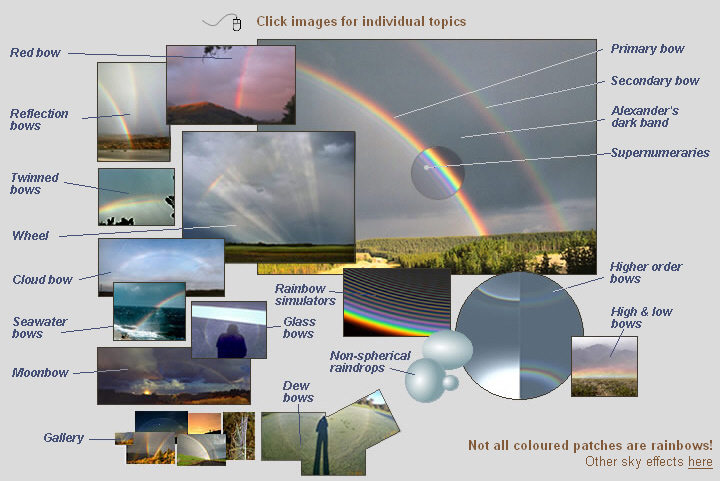
I stumbled upon a very cool site this morning from the UK called Atmospheric Optics. The site is comprised of an extensive series of images and explanations (some of the best I have ever seen) for the most common optical phenomena that result from various atmospheric conditions.
Rainbows, halos, shadows, ice crystals, and sunsets all figure prominently. Do check it out if you have even a passing interest in physics or even if you just like pretty sunsets. Here's a sample on the directory page for the Rainbow Section.
LEGO Group is producing 15 billion components a year--that's 1.7 million items an hour, or 28,500 a minute. Tire production accounts for some of that number; the factory also produces 306 million tiny rubber tires a year. In fact, going by that number, LEGO is the world's No. 1 tire manufacturer.
The bricks are so versatile that just six of them can be arranged in 915,103,765 ways.
I'm always on the lookout for good starter educational kits for students to learn electronics through their own hacking project, and I hit the mother load this week. First, this month's Wired magazine had a plug for the new Micro-controller kit from Thames and Kosmos, which you can purchase here at Amazon.
The $136 price tag is a bit steep compared to the raw cost of all the parts, but everything is ready to go with almost no effort or overhead whatsoever, including all the necessary interface cables and whatnot.
Secondly, for those more intrepid (or budget conscious), there is the path for the purist. This link over at Instructables will send you on your way to building your first prototype systems from scratch including your own interface cables. On the up-side, total cost to start doing fun stuff can be managed within a $10 budget or so as long as there is an old PC with a parallel port lying around somewhere. The canonical first project it to light up an LED and control it.
This Instructable also include links to Cornell, where the devices are used in a class, complete with links and blogs about the student's final projects, and there is an extensive web reference site called AVR Freaks.
For those of you unfamiliar with Moore's law, Gordon Moore, the founder of Intel predicted that semiconductor technology would advance at a rate that doubled the number of transistors that would fit on a chip every 18 months or so.
Now, the University of Delft and IMEC have fabricated a MOSFET device (a type of transistor) with wires so small (around 35 nanometers across, or roughly 1/200 the size of a human hair) that the conductivity and other electronic properties of the material depended on the flow of electrons around a single dopant atom of arsenic.
Obviously, classical electromagnetics, which are based on the assumption that materials can be modeled as a continuum with homogeneous properties starts to break down when you need to consider individual atoms. But fortunately, we are headed towards quantum computers which might map very nicely to the quantum atomic properties.
If you didn't happen to catch this when it was live on television, YouTube has come to the rescue. Check out this amazing Rube-Goldberg machine from a couple-year-old Honda ad:
"This Advertisement for the new Honda Accord was shot in real time with no CGI involved in the sequence. It required 606 takes and cost $6 million to shoot and took 3 months to complete.
The equipment was so precisely set up that the crew literally had to tip toe around the set for fear of disturbing things, which led to some unexpected problems. "As the day went on, the studio would get hotter," says Steiner. "It meant that the wood would expand and the cog or exhaust that spins around would move slightly faster." These tiny changes made big differences to the precision set-up of the equipment......
.....The sequence where the tires roll up a slope looks particularly impressive but is very simple. Steiner says that there is a weight in each tire and when the tire is knocked, the weight is displaced and in an attempt to rebalance itself, the tire rolls up the slope."
After all the hoopla about Pluto being demoted to "Dwarf Planet" status a few months back, I've gotten a lot of questions about what qualifies a hunk of rock as a planet. One of the criteria which Pluto failed to satisfy, was that of having attained sufficient mass and thereby gravitation pull so as to have cleared its orbit of other debris.
Well it turns out that a very nice image illustrating the principle turned up a few days ago. NASA's Cassini spacecraft just turned in a very nice closeup of Saturn's tiny moon Pan in the midst of the planets network of rings.
The tiny moon, little more than 16 miles in diameter, has swept clean a 200 mile-wide gap in the rings which we now call the Encke gap. Incidentally, we saw the gap first, and deduced that there must have been some sort of gravitational object to have caused the sweep, and then later found the moon.
Jim Faketselis of Huntington, NJ took this short 18 minute movie of the famed Orion Nebula, only to find what looked like a shooting star. But actually, it is the star field that is rotating about as the earth spins, made still by the motor drive the the telescope. What looks like a shooting star here is actually a geosynchronous satellite. These satellites are launched into a very specific orbit that circulates around the earth at the same angular rate that the earth spins to hover stationary with respect to a single point on the ground.
Here is another image of the Orion Nebula moving past four geosynchronous satellites but with the motor drive disengaged.
Back in my teaching days, whenever some jaded, burned-out high school teacher would tell me something like, "...that's just too hard for the kids! Why do you make it so hard?" I generally ended up showing them the projects that actually ASKED to do and saying, "...well these students didn't think it was too hard. Check out the telescope and photometer that Jennifer built, and she didn't think she was good at either Physics or Math." And true, it might have been hard for some of the students, but not for all of them. The key was always to keep both ends of the intellectual engagement spectrum challenged.
But I just can't resist highlighting real teen achievement in such a way as to show that the main limitations in many of our science curricula are the limited breadth and depth of the curricula themselves when the main mechanism for pedagogy is the lecture. This story shows the true power of unlimited guided and independent innovation.
Thiago Olson put in over one thousand hours over a couple of years to create a fusion reactor in his basement. This is no mean feat, given that there are only a few dozen working fusion reactors in the world, with most of them at multi-million dollar research institutions. Thaigo, in the true spirit of scrappy innovation scoured EBay for the parts and built it on a shoestring with a little help from Dad.
My favorite quotes from the article come from his mother:
Thiago's mom, Natalice Olson, initially was leery of the project, even though the only real danger from the fusion machine is the high voltage and small amount of X-rays emitted through a glass window in the vacuum chamber -- through which Olson videotapes the fusion in action..
But, she wasn't really surprised, since he was always coming up with lofty ideas.
"Originally, he wanted to build a hyperbolic chamber," she said, adding that she promptly said no. But, when he came asking about the nuclear fusion machine, she relented.
"I think it was pretty brave that he could think that he was capable to do something so amazing," she said.
Thiago's dad, Mark Olson, helped with some of the construction and electrical work. To get all of the necessary parts, Thiago scoured the Internet, buying items on eBay and using his age to persuade manufacturers to give him discounts. The design of the model came from his own ideas and some suggestions from other science-lovers he met online.
Someday, he hopes to work for the federal government -- just like his grandfather, Clarence Olson, who designed tanks for the Department of Defense after World War II. Thiago, who is modest and humble about his accomplishment, said he knew from an early age what he would do for a living.
"I was always interested in science," he said. "It's always been my best subject in school."
But, his mom had other ideas.
"I thought he was going to be a cook," Natalice Olson said, "because he liked to mix things."
I pulled into a Chevron station a few years back to gas up my ride, when a rather graphic flier taped to the pump caught my eye. It was a laser-printed page with a picture of a charred car complete with melted tires, glass and all, sporting a headline that said "BEWARE OF GAS TANK FIRES AT FILLING STATIONS! THIS COULD HAPPEN TO YOU!"
There followed a couple of dense paragraphs that I simply couldn't resist reading at that point, outlining a horrific story of the author's wife who inadvertently killed herself by starting a fire at the pump after topping-off her car.
The flier went on to explain that while this hazard was quite common, it was generally underreported. "Please pay attention and change any dangerous habits so that forewarned, you don't loose your wife like I did," it said.
I was completely hooked on the curious phrasing at that point. Why were women in particular at risk? The flier went on to claim an "extensive" level of post-accident research that determined the filling-station fire hazard beset a population heavily skewed towards women because they tended to get back in the car while waiting for the tank to fill, whereas men tended to stand around outside the car while waiting.
This seemingly innocuous relaxation is indeed a very real risk because the very act of getting into or out of your car can transfer or induce a rather large electrostatic charge to your body. I suspect most people have at one time or another felt a tiny shock of static discharge getting in or out of their car. Just imagine if that spark arises at the wrong time and place. And when people wear think-soled (insulating) shoes, and particularly when the air is dry, there are no fast mechanisms to bleed off the accumulated charge, which will then be retained until some connection to a ground is established.
The gas tank pumping risk is managed automatically for those who stay out of the car for the duration, because the pumps are grounded, and when the fueling operation is initiated, the driver is grounded when he/she first touches the pump before any pumping begins. The danger begins when someone releases their ground connection, and gets charged up electrostatically-speaking by getting back in the car. If the first contact to ground after re-emerging from the car happens near the pump nozzle, the resulting spark can ignite any fumes that had been released during fueling. (This, incidentally, is one of the principle reasons why all modern gas pumps have sleeves to trap fumes in the tank, and it is important to be sure the sleeve seal is fully engaged and mated to the gas tank pipe.) If enough fumes have been released over a protracted or poorly-sealed fill-er-up type operation, the resulting explosion could set fire to anything flammable nearby, like the poor late woman mourned in the flier.
So the first thing I did upon returning home, was to ask my wife what she tended to do while waiting for the gas tank to fill up at the self-serve gas station. To my surprise, she said, "I just sit in the car and wait." I personally NEVER get back into the car. I then went on to relate the story, and physical explanation. My hope at this point is that she will keep herself grounded forever more whenever near any gasoline pumping operations.
For those of you in any doubt as to the serious nature of this warning, here is a YouTube video that I found this morning for your review entitled "Always Ground Yourself at the Pump."
So what should you do, using your newfound electrostatics knowledge to stay safe at the gas station? Well, there are a few options.
1.) If you can afford the price premium, you might consider staying inside the car and having someone else pump the gas who is always outside and stays grounded.
2.) If you do get out to pump your own gas as I generally do, stay outside of the car until the filling operations is complete, and the gas tank is capped off.
3.) If for some reason you HAVE to go back inside the car, make sure to ground yourself to the outside of the car, and the pump FAR from the junction between the pump and the car before you approach the nozzle.
My wife and I were car shopping last weekend, and we saw the future of automobiles. It was both an inspiring and depressing view, all at the same time.
Being a little bit of a car and driving nut, I've always tended towards the performance and handling side of the car market. Even my wife's current "grocery getter and kid hauler" is a sport model mini-station wagon Audi A4 that in some ways is more fun to drive than my old '95 Porsche 911. And while I've always been intrigued by the prospects offered by advancing hybrid gas-electric technologies, the earliest commercial efforts towards "green" cars like the Honda Insight and the Toyota Prius always left me underwhelmed despite the amazing gas mileage because the performance just wasn't there.
But last Saturday, after test driving the latest crop of performance autos Audis, Beamers, and Volvos, we drove the new Lexus Hybrid mini-SUV.
My first impression as the salesman pulled the car up in front of us was a momentary visceral response of surprise and fear of being run over. The car was completely silent as over a ton of steel rolled up right next to me solely on battery power. It was just unnatural how so much mass could move without a gas engine that you could hear coming, and before I could help myself, I actually looked to be sure that someone was at the wheel of the car, and that it wasn't rolling out of control to crush us. My second thought, after noting the salesman at the wheel, was that I was going to need to immediately adjust the care with which I looked both ways when crossing the street.
Despite my skepticism, I climbed into the car to find pretty much what you would expect in any luxury SUV from Japan or Germany: great fit and finish, fine materials, clearly organized controls and labels, 8-way adjustable leather seats. The salesman made a point of telling me immediately that the car was already running. "How the hell can you tell? It's utterly silent!" I thought. Ahh. A tiny blue light on the dashboard.
So off we rolled, out of the lot and onto the busy streets of weekend Concord, CA. The only sound that accompanied the start of our journey was the whisper of the air and the tiniest of rumbles from the rubber meeting the road. At irregular intervals, the engine would start, and to my surprise, while you could hear the engine start and stop if you paid attention, there was no hitch or vibration or change in the ride whatsoever as it shifted from electric to gas power.
Then the salesman turned on the in-vehicle information display with an active diagram showing where the power was coming from at any moment, with a schematic of the car showing the effects of the engine, battery, and regenerative braking. High cool. My wife's comment at the time was, "...well, we clearly can't have THAT on if we expect him to pay any attention to the road."
Overall, the drive wasn't high on the handling ladder (admittedly it was an SUV) though there was plenty of horsepower. But it was remarkable that there wasn't anything different or troubling from the new hybrid technology other than the 30% improvement in gas mileage (a much better rating, in fact, than our little sport wagon of one half the size) and the freaky stalking behavior of the silent motor. Now we're not likely to get such a big vehicle at this point, but when the technology makes it into the smaller sports oriented cars, it will be a no-brainer. And it is clear to me that hybrid technology will eventually comprise the future of ALL automobiles, and that they have already become a viable quality consumer products now.
So what was the depressing part? The fact that this 3rd-generation hybrid from Japan was so freakin' fantastic, and that the American companies are just getting started (and headed towards bankruptcy). But maybe there is hope for a US auto maker if Tesla Motors can get their car into production. I met a couple of the company's founders a few weeks ago, and we commiserated that they were going through the NSTA crash test trials. The thought of building 20 of these sexy little $100k numbers just to destroy them was depressing. Be sure to check out their web page. They might not have the impressive window-rattling vroom vroom when you throw down at a stop light drag, but they will kick-ass in a very quiet and sneaky way.
Several people have asked me lately about book recommendations for students and high school teachers to learn basic electronics. And while there are plenty of texts suitable for the college student, there are precious few works that can present aspects of electronics in a clearly simple form that is not dumbed-down to the point of silliness and is still fundamentally correct. There are always canonical references such as Horowitz and Hill's "The Art of Electronics" to help the teachers out, but more than 60% of that material will be virtually out of reach for the typical secondary student.
Although I though the ordering and organization of some of the chapters fell a little out of the sequence I would have used, the material is concise and simply stated, mostly correct, and replete with useful photos, examples and web links to take some of the basic theories and mathematics and translate them into working circuits, complete with descriptions of necessary lab equipment and how to use the tools, meters, scopes, and whatnot.
Any of you would-be circuit or robotics hackers should check it out!
I was talking to a friend from MIT a few years back, when she told me about this guy she used to date and what an incredible geek he was. Given her own tenure at MIT and her resultant accrual of a rather high level of nerd pride, it was indeed noteworthy to hear her cast such aspersions.
She went on to say "...he had even spent years collecting samples of most of the elements in the periodic table, and built a display case to hold them in the same layout." Though I didn't share it at the time, my first thought was "geeky or not, I would love to see it...maybe even build one of my own..." So I guess I'm a geek too.
What partly set off my imagination at the time, though, was the fact that the elements seemed very abstract to me when we first learned about them in high school chemistry. It wasn't until decades later in my technical career when I had been exposed to all the uses and applications of the different elements that there was any physical grounding for the abstract table. A little extra time studying the applications of the elements, and a physical sample of each one seem like a capital idea!
I never did manage the meeting or the initiative to build my own collection, but now I can get pretty close with a lot less effort. Check out this photographic table of the elements.
(click on the image for an enlarged version)
I particularly like the titanium turbine blade, the hydrogen in the nebula, and the neon bulbs for the noble gases. I'd still like to see more examples per element, including things like integrated circuits for silicon and aluminum and so on. But at least it's a start.
You can get all the posters and place mats you want here. Every chemistry classroom should have one!
I found a great video on UTube this morning. It is a time-lapse view of the International Space Station's evolution compressed to about 25 seconds.
Keep in mind that the ISS is still a work in progress with at least 17 additional flights planned to complete the station. After those missions and the planned Hubble Telescope rescue, the shuttles are to be retired and replaced by the yet-to-be-built Orion launch vehicle.
After collecting several technical degrees at Cornell and MIT and a stint building spacecraft sensors and new computer architectures at NASA's Jet Propulsion Laboratory, I am now a serial entrepreneur. MicroDisplay was the first company I started, spun out of my grad school dissertation on Integrated Optoelectronic Computers while at MIT's AI lab. MobiTV is looking to be a little more of a break-out after we invented the technology, built the infrastructure, and licensed the content to deliver live television over wireless networks to mobile phones, PDAs, and now Computers. Besides that, I am the founding Chairman of the Westminster Institute for Science Education [WISE]
You can check out a more serious bio here.





 Posts