Friday, December 08, 2006

Pining for a White Christmas? More on Snowflakes

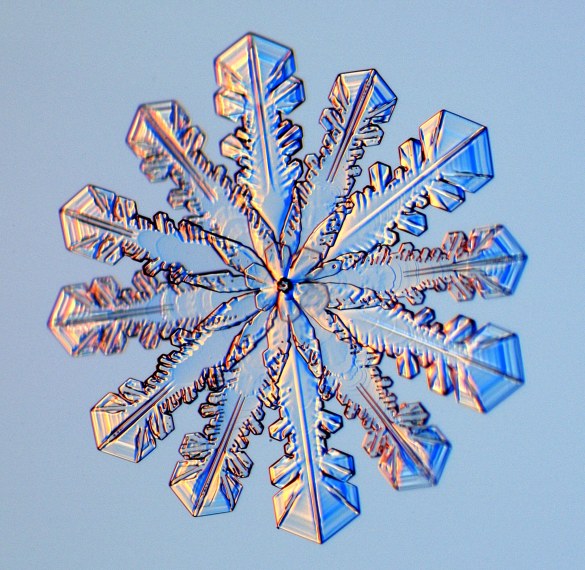
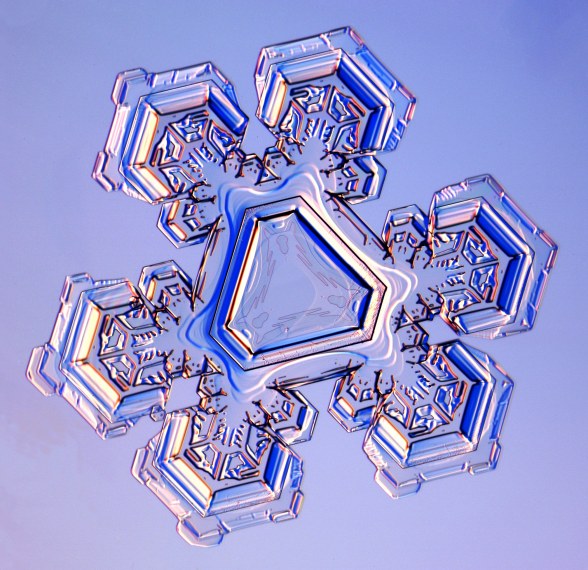
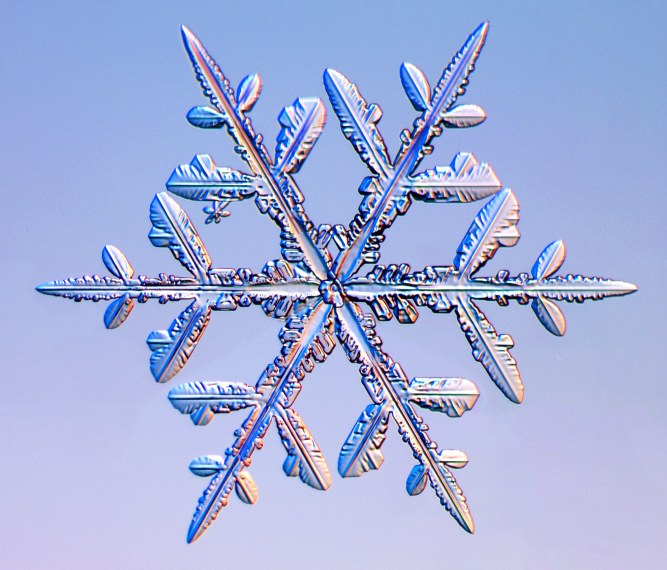
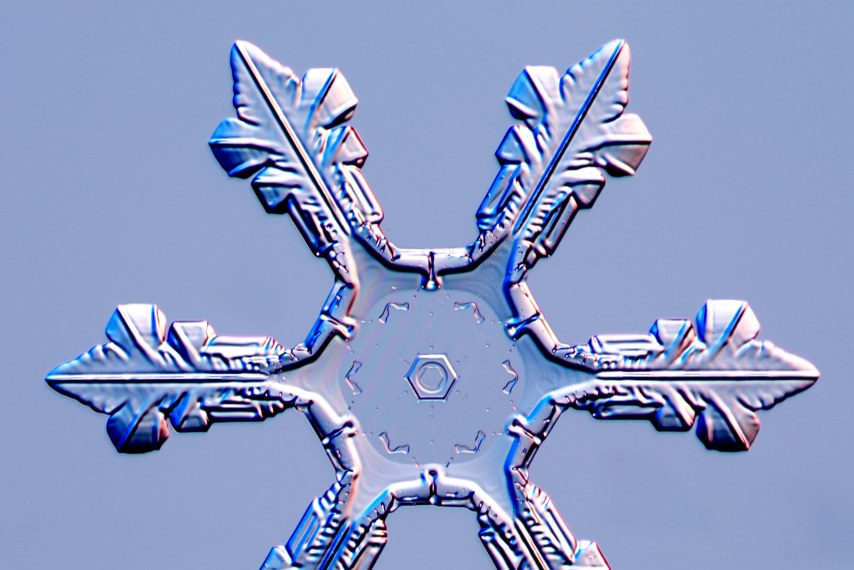
Over the course of the last few months, it turns out that one of the most popular posts here on All the Best Bits was the one entitled: A Snowflake Closeup. So in honor of the season, here is some more on snowflake science.

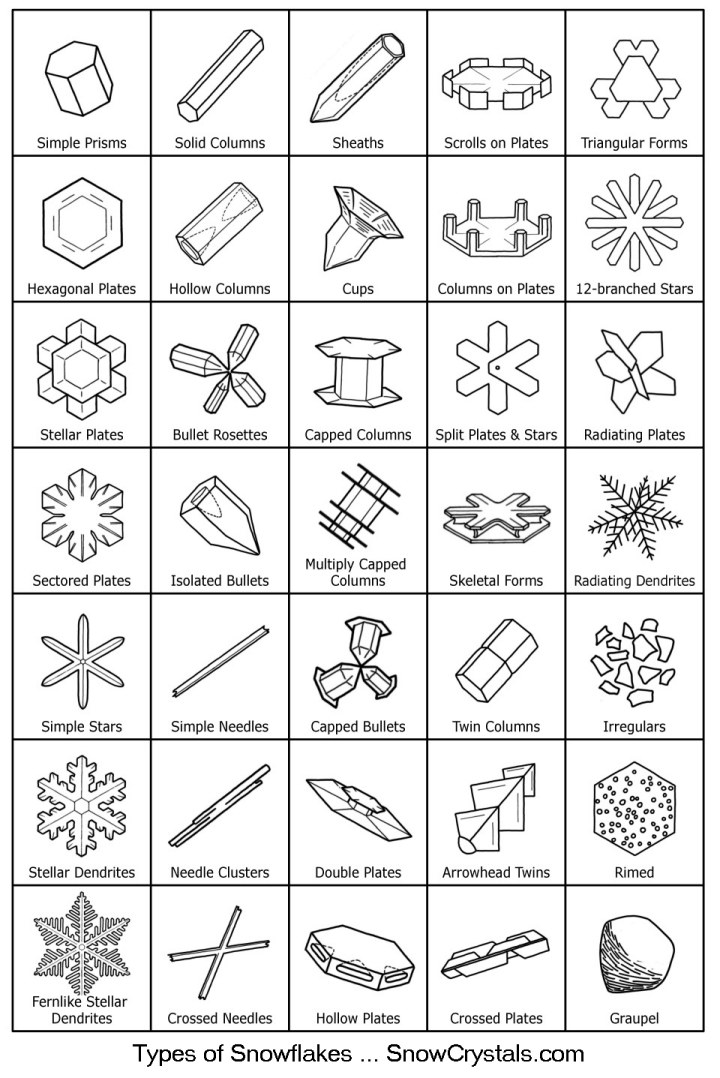
Some folks from Caltech have posted Snowcrystals.com, a great site to learn all things snow related, including a great taxonomy of ice and snow crystals and more snowflake photos than you can shake a candy-cane at.


Wednesday, December 06, 2006

PicoFlyer, the Furby of 2006

It's true that I tend to obsess about little hobby widgets. But this one is just too cool for words. A company in Norway called ProxFlyer has been developing tiny radio controlled helicopters for a few years now. More recently, they licensed some of the technology to a company called Interactive Toy Concepts which manufactured a toy for sale through Radio Shack last year. I tried to get one last year but they had sold out way before Christmas. Well, now they've outdone themselves. Check out their latest effort, the PicoFlyer.

battery

Here are the stats from the ProxFlyer page:

Key specifications, components and materials used to build the small Picoflyer:

Rotor:


Airframe:


Main motors:
Gears:
Tail motor:
Battery:
Control:


Weight:
Flight time:
    60 mm diameter (2 contra rotating 4-bladed rotors)
    Carbon rod 0.3 mm and 0.5 mm from WES-Technik
    Aramid 30 g/m2 fabric from CST, foam tape hinges
    72 mm long, 0.08 mm carbon plate, 0.3 mm rod,
    1.5 x 0.2 mm tube, brass bearings 0.7 mm from Didel

    4 x 8 mm, 11 ohm from Didel (2x)
    Plastic gears, module 0.2 from Didel (6.7 : 1)
    2.8 x 6 mm, 25 ohm from Shicoh, 0.16 grams
    1 x 3.7 V, 30 mAh Didel cell, 0.86 grams
    3 channels custom Plantraco 900 MHz radio control
    Atmel ATtiny26L with 3 x ESC
    Yaw control by differential speed of rotors
    Tail motor used for forward horizontal flight

    3.3 grams (incl. battery and control)
    Up to 1 minute, (0.5 minute continues)

Sadly, this one-off prototype isn't for sale, but you can get a slightly larger version manufactured by ITC at Radio Shack. Get 'em while they last. I'm ordering a bunch for all my nerd friends. And I might keep one for my four-year-old. Of course I'll have to help her learn how to fly it! Oh, and then I might also need another one for all the nifty little parts I could use on other projects....

Blog Image

Here's a video of the little copter in action.


High cool.

Tuesday, December 05, 2006

Solar Images from SOHO

So NASA has this great solar telescope in orbit with a massive ultraviolet telescope aboard.

[image of SOHO EIT telescope    without thermal insulation]

I am continually stunned by the amazing images it churns out on an almost daily basis. Check out these GIF movies at a couple of different filter wavelengths.

http://sohowww.nascom.nasa.gov/data/LATEST/current_eit_284small.gif

http://sohowww.nascom.nasa.gov/data/LATEST/current_eit_171small.gif


Monday, December 04, 2006

Vote for Me!

I realize that most of you are probably not reading this blog to find out more about the wireless or broadcast industries and I generally try to avoid blogging about work. But this is just too good to resist. RCR Wireless, one of the industry's trade rags has just nominated me as a candidate for "Person of the Year."

Aw shucks. I'm already flattered. But it would be even cooler to win. So vote for me at this link!

Will Canada Become the World's Breadbasket?

I couldn't escape the grand political irony exposed in this recent story entitled "New Crops Needed to Avoid Famines" from the BBC on climate change. The basic thesis is that the expected increases in global temperature will shift the regions amenable to fertile crop production northward. Worse yet, in the absence of any replacement crops, or the adoption of massive farming infrastructure in the newly fertile regions, broad famines will ensue. The shift has reportedly already begun with rice yields in Asia declining 10% per degree of average annual temperature increase.

Then it struck me. The cornerstone of political support for the Republican party lies in America's breadbasket, the Red States. The following map from the BBC article says it all.

Map of North America. Image: BBC

One would think think that such a clear and present threat to their core constituency would get a little more attention. But sadly, the Republican platform is currently opposed to both efforts at mitigating global warming AND genetic engineering which could develop more climate-proof crops. It is almost as if they are trying to guarantee the economic ruin of their constituency (and the rest of the US with them) within a couple of generations. Liberals take heart!

Sunday, December 03, 2006

A Japanese Science Magazine with Hands-on Kits!

Now THIS is a science magazine. It's called Otona No Kagaku, and the publisher, Gakken of Japan, calls it a Mook (Magazine+Book). Leave it to the Japanese to include actual kit parts and instructions so people can throw down some real hands-on experimental action. Maybe if we ramped up manufacturing in China and whipped off a few quick translations we could bring the issue/kit costs (typically around $45 ) down to the point where we could get subscriptions for a significant number of kids....Given MobiTV, I'm a little swamped at the moment. Anyone else wanna start a fun company?


The first one I stumbled across was the Sterling Engine issue that several people had managed to acquire, build, and document including a nice video on YouTube.


I'm particularly fond of the Sterling engine marketing photos on their US distributor's web site (The Karakuri Corner) The Canine-driven engine is my favorite.

Low Temperature Differential Stirling Engine

There are a bunch of other great issues that include great projects such as an Edison-style phonograph and a Berliner style Gramophone that record and play audio on plastic cups and CDs.


And check out these other fantastic projects from previous issues:


Vol.9画像:150×200Vol.11画像:150×200
A mini planetarium and a replica of Newton's scope.


Vol.4画像:150×200Vol.5画像:150×200
A crystal radio, and a Hooke's Microscope replica.


Vol.6画像:150×200
The working Gramaphone issue.

Needless to say, I've already subscribed and ordered several of the back issues. They also have a few other cool gadgets that are hard to pass up as holiday presents, including the Homestar planetarium.

Homestar Planetarium Star Projector Black


This nifty little gadget takes a 5cm diameter film image of the night sky and projects it on your cieling! Boy wouldn't one of those be a great Christmas gift for an astronomically inclined nerd... (hint, hint...) There's also an industrial version better suited for larger rooms called the MegaStar.


Star Wars Origami

One of my favorite technical books from a couple of years ago was this textbook by Robert Lang on the mathematics and symmetry properties of paper and origami.

http://gallery.origami.free.fr/Auteurs/US-GB/lang/photos/Secret%20design/cover.jpg

But there was just that something that was missing. The models were so..., well..., so traditionally Asian that I had trouble connecting with them culturally. NOW, however, there is hope, for the Force is with us all. Phillip West has folded a set of Star Wars Origami models. Enjoy.


Saturday, December 02, 2006

Discovering a 2,000 Year Old Computer

Every scuba diver, myself included, dreams of finding that priceless artifact. Will it be the next guided wreck dive in the Caribbean? Unlikely. I clearly need to be diving in Mediterranean, or Agean, or Latin American waters for any kind of chance at all. Truth be told, I'm not sure what I would have done had I fished this hunk of corroded metal-encrusted rock out of the ocean on a snorkeling trip.


Elias Stadiatos, a Greek sponge diver, wasn't really sure what he had found either when he discovered an ancient cargo ship wreck off Antikythera island just before Easter in 1900. Fortunately, he found it amidst a series of more traditional artifacts, and so it has circulated through museums ever since, and now resides in the Athens Archeology museum. Here is an image from LiveScience that shows all the parts that were eventually associated with this odd widget.


Earlier efforts at reconstruction were mainly focussed on the visible inscriptions and lettering on the outer plate surfaces, and highlighted a very interesting application of classical image processing with programs like Photoshop to archaeological discovery.

Fragment B text area

The VGSTudioMax interface

The Golden Sphere
... "Chrysoun Sfairion": the little "Golden Sphere"!

These resulted in a number of reconstructions of the outer casings to show dials related to the motion of the Sun and the Moon and the zodiac.


In the 1930s and 50s, several groups used progressively improved X-Ray images in an attempt to divine the internal mechanism with decent success,


to ultimately result in some very nice reconstructions of the internal mechanisms, which turned out to model the motion of several planets as well.


All of this is simply wondrous in terms of early mechanical realization of solar system models proposed by
ancient Greeks, in effect a mechanical computer that would simulate the solar system.

More recently however, a company named X-Tek used their latest 3D X-Ray Tomography machine (an X-Ray cousin to the latest MRI machines) to make much more detailed 3-D images of the components hidden within the block of sediment. The images are amazing:


An old film radiograph of the largest fragment of the Antikythera Mechanism, taken in 1980.

A single 2D CT slice of the largest fragment of the Antikythera Mechanism from X-Tek's new 3D CT data

Using these new images, researchers at the Universitys of Cardiff and Athens published a paper in the November 30, 2006 issue of Science detailing that the internal componentry of this mechanical computer surpassed anything to emerge over the succeeding 1000 years. From the article:

Named after its place of discovery in 1901 in a Roman shipwreck, the Antikythera Mechanism is technically more complex than any known device for at least a millennium afterwards. Its specific functions have remained controversial because its gears and the inscriptions upon its faces are only fragmentary. Here we report surface imaging and high-resolution X-ray tomography of the surviving fragments, enabling us to reconstruct the gear function and double the number of deciphered inscriptions. The mechanism predicted lunar and solar eclipses on the basis of Babylonian arithmetic-progression cycles. The inscriptions support suggestions of mechanical display of planetary positions, now lost. In the second century bc, Hipparchos developed a theory to explain the irregularities of the Moon's motion across the sky caused by its elliptic orbit. We find a mechanical realization of this theory in the gearing of the mechanism, revealing an unexpected degree of technical sophistication for the period.

An X-ray scanner revealed a complicated arrangement of 30 precision, hand-cut bronze gears. The team has inferred that there were at least seven more gears. "It is only when you get medieval astronomical clocks that you go beyond this in complexity," said Prof Edmunds. Speculation about how this marvel was used continues and the team is now building a virtual version in a computer.

Enigma of ancient computer solved


Prof Edmunds said: "It makes you wonder what they would have achieved if the Romans hadn't taken over and put a stop to things. Would they have had a man on the Moon by AD300?

"It sounds ridiculous, but if they were able to construct something as technically brilliant as this, it's not complete fantasy."


See More detail here:

Friday, December 01, 2006

Mercury Transit Photos

SpaceWeather finally posted the results of the Mercury Transit Photo Contest from a few weeks back, so I thought I would link to a few of my favorites.

http://spaceweather.com/eclipses/08nov06c/vsoske1.gif
From Thad V'Soske, Colorado National Monument, Colorado, USA Nov. 8. 32-frame transit photo animation represents the motion of Mercury from 12:12pm to 1:29pm (local time) on November 8, 2006.


http://spaceweather.com/eclipses/08nov06d/Jones1.jpg
From Phillip Jones, Dallas, TX, who set up setup at the Univ. of TX - Dallas campus for students and faculty to partake the in transit event. Live video feed of the transit was displayed on his laptop. Photo details: Lumenera SKYnyx 2-1 attached to a Coronado SolarMax90 on a Tak NJP mount.


http://spaceweather.com/eclipses/08nov06b/hinode_anim.gif
From the Japanese Hinode Spacecraft, which used its Solar Optical Telescope to capture a 0.2-arcsecond resolution movie of Mercury transiting the sun. See also the X-ray Transit of Mercury.


http://spaceweather.com/eclipses/08nov06f/Ramotowski1.jpg
A young astronomer named Ryan Dunn manned the Solar viewer and expertly explaining the details and dynamics of the transit to the public at the Albuquerque Astronomical Society event.


http://spaceweather.com/eclipses/08nov06e/dodson1.jpg
From Andy Dodson, Huirangi, NZ. Photo details: SolarMax40 H-alpha filter, Stellarvue 80.


http://spaceweather.com/eclipses/08nov06e/Alvarez1.jpg
From Larry Alvarez, Flower Mound, Texas, Photo details: Coronado CaK 70mm scope and a Lumeneara CCD.

Atmospheric Optics

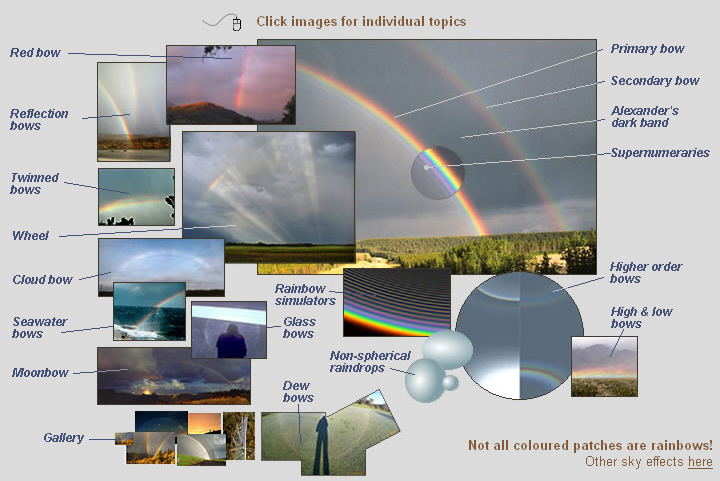
I stumbled upon a very cool site this morning from the UK called Atmospheric Optics. The site is comprised of an extensive series of images and explanations (some of the best I have ever seen) for the most common optical phenomena that result from various atmospheric conditions.


Rainbows, halos, shadows, ice crystals, and sunsets all figure prominently. Do check it out if you have even a passing interest in physics or even if you just like pretty sunsets. Here's a sample on the directory page for the Rainbow Section.