Tuesday, October 31, 2006

An Alien Sky?

The Astronomy Picture of the Day web site highlighted this photo today of what looks like a daytime sky from another planet.


It was actually taken of our daytime sky using a small refracting telescope; The small crescent is Venus, and the larger one is the moon. Click on the image to see a higher resolution version, and find all the details on how the image was taken here.

Monday, October 30, 2006

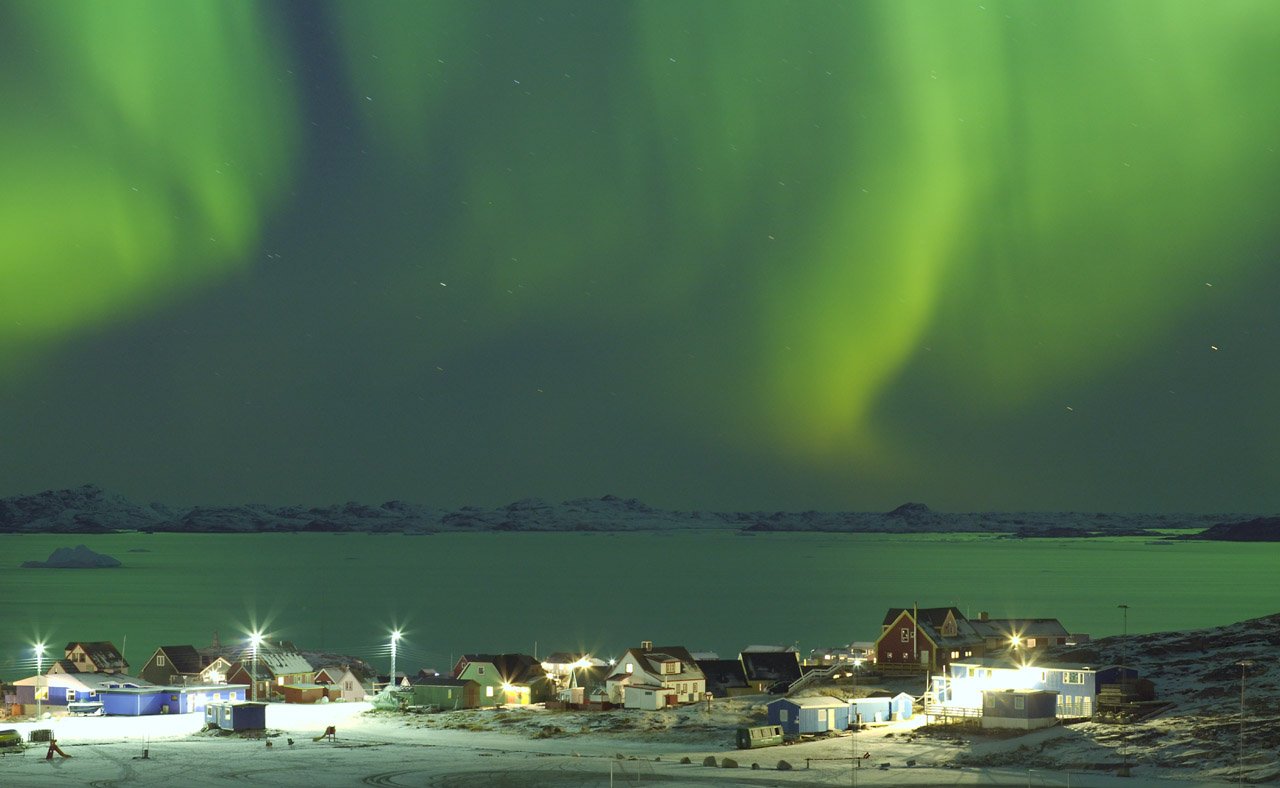
More Solar Wind Shows

Space Weather had an excellent photo of the auroras over Nuuk Greenland when the solar winds hit the earth's magnetosphere last night.

Friday, October 27, 2006

A Snowflake Closeup

I first found this image on Chet Ramo's Science Musings blog, and just stopped to look at it for a while. (click on the image to view a high resolution version.)


At first glance, it doesn't really look like a snowflake. In actuality, it is an image of several snowflakes of differing conformation (I counted about eight different varieties) that have been sputter coated with platinum at a very low temperature (in order to make them conductive) and then imaged with a Scanning Electron Microscope equipped with a low temperature stage. The resulting gray-scale image formed by the electron beam was then digitally colored just as the old black and white movies have been "colorized" to result in the above "false color" image. Here's a picture of the specific unit that was used to take this image.

Hitachi S-4100 field emission Scanning Electron Microscope
Check out more details on the equipment here, and the original source of the snowflake crystals images here, and here.

Thursday, October 26, 2006

A Stellar Explosion in Progress

Check out the latest Hubble photo showing the same stellar explosion from V838, Monocerotis and its evolution since 2005.

http://imgsrc.hubblesite.org/hu/db/2006/50/images/a/formats/web_print.jpg

From the Hubble Web site: "These are the most recent NASA Hubble Space Telescope views of an unusual phenomenon in space called a light echo. Light from a star that erupted nearly five years ago continues propagating outward through a cloud of dust surrounding the star. The light reflects or "echoes" off the dust and then travels to Earth.

Because of the extra distance the scattered light travels, it reaches the Earth long after the light from the stellar outburst itself. Therefore, a light echo is an analog of a sound echo produced, for example, when sound from an Alpine yodeler echoes off of the surrounding mountainsides.

The echo comes from the unusual variable star V838 Monocerotis (V838 Mon), located 20,000 light-years away on the periphery of our Galaxy. In early 2002, V838 Mon increased in brightness temporarily to become 600,000 times brighter than our Sun. The reason for the eruption is still unclear.


A Great Intro Electronics and Robotics Project

The Make Magazine web site pointed me to this great open house activity that the Electrical Engineering department over at WUSTL put on for potential incoming freshmen. Students could show up and build their own light-activated robot with a few dollars worth of parts in about 30 minutes using absolutely no tools whatsoever. And they got to take their new pet home when they were finished with version 1.0.


Using the paint roller drive wheel vs. motor shaft ratio of diameters as an effective gear reduction is a bit of creative genius. Given that there are only ten or so parts and the instructions are only a page long, I'm thinking this one could be useful even in late elementary school.

Some early prep work was necessary to hot-glue the breadboards to the paint rollers, and perhaps solder the connectors onto the battery leads. But intrepid students could easily figure that part out for a longer classroom activity. I just love this photo from the web site of one student "walking their robot" and leading it with a flashlight.


Get the one-page assembly instructions here and get those kids building robots. Once they've mastered this initial version, begin asking questions like, "okay, now how would you build another version that steers?" or "How would you make it go faster, or climb steeper hills?" or "how big could you make it and how much would it carry?"

What a great beginning.

Diet For Energy Independence

In a paper scheduled to appear in the Engineering Economist, Laura McLay and Sheldon Jacobsen have determined that growing obesity across the US is imposing even more of an economic impact than the often-reported health care costs of treating its side effects such as type 2 Diabetes.

It should come as no surprise to anyone with any Physics background at all that it takes more energy to move more mass around.
"The obesity rate among U.S. adults doubled from 1987 to 2003, from about 15% to more than 30%. Also, the average weight for American men was 191 pounds in 2002 and 164 pounds for women, about 25 pounds heavier than in 1960, government figures show."
Using those weight figured combined with statistics on 2003 driving habits, it is pretty straightforward to conclude that about 39 million gallons of additional fuel are used each year for every pound of average weight increase across the US.

So relative to our svelte 1960 profiles, at a gas price of $3.00 per gallon the US is consuming around an extra $3 billion of oil for automotive fuel a year simply because we are getting fatter. And then there's the issue of airline fuel costs as well, an effect already reported by the CDC.

So if we could just manage to curb our waistlines, we can decrease our dependence on foreign oil. Maybe we could even manage it by driving less and walking more. What a virtuous cycle that would be.


The Economic Value of Education

A government report based on data from the Census Bureau has determined that a bachelor's degree is worth about $23,000 a year, with college graduates earning and average of $51,554 in 2004 compared with $28,645 for those with only a high school diploma. If you carry that yearly salary difference through retirement age, you end up with a total difference of about $1.2M.

High School dropouts earned an average of $19,169 a year, and those with advanced college degrees earned an average of $78,093.

So high school is worth about $502,000

College is worth an incremental $1.2M

Graduate school is worth another $1.4M

It seems like a no-brainer to me, specially when you consider some of my buddies who have turned what they learned into economic engines worth billions of dollars as an up-side. Of course there is a down side, but according to the large-scale statistics, even Joe-average is best served staying in school a little longer.

Nursery Rhyme Cures Speechlessness

Scott Adams, the creator of the famous series of Dilbert cartoons, lost his voice 18 months ago from a condition called Spasmodic Dysphonia, in which that part of the brain which controls the muscles around the vocal cords malfunctions and either shuts down or spasms. No one has ever recovered from this condition before. Adams, however, persisted in experimenting with his remaining speech function for over 18 months of fruitless efforts to finally discover that he could speak normally when rhyming. With a little more concerted effort around the rhyming, he has now almost fully recovered. Read the amazing story here on his blog. It is a fantastic example of the wonders and complexities of the human brain, and a testament to the power of perseverance and open-minded discipline in experimentation and the scientific method.

Tuesday, October 24, 2006

You Can't Handle The Truth!

bizarro.jpg

Where There's Math, There's Fire

I'm always on the lookout for a good screensaver. And mathematically-defined flames just seem too good to pass up. These tasty little bits of eye candy are based on the work of Michael Barnsley from Georgia Tech (One of my freshman calculus instructors, incidentally) who invented Iteratted Function System fractals, which were used by Scott Draves in 1992 to make artificial flames. These examples were made by rajah, and you can see many more examples and animations here and here.


Now you can go and make your own artificial flames with a freeware application called Apophysis that runs on the Windows operating system. Donwload it here. If you'd just like to check out some animations and images, look here.

Art Restoration With Nanotechnology

Nanotechnology has certainly garnered its share of media attention over the last year or so in applications ranging from drug delivery and high-density magnetic recording materials to new LED lighting systems. But yesterday I stumbled across an unexpected application that showed remarkable results; the restoration of antiquities through the removal of resins and salts from paintings, consolidation (reattaching and solidifying) paint on canvas and frescoes, and de-acidification of paper.

The key limitations of the traditional techniques centered around the fact that the cracks and pores in the antique surfaces were too tiny for the materials with macro-sized particles to effectively penetrate. Enter the new techniques for fabricating nano-scale particles of the same treatments.


This is a scanning electron micrograph of a Calcium-hydroxide nanoparticle synthesized through an homogeneous phase reaction at 90 degrees celcius.
These nanoparticles can now enter easily into the tiny pores in the paintings and frescoes and work their chemical and fixative magic without leaving any annoying discoloring films. The effects are remarkable.


Crucifixion by Beato Angelico (15th century, Florence). On the left, pre-restoration images of the wall painting. On the right, apost-restoration image. Desulfatation and consolidation was performed with the Ferroni–Dini method (ammonium carbonate plus barium hydroxide). (Courtesy of Daniela Dini).
Here is a link to the technical paper describing the restorations from which these images were taken. Here are a couple more amazing examples from this web site.


Santa Maria Novella Basilica in Florence, wall paintings by Andrea da Firenze: conservation carried out by means of lime/alcohol dispersions.

The fresco by Pozzoserrato (XVI century) in the Conegliano’s Cathedral after the cleaning with the micellar solution developed ad hoc for this workshop.

Sunday, October 22, 2006

By Your Command

I might actually make one of these in honor of halloween.


The circuit is pretty cimple with just one timer chip and a counter.


All the circuit diagrams and construction advice can be found here on the Evil Mad Scientist Blog.


The Difference Between a Mechanic and an Engineer

In the seventies and eighties, my father used to really enjoy working on our cars. I vividly remember watching him fastidiously cleaning and wiping parts and surfaces as he changed plugs, points, filters, and whatnot. I would tend to flit in and out as he carefully maintained the vehicles, always wearing an unusually clean tan button-down shirt.

I must have been about ten years old when he turned to me as I stood there observing his auto efforts one day and said, "Phillip, do you know the difference between a mechanic and an engineer?"

"An engineer can do the same job, and more, but without getting dirty."

It was then that I noticed the crisp starched crease on the shirt, and the impeccable tan shirt-front. His clothes were spotless despite a couple of hours spent disassembling and reassembling an engine.

I didn't really think much of it at the time, but later learned how that sort of meticulous care, discipline, and forethought led to parts that would mate better and run without grit to wear them, and that disordered problems, leaks, and breaks would stand out more against a clean, well-organized system. Neatly organized tools are easier to find and when handled with care, are less likely to damage parts under repair. A little forethought and advanced planning often save a lot of work, and prevent mistakes that cost time and money (and get your clothes dirty.) Now I use those lessons almost every day.

Dad would LOVE this photo tour of the Volkswagen plant in Dresden. Check out a few photos from this assembly line.


Now compare the German photos above with these North American plants.


Auto Assembly Plant © Arup

Just on the basis of cleanliness and orderliness alone, which car would you anticipate to be more reliable?

The Saddest Place on Earth

I just spent that last few days at Disney Land with my wife, our four year-old daughter, and another family with their own child of three. I hadn't been there for many years and was looking forward to reliving the park through my daughter's eyes. The park itself was fantastic and had been updated significantly with new rides like "Buzz Lightyear's Astro Blaster ride-cum-video game, and some of the old classics like Pirates and the Haunted Mansion still retained their classic touches. Admittedly, commercialism and merchandising have run rampant, with each major ride ejecting joyful consumers directly through shops to run their toddlers through a gantlet of plastic and sweets. The average parent must have to suffer "Daddy, can I get one of these?" at least twice an hour. Sooner or later, everyone must break down under the onslaught. The place really has evolved to become a very efficient machine to separate you from your money while enjoying the process.

But for all that, the rides were fantastic, the food was much improved and better than anyone expected. Everyone had a blast. So far, so good.

But then on the way back to the car, we had to pass one more gantlet, through "Downtown Disney," a rather nice but obviously well-place outdoor shopping mall complete with all the typical name brand chains. Just when I was thinking "how shameless can you get?" I spotted the LEGO store.

I remember thinking, "I can live with all the other crap. They have a LEGO store. THAT one, we can enter. Life is good." You see, LEGOs were a transformative toy for me that unleashed my imagination around the realization that I could build ANYTHING. Spacecraft, moon bases, robots, airplanes, cars, trains, tanks, ... it just went on and on without limit. As I grew up, LEGOs evolved in parallel from the traditional suitcase full of rectangular blocks and simple gears and hinges, to LEGO Technic with cams and struts and beams and pneumatics, and finally to the Mindstorm robotics kits. Later in grad school, I met Mitch Resnick who developed the first "smart bricks" that were the foundations for the Technic and mindstorm kits and thanked him personally. The very name in Danish means "Play well" and in Latin means "I put together." 'nuff said.

So even though my daughter is already pretty well-equipped with an extensive LEGO kit, I was imagining all the cool new things that we were going to be able to build together based on the latest developments out of Denmark. I even ran out ahead of our small group while they were wending their way through the isles of Mickeys and Plutos so I could have some extra time in LEGO nirvana.

What I found, however, quite literally foretells the decline of western civilization. Instead of finding a store filled with great new kits of parts to further propel the imagination, I found a toy store that was almost completely filled with cheap plastic toys. Yes, some of them were kits that you could put together, but for the most part, they were tiny kits with fewer than 30 very specialized parts that could only really be assembled into one or two pre-designed dolls.

Out of a couple hundred yards of shelf space, maybe 4 feet were devoted to less than half a dozen Technic kits (also small specialized versions) and the fantastic new NXT robotics system. Everything else looked something like this:


I remembered reading recently that LEGO had just barely managed to survive a major financial crisis. It would appear that their survival has been buoyed by a transition to selling the crap that most people will buy instead of the transformative tools that, in my opinion, elevated children to explore creativity without limits. It is clear that through a Darwinian process of consumer selection driving survival of the fittest retailer, LEGO has undertaken a forced evolution to supply the market demand for a quick-fix doll to play with immediately at the expense of kits with little instruction that require imagination and creativity. Imagination and industry, it would seem, are becoming commodities in ever shorter supply.

To have this bellwether at Disney Land, a national tourist crossroads, sends a clear signal to me that as a nation, we are becoming less likely to engage our brains and make something. We would rather play with something that is pre-made for us in China, or in Denmark, as the case may be. No wonder the Chinese economy is growing at more than 11% a year while we are stuck below 3% annual growth.

Does that trouble anyone else? It depressed me for the rest of the week.

Wednesday, October 18, 2006

Martian Vistas: Ancient Water Flows and Ice

The ESA's Mars Express spacecraft is sending back an absolute treasure trove of incredible photographic data. Check out these images showing everything from ice trapped in craters, to dried flood planes.

Perspective view of a glacial feature ìn Deuteronilus Mensae
This image taken by the High Resolution Stereo Camera (HRSC) on board ESA's Mars Express, shows a perspective view of a glacial feature located in Deuteronilus Mensae. The image is centred at a 37.92º North latitude and 24.61º East longitude (click on image for high-res version) Credits: ESA/DLR/FU Berlin (G. Neukum)


Residual water ice in Vastitas Borealis Crater
This HRSC image provides a perspective view of residual water ice on the floor of Vastitas Borealis Crater on Mars. The image is centred at 70.17º North latitude and 103.21º East longitude. Credits: ESA/DLR/FU Berlin (G. Neukum)


More details at the ESA site.

Colliding Galaxies: The heart of the Antennae

http://www.universetoday.com/wp-content/uploads/2006/10/2006-1017antenna.jpg
From NASA:
The two spiral galaxies started to interact a few hundred million years ago, making the Antennae galaxies one of the nearest and youngest examples of a pair of colliding galaxies. Nearly half of the faint objects in the Antennae image are young clusters containing tens of thousands of stars. The orange blobs to the left and right of image center are the two cores of the original galaxies and consist mainly of old stars criss-crossed by filaments of dust, which appears brown in the image. The two galaxies are dotted with brilliant blue star-forming regions surrounded by glowing hydrogen gas, appearing in the image in pink.

Sunday, October 15, 2006

Intelligent Design Plank in Iowa Republican Platform

This almost makes me want to cry.

Check out the web page for the Republican Party of Iowa. In particular:
3.4 We support the teaching of alternative theories on the origins of life including Darwinian Evolution, Creation Science or Intelligent Design, and that each should be given equal weight in presentation.
Anyone else know if this regressive disease is present in other state platforms?

300 Million and Counting

From Yahoo:

The Census Bureau projects that America's population will hit 300 million at 7:46 a.m. EDT Tuesday. The projection is based on estimates for births, deaths and net immigration that add up to one new American every 11 seconds.

The estimated 11 million to 12 million illegal immigrants in the U.S. are included in official population estimates, though many demographers believe they are undercounted. The population reached its last milestone, 200 million, in 1967. That translates into a 50 percent increase in 39 years.

During the same period, the number of households nearly doubled, the number motor vehicles more than doubled and the miles driven in those vehicles nearly tripled. The average household size has shrunk from 3.3 people to 2.6 people, and the share of households with only one person has jumped from less than 16 percent to about 27 percent.

"The natural resource base that is required to support each person keeps rising," Replogle said. "We're heating and cooling more space, and the housing units are more spread out than ever before."

The U.S. is the third largest country in the world, behind China and India. The U.S. is the fastest growing of the industrialized nations, adding about 2.8 million people a year, or just under 1 percent. India is growing faster but the United Nations considers it to be a less developed country. About 40 percent of U.S. population growth comes from immigration, both legal and illegal, according to the Census Bureau. The rest comes from births outnumbering deaths.

"It's not the population, it's the consumption that can do us in," said William Frey, a demographer at the Brookings Institution, a Washington think tank. "These are the luxuries we have been able to support until now. But we're not going to be able to do it forever."
Check the Population Clock here.

Friday, October 13, 2006

The Earth From Saturn

Yep, it's that tiny blue dot in between some of Saturn's rings.
Kind of makes you feel a bit smaller, doesn't it?
More at the Cassini Imaging site.

Saturn With a Solar Backlight

Nice photo from the Cassini Spacecraft:

http://www.universetoday.com/wp-content/uploads/2006/10/2006-1011saturn.jpg

More details available on the NASA site.