Saturday, April 05, 2008

Glass Frog

Tuesday, April 01, 2008

MA Regional First Championships

During my trip to Boston last week for the National Science Teacher's Association conference (more on that later) I totally lucked out in also catching the FIRST Robotics League Northeastern Regional Championships. If you haven't been to one, you simply must go. As remarkable as this sounds, there is almost certainly one in your area. It was AWESOME. There were more than 7,000 people in attendance in the Agganis Arena at Boston University to see the real deal, professionally produced and run, very well-organized, with pro announcers, cameramen and lighting.


Over forty teams of high school students were running robots that they built from nothing inside of 6 weeks to accomplish a VERY complicated challenge. They were so FANTASTIC that I am going to run out of superlatives before getting to the end of this post. The very idea that this organization has grown since 1992 to reach more than 13,000 schools across the US, and that there are 41 REGIONAL competitions before the upcoming late April finals in Atlanta is just incredible. Better yet, FIRST has clearly been very successful in perpetuating and growing a model that is self-sustaining, with many teams having competed for several years, with former FIRST team members returning to mentor their old team or going on to start new ones.

I managed to arrive just in time to watch the contest start up for the final day with a performance by the Blue Man Group, followed by the grand entrance of Woodie Flowers, the legendary MIT professor who founded FIRST, and before that was the originator of the famous MIT 2.70 and 6.270 robotics contests. Check out how these people LOVE him as he enters the arena using an interesting MIT spin-out technology called the Atlas Ascender (a self-contained box that allows rapid ascent as well descent.)


Woodie Rappelling - Boston Regional 2008.


The day began with the quarter-finals matches and I stayed through the final. The designs were quite varied, with the older more experienced teams (you could tell from the low team numbers below 100 that were granted years ago) clearly demonstrating that years of experience really helps in refining robust approaches to complicated problems. That said, even the rookie teams showed great creativity and incredible dedication and teamwork. Check out these photos of several of the robots.


The matches were real nail-biters with cheering and chants that rivaled any football game I had ever attended (except maybe the Chelsea Tottenham match in London). To see this leve of excitement and adulation usually reserved for sports and entertainment celebrities unleashed on students for engineering and innovation just warmed my heart. Something has been made right in the world.


Everyone I spoke with loved the experience and couldn't even imagine failing to participate next year. And as Steve Wozniak, one of the FIRST luminaries said, "There are lots of prizes and awards, and only one of them is for winning." Their hearts and minds are certainly in the right place.

Find out about your local FIRST events and sign up however you can, as a participant. mentor, coach, parent, whatever. You won't regret it.

Sunday, March 30, 2008

Sneaking Out of the House to Build Robots

My favorite story from the whole FIRST Northeastern Regional competition was revealed in the delivery of the "Woodie Flowers" award. Woodie, you see, is the MIT professor who founded FIRST with Dean Kamen of Segway fame, after starting the legendary 2.70 and later 6.270 robotics contests at MIT. In many ways, Woodie was responsible for my attendance at MIT, just as he has now been responsible for inspiring tens of thousands of aspiring technologists across the US through FIRST.

So in thanks and recognition, the Woodie Flowers Award is granted to the team mentor at each regional and final First contest that best exemplifies Woodie's spirit of contribution, teamwork, and inspiration.


Woodie Flowers and Elizabeth Carruthers

This year's recipient, Elizabeth Carruthers from the Columbus School for Girls, had a great story. As a high school student, her parents weren't all that supportive of the time and energy that FIRST demanded, so she had to sneak out of the house to work on her team's FIRST robot.

She was so committed to the program and her teammates, that when her parents caught her sneaking out, she told them that she was just going to "parties with her friends," which turned out to be okay with them. You see, they wanted her to be socially well-adjusted, and feared seeing their daughter turned into a nerd.

Given that she has now gone on to a technical undergraduate program, and returned to mentor her old high school's FIRST team (an all-girl's team, at that) into the regional finals, (a remarkable accomplishment that takes MANY more skills in communication and leadership and interpersonal relationships than just the technical ones) I'd say she's VERY well adjusted!

Congrats, Elizabeth. Our nation need more inspirations like you.

Tuesday, March 25, 2008

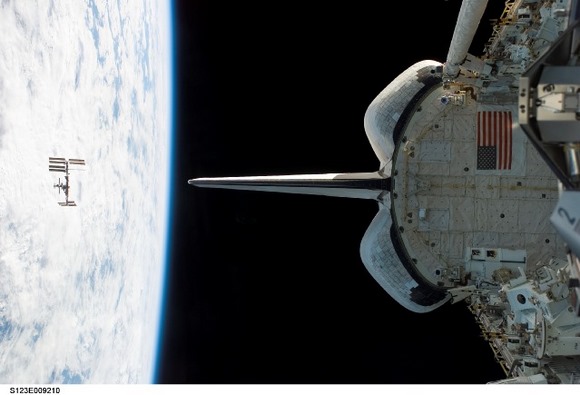
Shuttle and ISS

Shuttle Separates from the Station.  Image Credit:  NASA

Monday, March 24, 2008

Data Visualization for US Politics

With the end of the primary season coming up this summer, I expect a resurgence of the talk about "red and blue states" that dominated the 2004 election as we approach the direct engagement of the Republican and Democratic parties. This morning, I stumbled on a great site by Michael Gastner, Cosma Shalizi, and Mark Newman from the University of Michigan that uses very nice cartographic representations of the last election results to better visualize the electorate.

Popular publications such as USA today published many maps of this sort showing the winner's party by county.


But this graphical representation fails to take into account either the population density, electoral votes by county, or how close the vote was. If you process the map topology and scale each county to represent electoral votes, and color the vote results as a continuous scale from red to blue with even results represented as a mixed color of purple, the result is much more interesting.


Rather than the stark red/blue divide of the trivial map above, a more representative view of our nation deemphasizes sparsely-populated geographies with little economic impact and highlights those regions driving tomorrow's economy. We also look like a much more homogeneous purple nation in this view.

Interestingly enough, in the economic-political view, the most politically homogeneous regions are the blue counties where economic development is the strongest.

Check out the whole site here.

Time-Lapse Video of Retreating Glacier

For all you climate change skeptics, check out this time-lapse video of the Columbia glacier near Valdez Alaska from National Geographic (click through for full res version.)


From the Nat Geo page:
This remarkable image sequence captures a series of massive calving events at Columbia Glacier near Valdez, Alaska. Composed of 436 frames taken between May and September of 2007, it shows the glacier rapidly retreating by about half a mile (1.6 kilometers), a volume loss of some 0.4 cubic miles (1.67 cubic kilometers) of ice or 400 billion gallons (1.5 trillion liters) of water.

The time-lapse was taken as part of the ongoing Extreme Ice Survey (EIS), an ambitious project to capture global warming-induced glacial retreat in the act. Beginning in December 2006, photographer James Balog and his colleagues set up 26 solar-powered cameras at glaciers in Greenland, Iceland, Alaska, the Alps, and the Rocky Mountains. Each unit will take a photograph every daylight hour until fall 2009.

In 2008, Balog's team began to return to each of the camera sites to collect images. In the end, they will have more than 300,000 images to analyze and stitch together to produce more dramatic videos like this one.

This kind of multiyear effort, says Balog, is necessary to "radically alter public perception of the global warming issue."

Aurora from ISS

The image “http://static.reuters.com/resources/pictures/galleries/Stories/633308185815625000/Previews/032103.jpg?rpc=64” cannot be displayed, because it contains errors.
While docked and onboard the International Space Station, a STS-123 Endeavour crew member captures the glowing green beauty of the Aurora Borealis March 21, 2008. Looking northward across the Gulf of Alaska, over a low pressure area (cloud vortex), the aurora brightens the night sky. This image was taken on March 21, 2008 at 09:08:46 GMT, credit-Reuters.

Sunday, March 23, 2008

Most Children Left Behind

Just last week, I had a chance to hear a presentation by Alfie Kohn, one of the more (in)famous progressive education proponents, on the perils of emphasizing achievement and performance over engagement in a subject. Besides being an enthusiastic and engaging speaker, Alfie made a number of great points that really resonated with me regarding the damage a national obsession with standardized testing and assessment has wreaked on the quality of education at large. (We coincidentally follow most of Kohn's recommendations in how we operate the WISE labs and programs...)

His central point on this topic was that by focusing so much school and parental attention on HOW students are doing instead of on WHAT they are doing and WHY, the very effort assessment has a now reasonably well proven effect of focusing the student's attention on external validation from teachers and grades instead of on the actual subjects under study. The result, according to the many cited research articles, is that students lose intrinsic motivation and interest in the very subjects around which we really hope to instill a lifelong love of learning. It didn't take much effort to extend the notions not only to grades and class rank, but even further to parenting techniques and practices as well.

And of course, the "No Child Left Behind" legislation, already the whipping boy of education Illuminati nationwide, took a severe beating in the process. One of my favorite moments in his talk was when he impersonated our current President and Senator Ted Kennedy complete with accents in their "misguided support in passing the law." It didn't take much looking around online to find pretty strong independent evidence in support of what Mr Kohn has been saying for years on this topic. My favorite articles came from Rice University and the NY Times.

The Rice/UT study was particularly sobering, not just for its striking revelations surrounding the duplicity of the Texas public school system's reporting, but because it was this very public school system's approach that was used to promote and establish the model for the national NCLB legislation. In the study entitled "Avoidable Losses: High Stakes Accountability and the Dropout Crisis" McNeil, Coppola, and Radigan of Rice University basically stripped the clothes right off the emperor.

Until recently, the GOP held out the "Texas Miracle" program as a model for national education reform with improving scores and an astonishingly low dropout rate of less than 3%. According to this paper, however, when researchers actually investigated how many high school students actually graduated within 5 years (not even the hoped for four-year tenure) the answer was a horrifyingly low 33%. Yes, 33%. I'll say it again, because I didn't believe it the first two times I read it either. Fewer than 33% percent of entering public high school students in Texas graduate within 5 years.

Needless to say, this doesn't quite match up with the public accounting of dropout rates the state has been touting for the last few years. When challenged, the state sheepishly admitted,

"The discrepancy between the official dropout rates, in the 2 to 3 percent range, and the actual rates can be attributed to the state's method of counting, which does not include students who drop out of school for reasons such as pregnancy or incarceration or declare intent to take the GED sometime in the future."
Duh. As if they didn't know that their purposefully and carefully chosen metric diverged so widely from the stated goals of the program. "Oh. You mean you want us to count ALL the dropouts?" And the real results?

"A new study by researchers at Rice University and the University of Texas-Austin finds that Texas' public school accountability system, the model for the national No Child Left Behind Act (NCLB), directly contributes to lower graduation rates. Each year Texas public high schools lose at least 135,000 youth prior to graduation -- a disproportionate number of whom are African-American, Latino and English-as-a-second-language (ESL) students.

By analyzing data from more than 271,000 students, the study found that 60 percent of African-American students, 75 percent of Latino students and 80 percent of ESL students did not graduate within five years. The researchers found an overall graduation rate of only 33 percent.

"High-stakes, test-based accountability doesn't lead to school improvement or equitable educational possibilities," said Linda McSpadden McNeil, director of the Center for Education at Rice University. "It leads to avoidable losses of students. Inherently the system creates a dilemma for principals: comply or educate. Unfortunately we found that compliance means losing students."

In the effort to improve scores, MOST children, 67% of them in fact, are being left behind. My personal belief has been for years that we KNOW there is a problem already, and more testing will not fix the problem. Further, it won't even tell us anything we don't already know. In reality, the effect is even more damaging than I could have possibly imagined.

This was exactly one of the key points Mr. Kohn was making writ large across an entire state with unforgivable effects on the lives of millions of children across the nation, particularly impacting minorities. Don't take my word for it, and don't think I have even begun to cover all the deleterious effects of the assessment obsession that Kohn describes with heartrending insight. Read the whole report here.

If all of the references on Alfie Kohn's site and the Rice/UT report weren't enough to really depress you, or if maybe the paper was a little too academic for you, check out last week's article from the NY Times entitled, "State's Data Obscure How Few Finish High School." It basically exposes more of the same sort of accounting fraud. Here is the acompanying graphic from the article.

Graduation Discrepancies

This educational assessment disaster is yet another very good reason to strongly consider replacing the current republican administration so that we might quickly halt the spread of this cancer that is strangling our nation's future.

Even more importantly, don't be fooled that the testing is good for your own kids, much less for the minority kids down the street.

Friday, March 07, 2008

Live 3D Graphics With Excel

Every time I get a chance to watch one of our finance folks over at MobiTV wield a spreadsheet, I learn some new tricks. Those financial analysis folks steeped in the arcane features of Excel seem to be able to make the software package produce ever more astounding and useful models of increasingly complex systems.

But this one takes the cake. Check out this really cool implementation of a 3D graphics rendering engine. IN EXCEL! Peter Rakos over at Gamasutra outdid himself.


This image and video pair shows the rendering system using a simple display that colors the native Excel spreadsheet cells as the calculations are being performed.


This image and video pair shows the same program using the Microsoft Office Graphics Abstraction Layer to do the rendering instead of using writes to the spreadsheet cell.


Even better, some of the spatial layout and cell computation models of spreadsheets turn out to be very useful in designing and presenting very compact and elegant representations of the rendering pipeline. This design and layout in the 2-D spreadsheet grid is massively easier to see and understand than all the simple linear text files that I coded up in my college graphics course. It also makes the interrelationships and cell/function dependencies immediately obvious, and debugging is trivial with live previews of the calculations while the program is running. High cool.


"The yellow color marks the user-defined parameters and green color indicates the engine-calculated values. Numbered areas contain the following data:

  1. Parameters of the perspective projection
  2. 3D coordinates of the objects' points (relative to their center)
  3. Shift and rotation matrix (further details can be found e.g. at http://en.wikipedia.org/wiki/3D_projection)
  4. Parameters of the rotation
  5. 3D absolute coordinates of the points after the shift and rotation
  6. 2D coordinates of the points after the perspective projection
  7. Screen coordinates of the points
  8. End points of the objects' edges
  9. Formula of an element in the shift and rotation matrix. Simplicity and compactness are clearly visible."


    Now I don't think anyone currently expects this to evolve into a real 3D simulation system, but it does point to some very interesting 2D layout programming paradigms that might very well turn out to be VERY useful in developing more complex software. It wouldn't surprise me if the professional code development environments evolve towards this sort of thing within the next few years. And of course, 3D environments are just a step away.

    And I have a whole new animation tool for my next presentation!

    Check out the whole post here.

    Wednesday, March 05, 2008

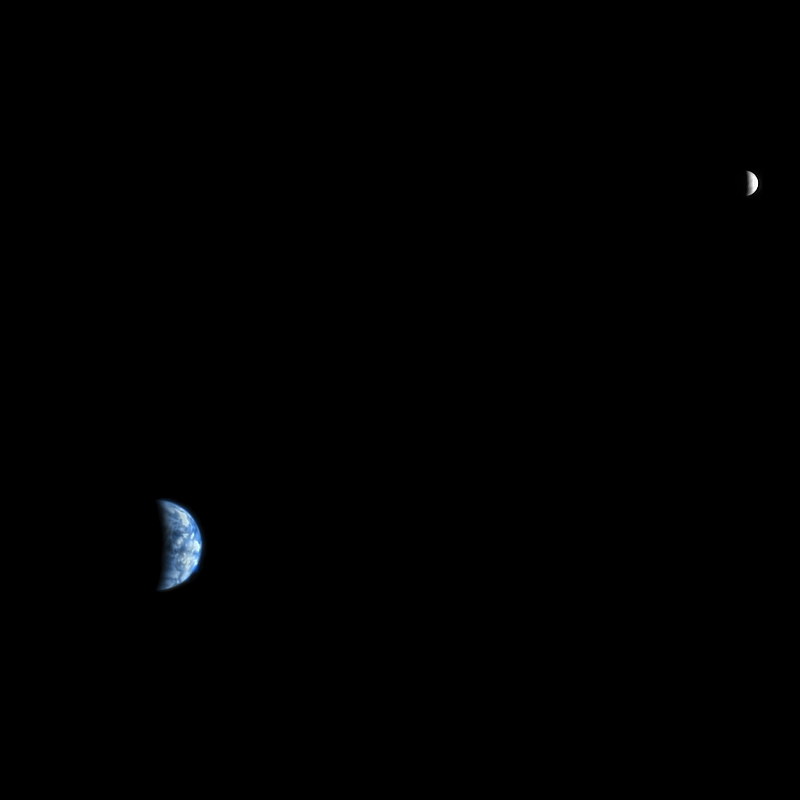
    Earth As Seen From Mars

    Saturday, March 01, 2008

    The Last Twelve Lunar Eclipses

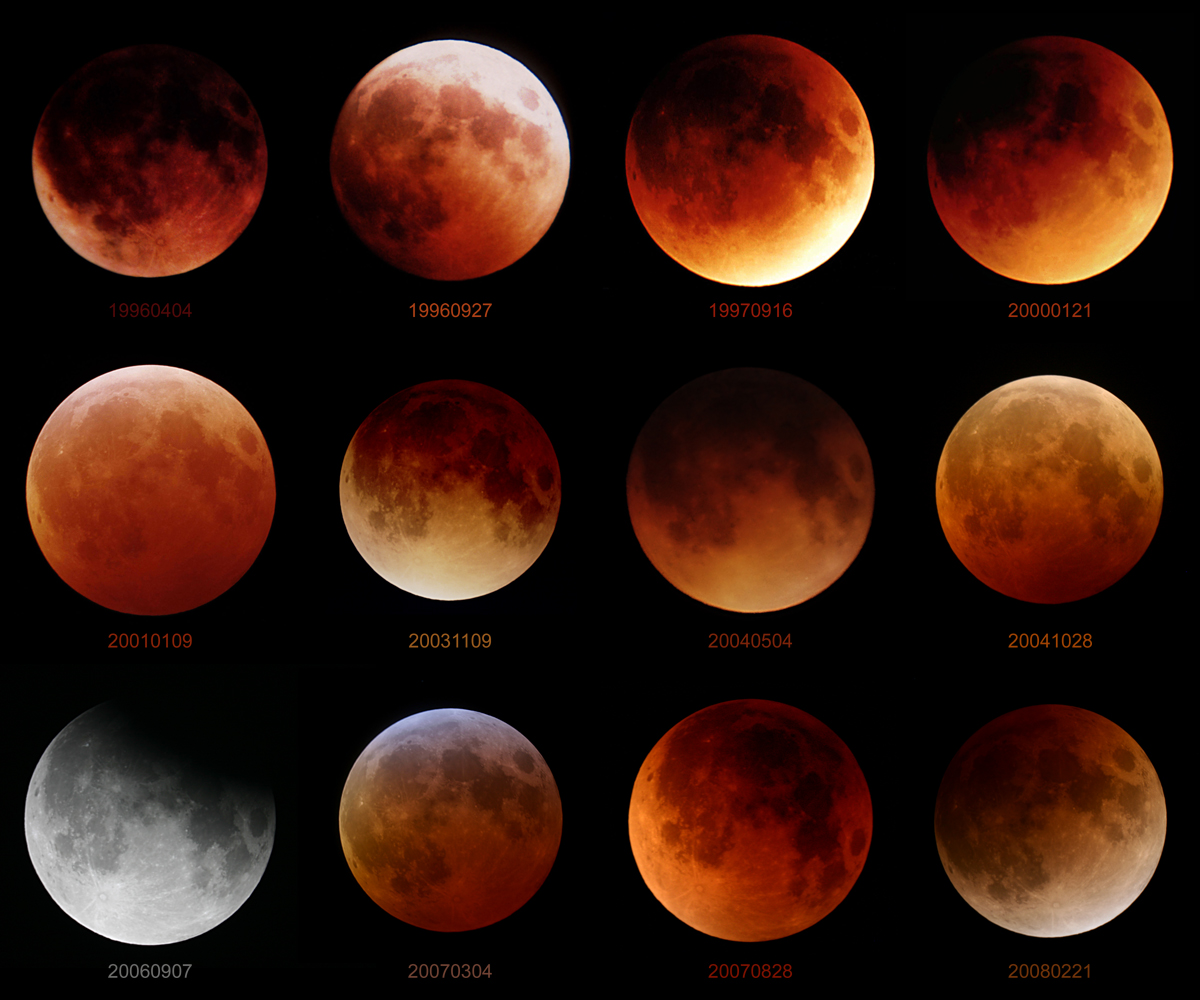
    Here's a nice montage of the 12 most recent Lunar eclipses from APOD. Click on the image for a higher-res version.
    See Explanation.  Clicking on the picture will download  an mpeg movie file.

    Twelve Lunar Eclipses
    Credit Tunç Tezel (TWAN)

    Explanation: Welcome to the extra day in the Gregorian Calendar's leap year 2008! To celebrate, consider this grid of lunar eclipse pictures - starting in leap year 1996 and ending with February's eclipse - with the date in numerical year/month/day format beneath each image. Mostly based on visibility from a site in Turkey, the 3x4 matrix includes 11 of the 13 total lunar eclipses during that period, and fills out the grid with the partial lunar eclipse of September 2006. Still, as the pictures are at the same scale, they illustrate a noticeable variation in the apparent size of the eclipsed Moon caused by the real change in Earth-Moon distance around the Moon's elliptical orbit. The total phases are also seen to differ in color and darkness. Those effects are due to changes in cloud cover and dust content in the atmosphere reddening and refracting sunlight into Earth's shadow. Of course, the next chance to add a total lunar eclipse to this grid will come at the very end of the decade.


    For another nice series of images highlighting the Moon's libration (wobble and variation in orbit ) see my related post entitled "Our Constant Moon?"

    Friday, February 29, 2008

    Abstinence-only Driver's Ed

    Don't miss reading this link at McSweeny's. Hilarious.

    Tuesday, February 26, 2008

    We Are What We Drink

    Cerling and Ehleringer over at the University of Utah just published a paper in the online journal "Proceedings of the National Academy of Sciences" describing their new forensic technique, which uses Hydrogen and Oxygen isotope concentrations from local water tables in your hair to determine where you have spend your time.


    The two maps here show predicted average hydrogen (top) and oxygen (bottom) isotope levels in human hair across the continental United States -- isotopes that vary with geography because of different isotope levels in local drinking water. The ratios of heavy, rare hydrogen-2 to lighter, common hydrogen -1 are highest in red and orange areas in the top map, and lowest in the blue and darker green areas. The ratios of heavy, rare oxygen-18 to lighter, common oxygen-16 are highest in red and orange areas of the bottom map, and lowest in the blue and darker green areas. Credit: University of Utah

    “You can tell the difference between Utah and Texas,” Ehleringer says. But, Cerling adds, “You may not be able to distinguish between Chicago and Kansas City.”

    So in case you're considering a life of crime, you might want to
    1. Consider a new bald or buzz-cut look so the encoded travel history you carry along with you is limited.

    2. Drink only bottled water

    3. Shelve any green tendencies and eat at only imported meat and produce.

    Wednesday, February 20, 2008

    Lunar Eclipse Tonight

    Don't miss tonight's Lunar Eclipse. Otherwise you'll have to wait at least three more years to see another one.

    Eclipse Diagram

    More details at NASA.

    Sunday, February 17, 2008

    Aqua Forest Aquariums in SF

    If you happen to live in the area, and have the slightest interest in fresh-water aquaria, don't miss this amazing store in San Francisco.


    http://www.adana-usa.com/images/gallery03/18.jpg


    http://www.adana-usa.com/images/gallery03/11.jpg

    Read my whole review of the field and the store complete with more images at the WISE student blog where we're helping schools learn how to set up these incredible balanced micro-ecosystems.

    New WISE Web Site Launched

    Hi all,


    We just launched the new web site for the Westminster Institute for Science Education [W.I.S.E.]. Click on the logo below to check it out, including the links to the student and teacher blogs. Comments and suggestions welcome!


    Oh yes, and for any of you wealthy philanthropists or corporate titans with a hankering to invest in nationwide science, math, or technology education reform, donations are encouraged! Just email or message me, or post a comment here on "All the Best Bits."

    How Grandma Sees the Remote

    fixfix_2.jpeg

    via Gizmodo.

    Thursday, February 07, 2008

    "Teach Like Your Hair's On Fire" Book Review

    If any of you need just the littlest bit of inspiration in your roles as teachers, mentors, or students or perhaps if you are a parent looking for that perfect school for your kids, I can strongly recommend Rafe Esquith's book entitled "Teach Like Your Hair is On Fire."

    Teach Like Your Hair's on Fire

    Even halfway through the book, I found myself wishing I could get my daughters into a class like Room 56 at Hobart Elementary. Several chapters actually choked me up a little and seriously redoubled my motivations to make WISE a success. And the stories went on, and on, and on, and on to the point where it seemed almost impossible that so many incredibly cool things could be happening in one class under a single teacher. By the time I was finished with the quick read I realized that it is a passing rare teacher that can give so much of themselves to their students.

    Esquith demonstrates an almost pathological level of commitment to his students. But a couple of other critical traits show through the anecdotes. Esquith has an innate sense of very high standards across a very broad range of disciplines, coupled with both humility and initiative that in combination are more rare than hen's teeth. His humility reveals itself with a wry self-awareness and a willingness to critically evaluate where his skills and efforts fall short of his exceptional standards. The initiative comes into play when he realizes his failings and takes steps to find true experts and recruit them to support his cause. All of that combined with a work ethic most Protestants would find over-the-top makes for a magical classroom experience and students who regularly return after decades.

    After succumbing to my recommendation, me wannabe-teacher wife's major comment was, "I'm not sure I could give that much to my students. How would my own kids feel when so abandoned? That said, she read the book over a single night, and came away with the feeling "I would TOTALLY have LOVED that in 5th grade." An excellent read indeed. I wonder if there is any way to get seats for the play.

    From the book's back cover:
    “Rafe Esquith is my only hero.”
    —Sir Ian McKellan

    “Politicians, burbling over how to educate the underclass, would do well to stop by Rafe Esquith’s fifth grade class as it mounts its annual Shakespeare play. Sound like a grind? Listen to the peals of laughter bouncing off the classroom walls.”
    —Time

    “Esquith is a modern-day Thoreau, preaching the value of good work, honest self-reflection, and the courage to go one’s own way.”
    —Newsday

    Get it here on Amazon.

    Tuesday, February 05, 2008

    Dean Kamen's Prosthetic "Luke" Arm

    What a technical home run. If you need any more motivation to engage in cool robotics projects, just check out the reaction when the test subject figures out he can feed himself for the first time in 26 years. That's social impact. From the IEEE Spectrum site.


    Do Your Civic Duty

    Decisions are made by those who show up. So go and cast your vote without delay. Our country's future depends on you.


    Uncle%20Sam%20Wants%20You.jpg

    And as long as you are planning to vote, I'd like to put in a plug for the candidates who support those areas of science, technology, and education that will form the foundation of our future economy.

    If you are in any doubt as to which candidates are looking towards the future, just visit these links that the American Association for the Advancement of Science has established to review the science and technology policies of each of the leading candidates.
    Without making any specific plugs, let's just say that the Republican party has not been kind to science in the last eight years, and it would be good for this country to realize significant revitalization in those areas. Vote for science and our future!