Sunday, August 13, 2006

Very Cool Solar Images

Well, hot ones, anyway, from the TRACE (Transition Region and Coronal Explorer) instruments. You can actually even build a scale model of the spacecraft directly from these plans!

http://trace.lmsal.com/POD/images/FDM_1500_3EUV_19990730.jpg

This one shows the sun at 171 Angstroms


The image “http://trace.lmsal.com/POD/movies/LASCO20011001.gif” cannot be displayed, because it contains errors.
Coronal Mass Ejections

The Sun's Magnetic Heartbeat (1)The Sun's Magnetic Heartbeat (2)

A composite of the Optical (red/orange) and Magnetic Maps of the sun with each image taken roughly one year apart showing the roughly 11-year cycle from one period of maximum solar activity to the next.


Looking through the Sun's Atmosphere
Looking through the sun's atmosphere:

The Sun's magnetic field connects the different domains in its atmosphere. The bottom panel in this composite shows the visible surface, at about 10,000º F, with dark sunspots where the field is strong and coherent, and faint bright kernels where the field is about half as strong and broken up. Around them the seething motions of the convection form tiny cells (about the size of Texas) called granules.

The second image shows the emission from the chromosphere, some 4,000 miles above the surface. It has a temperature of approximately 18,000º F. The sunspots remain dark, but the smaller magnetic concentrations now emit much more brightly in the light of ionized calcium ions (Ca II K).

The third image shows the Sun in light of neutral hydrogen gas. Because hydrogen is the most abundant element in the Sun, its atoms contribute over a larger range of heights than images taken in the light of other elements at a comparable temperature. It is for that reason that the image reveals segments of the magnetic field with a three-dimensional character, rather than appearing as a thin slice through a fixed level in the atmosphere. Here the fields can be seen to lean away from the strong field in the sunspot in the center.

The top image shows the corona, with emission from gas at a million degrees. The atmosphere is completely transparent at these wavelengths, so we see the field at a range of heights, thus revealing fans and curtains of emission from hot, ionized captured within the magnetic field.

Images: Swedish Solar Observatory on La Palma, Spain (lower three), and with the Transition Region and Coronal Explorer (top).

The dynamic solar outer Atmosphere.The dynamic solar outer Atmosphere.The dynamic solar outer Atmosphere.

The Dynamic Outer Atmosphere of the Sun.

Nothing is static on the Sun, least of all the corona. These three images of a magnetically active region seen at the edge of the Sun, span only two and a half hours, yet look completely different. Each of the loop-like structures, outlining the magnetic field by the glowing of million-degree gas, changes in position, in density, and in temperature, resulting in a beautiful yet extremely complex atmosphere.

Image: Transition Region and Coronal Explorer (in light of ionized iron; Fe IX/X).


The Solar Surface and Below

This high-resolution image reveals the multitude of convective cells, each about the size of Texas, that cover most of the solar surface. In these cells, hot, buoyant gas from the interior rises to the surface where it expands and cools. The cooler, denser gas slides towards the edges and eventually sinks down in the cooler, darker, network of the lanes. The pattern of convection changes wherever there is strong magnetic field. Where the magnetic field is concentrated in fairly strong, but relatively small clusters, we see it reside in the dark lanes, the downdraft regions of the convection. Many of these clusters of magnetic field form bright specks.


Inset: Computer simulations not only manage to recreate the surface appearance of the Sun, they also show us what probably happens below the surface. The sides and the reflection of the bottom of the computed cube show the patterns in the convection down to a few hundred miles below the surface. Gradually, the cellular network that we see at the surface is replaced by narrow, turbulent downdrafts embedded in slow, broad flows where relatively warm gas wells up to the surface.


Image: Swedish Solar Observatory, La Palma, Spain; inset: Ake Nordlund, Nordita (Copenhagen).


Science Under Attack: Evolution

If you weren't already depressed about the recent ideological attacks on Science, check out this table from an article by Miller JD, Scott EC, Okamoto S (2006) Public acceptance of evolution. Science 313:765-766.


This is a compilation of international survey results regarding people's attitude toward evolution. As you may have noticed, we barely edged out Turkey to stay out of last place.

As reported on the Pharyngula blog: "

There was more to this study than just asking whether a person agreed with the statement that "Human beings, as we know them, developed from earlier species of animals." They also collected other data on age, gender, education, genetic literacy, religious belief, attitude toward life, attitude toward science and technology, belief in science and technology, reservations about science and technology, and political ideology, and carried out a statistical analysis to determine the relative contribution of these variables to ignorance about evolution." I don't think anyone will be surprised at the number one reason cited in the report.

"The total effect of fundamentalist religious beliefs on attitude toward evolution (using a standardized metric) was nearly twice as much in the United States as in the nine European countries (path coefficients of -0.42 and -0.24, respectively), which indicates that individuals who hold a strong belief in a personal God and who pray frequently were significantly less likely to view evolution as probably or definitely true than adults with less conservative religious views."
This is consistent with the results of the following: "Seventy percent of evangelical Christians believe that living things have always existed in their current form, compared with 32% of mainline Protestants and 31% of Catholics, according to the Pew Research Center for the People and the Press."

Reason number 2?
"Second, the evolution issue has been politicized and incorporated into the current partisan division in the United States in a manner never seen in Europe or Japan. In the second half of the 20th century, the conservative wing of the Republican Party has adopted creationism as a part of a platform designed to consolidate their support in southern and Midwestern states—the "red" states. In the 1990s, the state Republican platforms in seven states included explicit demands for the teaching of "creation science". There is no major political party in Europe or Japan that uses opposition to evolution as a part of its political platform."
Thankfully, there is hope, as one result of the survey showed that even minimal educational efforts have a strong impact. But we clearly have a lot of work to do.

"It appears that many of these adults have adopted a human exceptionalism perspective. Elements of this perspective can be seen in the way that many adults try to integrate modern genetics into their understanding of life. For example, only a third of American adults agree that more than half of human genes are identical to those of mice and only 38% of adults recognize that humans have more than half of their genes in common with chimpanzees. In other studies, fewer than half of American adults can provide a minimal definition of DNA. Thus, it is not surprising that nearly half of the respondents in 2005 were not sure about the proportion of human genes that overlap with mice or chimpanzees."
The final note in the study, though, is a rather depressing one that mirrors my earlier post on "Political Science."

"The politicization of science in the name of religion and political partisanship is not new to the United States, but transformation of traditional geographically and economically based political parties into religiously oriented ideological coalitions marks the beginning of a new era for science policy. The broad public acceptance of the benefits of science and technology in the second half of the 20th century allowed science to develop a nonpartisan identification that largely protected it from overt partisanship. That era appears to have closed."


So let's get out there and educate. Fight the ignorance!

How Blood Vessels Form in Embryos

"Developmental biology: The hole picture"

What's the best way to make a tube? Roll up a sheet? Hollow out a solid rod? Some innovative movies show how the problem is tackled during the development of blood vessels in embryos. Check out this incredibly cool movie from the journal Nature's web site that actually shows the formation of blood vessel structures from the merging of bubbles.

Keith Mostov and Fernando Martin-Belmonte are the authors of the article from the July 27th 2006 Issue of Nature on page 363.

Digital Photography Bodes Ill for "News"

I've always been a little skeptical about the sensationalism and obvious bias in much of the news these days, but I was rather surprised to come across several reports of photo manipulation of several images that had caught my eye in the New York Times, Newsweek, and Times over the last few weeks. Here is a site that compiles several of the recent Reuters photo frauds in Lebanon over the last couple of weeks. I suspect that this sort of thing is hardly unique to the Middle East, but sheesh. You can't even believe your eyes anymore. Digital editing, retouching, misleading captions, and staged photos all abound and seem to appear as NEWS in accredited sources generally held as reliable in the US.

Here is but one example from the site. Many of you may have seen the following photo either online or in the paper. It's pretty dramatic stuff, pulling bodies from the rubble and all. It certainly caught my attention when I was perusing the paper the other morning.


Well, check out the following photo from the same roll of film:


Recognize the guy in cap and cammie shorts? Pretty hale and hearty for the "corpse" they pulled from the rubble.

Mosquito Magnets?

Whenever assaulted by that annoying high-pitch whine of a mosquito fly-by, I've recently taken to gesturing vaguely towards my wife and whispering to the orbiting insect, "..pst...hey buddy, she's tastier." I meant it as a joke, but as it happens, my wife might really be tastier to a mosquito. According to this article on WebMD, one in 10 people are "highly attractive to mosquitoes." The chemical attractants include high concentrations of either steroids or cholesterol or uric or lactic acid on the skin. (and that is after being drawn from over 50 meters away by carbon dioxide and motion.

I think I'll make sure to take my wife along on my next backpacking or canoeing trip!

Friday, August 11, 2006

My Favorite Televisions: Part 1

After having started MicroDisplay a few years back, every now and then, someone asks we which television they should buy. Assuming you can convince your SO to tolerate some new living room accessories, now is actually an excellent time to be thinking about investing in a large number of new pixels. The prices are actually starting to become reasonable for some serious high-quality screen acreage.

There is a new wave of televisions arriving on the market supporting the latest high-definition "standard" DVD players coming out. The nice thing about standards today is that there are so many of them to choose from, what with Blue-Ray and HD-DVDs and all.

As far as the television sets go, if you happen to wander into a Fry's or Magnolia Hi-Fi (The Best Buys and Circuit Cities of the world tend to stock the lower-end mass-market models) and ask for one of the better sets, the average commission-seeking sales associate will probably steer you towards one of the new 1080P sets. This means that the set supports the highest-resolution progressive (not interlaced) video modes being output by the new DVD gear, and hopefully by some of the forthcoming cable and satellite boxes (but don't hold your breath on those.) I've seen two that I really liked, and a few that didn't impress me.

The first unit that actually made me stop in my tracks as I was walking by, was the new 56 inch Samsung DLP rear-projection unit (HL-S5688W). It was being driven by a demo Blue-Ray DVD running in the Samsung player in the back of the Concord, CA Fry's Electronics. This was easily one of the best consumer televisions I had every seen, and the price was just over $3,000. The only flaws I could point out were issues intrinsic to all rear-projection televisions:

a.) The screen gain was still a little high, meaning that the rear-projection screen was designed to focus the light from the projection optics to those areas from which a viewer was most likely to be watching to the point that the extent of the acceptable viewing angle was narrower than I would like in my living room, and as a result, the image characterstics still change notably as you walk across the room.

b.) As with most rear-projection systems, it's great in a dark room, but when the lights come up for any reason, you get a lot of reflected ambient light on the screen, which significantly lowers the contrast and apparent brightness of the image.

But note that these flaws are only really noticeable by someone who has literally spent years looking for even the minutest flaws in displays with serious analytical optics, and the TV is one of the best available for any price despite these issues.

I ALMOST purchased the unit right then and there. I then discovered that Samsung's new line of 1080P LCD screens was scheduled to reach the stores in a couple of weeks and decided to see what they would do without the rear-projection limitations. Given that their 1080i LCDs already looked pretty damn good (brighter and with better color saturation, in fact, than Plazmas now) I had rather high hopes.

Much to my surprise, when I returned to the store to compare the new Samsung 1080P LCD with the older 1080i set, which thankfully were sitting right next to each other, the older one looked MUCH better from normal viewing distances of 10-15 feet when viewing either HD or SD video via Echostar . Even after spending over half an hour fiddling with their respective color, contrast and brightness settings, it was clear that while the newer one did have very slightly better resolution (almost impossible to distinguish), the newer 1080P set had only about 70% of the other's peak brightness, and under the normal ambient illumination of the showroom floor, that made all the difference in the perceived image quality color saturation and whatnot. Interested in the odd reduction in key image metrics, I wandered to another aisle and picked up a loupe magnifier and went back to look at the screen architecture under about 50x magnification. As I suspected, when you look REALLY closely, it becomes apparent that to fit so many more pixels into the same area, each pixel was much smaller. And since there is a fixed minimum line with the manufacturing processes can print the pixel electronics and color gel filters, the fill-factor, or ratio of transmissive area to total area is much lower. Hence the drastically lower brightness. But there was no really good apparent reason for the worse (higher black levels.)

The bottom line is that there is just no motivation whatsoever to pay the extra $800 for a worse image under those source and environmental constraints. While it is true, that the real beauty should be revealed in the newer set when driven by a true 1080P source, like Blue Ray or HD-DVD, there is precious little content out there today in the new formats. So no purchase after all, with the DLP unit still standing as my favorite.

Pioneer Elite PureVision PRO-FHD1Then I saw the new Pioneer Plasma display in the Emeryville Magnolia Hi Fi. All I can say is WOW. Absolutely flawless. This is really the best consumer television I have ever seen. Even the scalar from SD wasn't bad. And it won a Best of CES award. I was thinking, "finally, an HD set that can unseat my current heavyweight champion." ( A 37" Sony XBR CRT behemoth that ways about 400 pounds and takes four people to move.) I was ready to whip out my check book until I noticed the price, a whopping $10k. Ouch. Maybe when Mobi goes public. (knock on wood.)

So far, the Pioneer Plasma is the one. With budgetary or wifely constraints, go with the DLP. A friend of mine from Mobi recently purchased the Samsung and is ecstatic with the set, though he tells me his wife occasionally complains that the unit is too bright. Sigh.

Thursday, August 03, 2006

Thoughts on "Self Defense"

An intro with an admitted Judo bias.

Several folks at work recently expressed some interest in taking a self defense class. I have to admit that the idea of teaching such a class definitely increased my pulse rate a bit. You see, I’ve noticed several withdrawal symptoms lately (though I bet my wife has noticed a few more). You know the typical sort of thing that comes up: I get to be a little twitchy late in the day, I always fiddle with a pen or marker, and the path to irritation is a little quicker than normal. Oh yes, and let’s not forget the extra spare tire that has gained a little too much ground over the last couple of years since the little ones arrived. My favorite local Aikido Dojo has class hours which I just can’t make on a regular basis, so what the heck … I guess I’ll teach a class myself and perhaps regain a little personal fitness in the process.

It’s a little ironic, really, because historically I’ve tended to scoff at these “Six Week Women’s Self Defense” sort of classes as being good for little more than instilling a false sense of overconfidence that can breed more trouble than it resolves. But upon reflection, with the right focus and philosophical underpinnings, a well-run class could serve as an introduction to the short, medium, and long-term benefits that can accrue (and the personal commitment, investment, and sacrifices that must underpin such gains) from even an introductory study of your own body and its relation to other people.

If you are looking for a class to help you open bigger cans of whoop-ass on people, this isn’t the one for you. This is a class about understanding what your mind and body can do today, understanding what other people’s bodies can do, how you interact with them, and how you can learn with time, dedication, and practice to master those interactions.

It is worth noting at this point that different schools of martial arts espouse a broad range of philosophies and methods to address threat, intimidation, or attack, but in each case, the philosophies and practices can be applied quite successfully across an unlimited range of situations and circumstances. The learning, balance, and timing skills acquired can be applied to learning any other sport or dance. The falling techniques can protect you whether you have been tripped by an attacker, or launch yourself off of a gnarly half-pipe, or even when hit by a car, as I have been. The techniques, tactics, and strategies surrounding how to prepare for, receive, deflect, and redirect attacks, or execute effective attacks of your own extend to verbal, social, and even business situations. The experience in pushing your body’s limits in practice and competition will help you achieve greater success in any future athletics. The philosophies and discipline that can accrue through long-term study and practice will help you in achieving any future goal.

As far as different martial philosophies go, at the highest level, I would classify them in three broad categories:

  • “Weapon” styles including fire-arms, knives, and sticks,
  • “Hard”styles such as boxing, Karate, and Tae-kwan-do that rely on strikes and kicks to do damage and incapacitate, and
  • “Soft”styles such as Judo, Ju-Jitsu, wrestling, and Aikido that rely on throws, holds, joint-locks and chokes to control an opponent without necessarily injuring them.

It is worth noting here that there are a couple of very big caveats around the necessarily part. Caveat one, is that even the introductory techniques can seriously injure anyone who has not had any training on how to fall without hitting their head, or how to submit to avoid having their elbow dislocated. (so don’t just run home and try these on your roommate, friends, or SOs)

Caveat two is that most beginners, and even intermediate practitioners, of any particular “soft” martial arts are typically only exposed to the watered-down sport-oriented aspects of many of these techniques. In Judo, for example, I have met many second-Dan black-belt holders who have never really studied anything beyond the sport competition techniques of what is a much broader martial art. (Note that earning a second-degree black belt can take the better part of 10-12 years of 3 times-per-week practice.) Part of the thinking is that only when a Judoka has achieved an appropriate skill level and control of their body, can they safely (for their partners) learn and practice these techniques, and only after acquiring sufficient mental discipline and self-control, can a judoka be trusted to NOT employ these techniques in rage or revenge, and use them only when someone’s life is truly threatened and there is no alternative. In the case of Judo, for example, it turns out that upon achieving an appropriate skill level with the right instructor, one can be guided to subtle variations of the techniques already learned and practiced over the years that change a controlling technique into a lethal one. (i.e. instead of controlling their fall to have them land with force on their back, most likely knocking the wind out of them, or have them land on their head to snap their neck vertebrae.)

If you haven’t figured it out by now, I favor the soft styles, Judo in particular. I find them more subtle, and difficult, but when mastered, more powerful and versatile. In particular, I find the softer styles more applicable throughout the complete range of possible interpersonal interactions from casual conversation all the way through full-blown bar fights, whereas it’s hard to execute a solid Karate technique to good effect without pissing someone off. The ability to use soft styles and have people not even notice is pretty amazing. The final aspect of the soft styles I love is that when mastered, they can become truly effortless. There is never an impact, or a feeling of force opposing force. It can actually look as if your opponent simply seemed to fall or fly through the air while you appeared to do very little at all. (But you did, in fact, do something very important at the very precise right time and in exactly the right direction.)

I have seen a 75-year-old Japanese man who weighed little more than 90 lbs and had advanced arthritis of the knees (his doctors didn’t even understand how he could walk) completely THRASH 20-year-old Olympic athletes, taking all comers for two hours straight, laughing and smiling the whole time, barely breaking a sweat. After studying Judo for 16 or so years, (the last three with this very incredible sensei, and competing internationally for three years), I managed to throw him ONCE. (I had to practice a particular counter-throw to his favorite technique for about six months outside of his dojo where he couldn’t see me practicing. What he did to me after that is another story… but it was worth it. ) I just checked up on him, and he is still practicing and teaching Judo today at 92 years of age.

This power is not about being faster or stronger or doing damage to people. It is about understanding and building that understanding into your body so that you can control yourself and someone else’s body without thought. Because if you have to think about what someone has done and what you should do about it, it is already too late. The thinking has to come in the learning and practice process, so that you become the fastest stimulus-response reflex possible. And it bears repeating that with control, there is no damage or hurt necessary. This, incidentally, is really the ONLY way a smaller or weaker opponent can consistently triumph over larger and stronger, and possibly even faster, opponents. For women or children looking to understand what it takes to protect themselves, I can’t think of a better option. (My 4-year-old daughter is already stoked to start Judo as soon as she turns five!)

That is what my self-defense class will be about.

Okay, that’s the philosophical mumbo jumbo part. If you have read this far, you are probably curious to know what, specifically, you will actually be doing in the class, and what you should expect to get out of it. (Many of you may have noted that my example of the acme in Judo achievement with the completely effortless technique had studied the art for more than 70 years by the time I found him.)

There are things that you will find to be almost immediately applicable, like techniques surrounding sensory awareness, standing, moving, balance, “ground” techniques, and falling, and there are techniques that will take over 30 years to master such as some of the hand throwing techniques that look so miraculous, and there is everything in between. The bottom line is that in martial arts there is really no shortcut; it just takes time and practice. You will get no more out of the study than what you put into it. People who have any experience in dance or gymnastics will find that many of the learning and balance skills acquired through those studies will place them ahead of others in the class.

Six weeks of effort will start you on the road to INTELLECTUALLY understanding some of the basic principles of awareness, basic mechanisms of movement and control, and what it might take to advance in skills. Each class will include rigorous stretching and strengthening exercises to help build a foundation for better balance and personal control, as well as begin the process of embedding some fundamental movements into muscle memory. Please keep in mind that this is a process that ultimately takes years. And while I have had a couple of students over the years use some of the “ground-work” techniques to avoid rape after only about 4 months of study, I don’t want to leave anyone with the impression that they will be able to take on a mugger after a six week intro class. So keep the self-confidence in check, and practice. Hopefully, if nothing else, you will soon learn to avoid the situations where muggers hang out, or maneuver your way out of such situations gracefully without conflict. And in the process, you might get interested in the longer term commitments necessary to really managing the worst-case scenarios more effectively.

Discussions of fundamental principals surrounding movement, balance, timing, space, maximum efficiency with minimum effort, and strategies and tactics for conflict avoidance and management will include demonstrations and opportunities for individual and partnered practice.

Classes will slowly build in intensity as students become comfortable with the basics.

Sounds like fun to me!
Who else is interested?

-P

p.s. If there is enough interest, a more detailed syllabus will follow shortly....

Wednesday, July 26, 2006

Political "Science"

President Bush announced earlier this week that he is now preparing a "swift veto" of the new Stem Cell bill currently under debate in the senate. This decision flies rather boldly in the face of the President's recent statements including those made in his last State of the Union speech. Double-speak surrounding difficult policy issues has become troublingly commonplace when they touch on scientific results that call political and religious positions into question. None of my friends were able to correctly attribute the following quotation:

“Science, like any field of endeavor, relies on freedom of inquiry; and one of the hallmarks of that freedom is objectivity. Now more than ever, on issues ranging from climate change to AIDS research to genetic engineering to food additives, government relies on the impartial perspective of science for guidance.”

These words actually came out of the mouth of President George H.W. Bush in 1990 and are sadly about as for from the actual science policy of the current administration as anyone could possibly imagine. Despite recent initiatives to expand science and technology education, a more genuine quote representative of the current administration's actual position was heard recently from the Whitehouse Spokesman, Scott Maclellan:

“This administration looks at the facts, and reviews the best available science based on what's right for the American people”
This is a chilling reminder that though there is lip-service to expanding science and technology competitiveness, there is no true understanding of what constitutes real science, or how it should be applied in our society.


If you are inclined to listen to several of the most respected scientists in the US, a rather scary picture of consistently politicized decisions to neglect actual scientific results for "moral or religious" reasons emerges. But as my old grad school advisor at MIT, Tom Knight, used to say, "Scientific truth is what remains whether you believe in it or not." Were it to persist, the long term consequences to this nation of such negligent decision-making will be profound.


In the case of Stem cells, Dr. Shirley Tilghman and Dr. David Baltimore (Nobel price recipient) tell us that human reproductive cloning and therapeutic cloning to produce stem cells that might be used for research are completely different biological investigations and that a wholesale ban on cloning designed to stop efforts to produce the former would have dire consequences for important biological research on the latter in this country.


But the Bush administration fails to note the distinction, and moves forward with a blanket veto. The result is a massive wave of departure across the elite biology research community so that they may continue this leading avenue of investigation in other more rational countries. See here for other related resignations.


Combine this sort of lamentable policy work and its broad application across issues ranging from Global Warming, Aids and Condom use, Environmental Protection, and most importantly, financial support for key fundamental scientific research, and the result is a recipe for long-term economic ruin.


Let me close with a couple of my favorite quotes from the Union of Concerned Scientists' report. After all, how wrong could 5000 scientists, 48 Nobel Laureates, 62 National Medal of Science Winners, and 127 members of the National Academy of Sciences be?

"There is a well-established pattern of suppression and distortion of scientific findings by high-ranking Bush administration political appointees across numerous federal agencies. Those actions have consequences for human health, public safety, and community well-being."

"There is strong documentation of a wide-ranging effort to manipulate the government's scientific advisory system to prevent the appearance of advice that might run counter to the administration's political agenda."

"There is evidence that the administration often imposes restrictions on what the government scientists can say or write about "sensitive" topics"
Is anyone surprised that there was absolutely no response by the administration to this report or several follow ups? To really warm the cockles of your heart, check out the Union of Concerned Scientists web site.


For a truly bone-chilling collection of evidence to support these concerns, check out Lawrence Kraus' page. There's enough there to get anyone going even if you don't share his political leanings. This Powerpoint presentation on scientific integrity in the current administration will give you some of the flavor.


I just feel dirty right now.


Real Astronomy for the Masses

One of the real challenges of approaching the "hobby" of astronomy, is that in today's increasingly urban and light-polluted environment, the cost of equipment necessary to generate even a passable image of the type that you might find in say, Astronomy or Sky and Telescope Magazines, is typically beyond the financial reach of even a committed student.

A good precision optical instrument, a stable mount with precise tracking of the celestial sphere, and a decent CCD imaging setup plus the computer to drive it can run as much as a few thousand dollars. And of course we are all teased in the process by the glorious Hubble Telescope images afforded by a NASA-sized budget.

Well, I am here to report that there is hope for the intrepid who set their sights on the starts. Ahem. As with so many other things these days, the Internet is here to save us. There are now several VERY nice connected observatories, each of which has several high-end telescopes and imaging systems accessible and controllable via a simple web browser.

A picture of the Dome 3 telescopeMy favorite is the "Astronomy Bed and Breakfast" called New Mexico Skies. They combine friendly service with some of the darkest and clearest skies in North America and some fine instruments including a RCOS 20" Ritchey-Chretien scope. For the price of any old boring bed and breakfast, you can spend the day spelunking in Carlsbad Caverns and hiking in the White Sands national monument, and then pass the wee hours of the night playing with a fantastic set of toys.

I would encourage any interested student old enough to look up and say "wow" to go run and bug your parents, teachers, or significant others without rest until they relent and agree to take you there.

For those of you with underdeveloped wheedling skills fear not. The NMS folks run a facility where they host a fleet of net-connected scopes that can be purchased outright and run on a contract basis, or even rented on an hourly basis.


The proprietors conduct regular classes in almost every aspect of astronomy from introductory binocular tours to advanced imaging and astrometry. The kind of pictures even beginners can take are astounding. Here is one from John Setle's Web site of the Magnitude 8.4 Whirlpool Galaxy, M51 in Canes Venatici.

The Whirl Pool Galaxy M51 NGC 5194

Note that he took this image on his FIRST NIGHT! A little more practice with exposure control and a little work with filters and a PC for some Photoshop image processing and he will be capable of selling magazine-quality astronomical images. Check out his web site (towards the bottom of the above link), or Google "New Mexico Skies Images" and see what can be done there and remotely.

Here's one more picture of the same galaxy taken by a more experienced imager, Ron Wodaski, the author of a fantastic book entitled "The New CCD Astronomy."


And here's yet one more link to the amazing images attainable at NMS. A couple of other interesting similar services are Slooh, and The Harvard Smithsonian-sponsored Micro-observatories.

Now for the truly eager to learn, yet financially challenged, I recommend another course in parallel. Go out and find a local ATM club. No, not bank machine lovers. Amateur Telescope Makers. With absolutely no experience at all and a little bit of non-profit type guidance, it is possible to make your own telescope, mirror, mounting, and all. The raw materials are quite inexpensive compared to what a commercial scope of similar quality would cost. And while the labor, particularly on the mirror grinding, polishing, and figuring side, will add up, the learning experience is almost unparalleled. I have evolved to the opinion that no student should be allowed to graduate from high school without having made a telescope of their very own.

Here is a link to the telescope makers' club I have frequented here at the Chabot Space and Science Center in the Oakland California hills. I've personally seen, and in a couple of cases, helped 12 year-olds build fantastic instruments that they treasured for years and later passed down to other amateur astronomers. More on Amateur telescope making in future posts.

If you are doubtful about whether this particular affliction is your thing, check out a local Star Party. Google your town and "star party" to find the nearest shindig of eager amateures. You don't even really need to bring anything, but do read up on the etiquette before you show up, i.e. show up early while it is still light, take some steps to make your car lighting "night-vision friendly," don't bring white flashlights (tiny red LED lights are the rule), etc...

Clear Skies!

The Statistics of Worry

Or, "What should we REALLY be worrying about?"

A friend of mine from MobiTV was telling me about the growing stress levels in Haifa, were his sister and several relatives were freaking out getting increasingly worried about tens of thousands of rockets that Hezbollah was starting to lob over the Lebanese border in what can best be described as a hopeful random walk.

My first thought was, "yeah...that's a pretty good reason to freak out."

But then I recalled my buddy's recent description of the staggering death rates per-capita on Israeli highways due to "loose" driving statutes and limited investments in road safety. And, of course, I began to wonder what the real relative risks were, and what the people should really be worrying about.

I was able to find the war casualty statistics here, and the auto fatality statistics here. Lo and behold, all the frenzy among the populous about the war was a little misplaced. The chart below compares the death and injury rates over the first several months of 2006 for both auto incidents and terror/warfare attrition.


The bottom line is that across the Israeli population, you are over 13 times more likely to die if you get in a car to drive somewhere than you are to be killed by a rocket or bomb. And you are about 4 times more likely to be injured in a car than by a rocket.

If you look at military vs. road infrastructure spending in Israel, their $9.7B military budget is several orders of magnitude higher than their infrastructure spending.

So in the short run, they would be better off investing in road improvements, and people should just ignore the bombs and concentrate on not colliding with other cars.


Friday, July 21, 2006

M vs. W

I Couldn't resist. from Cliff Pickover.

The difference between men and women:

High-Cool Science Projects On-the-cheap!


Okay, here I am ranting again about how you can do really interesting science with the right insight and guidance even if you don't have any money. Anyone who still doubts this idea after my last post, just sally forth to Sci-toys. Simon Quellen Field (Doesn't the name just conjure visions of Newtonian excellence?) runs a great site with a host of very accessible experiments and projects that can be conducted primarily with items found around the household.

And if you happen to find the larder a little shy of rare-earth magnets or something, he offers some nifty kits with almost no mark-up. Even without the kits, the parts lists are simple enough that anyone with enough neural interconnects to rub two sticks together can get ahold of all the critical peices. Check out a few of my favorites:

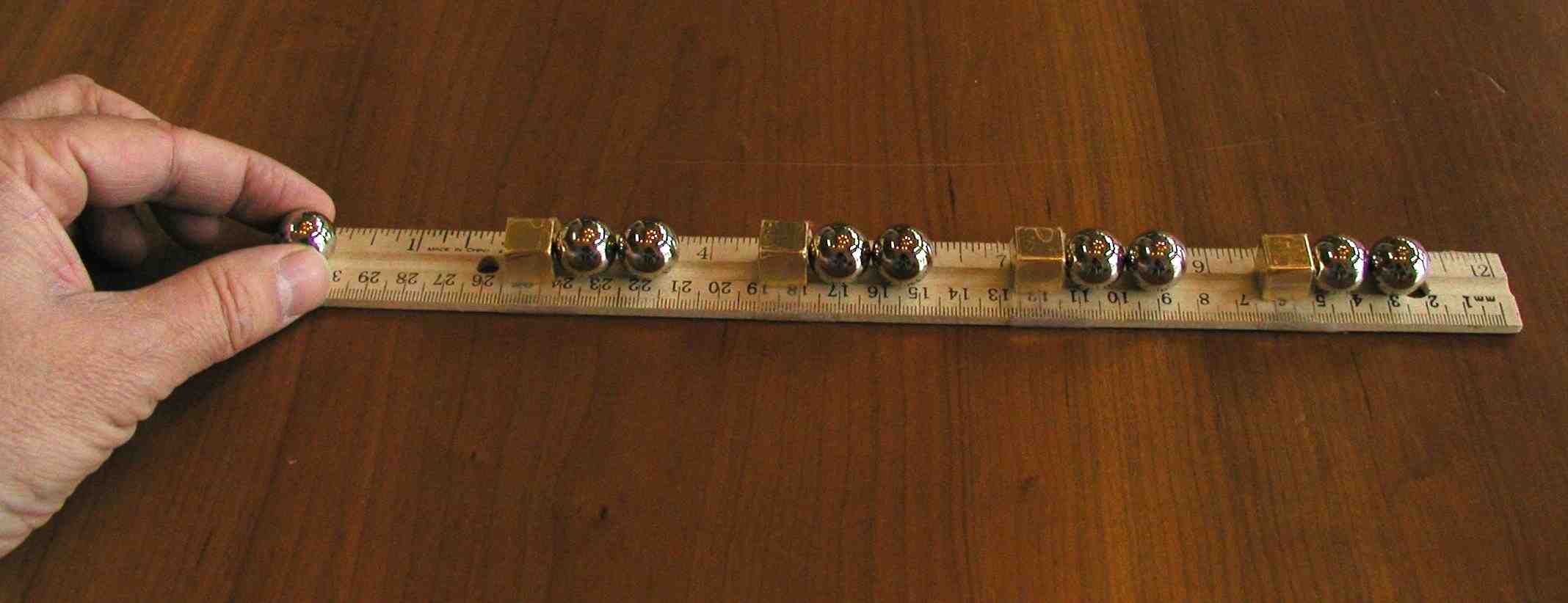
gauss rifle ready

The Gauss Rifle Magnetic Linear Accelerator:


The ten-minute electric motor:


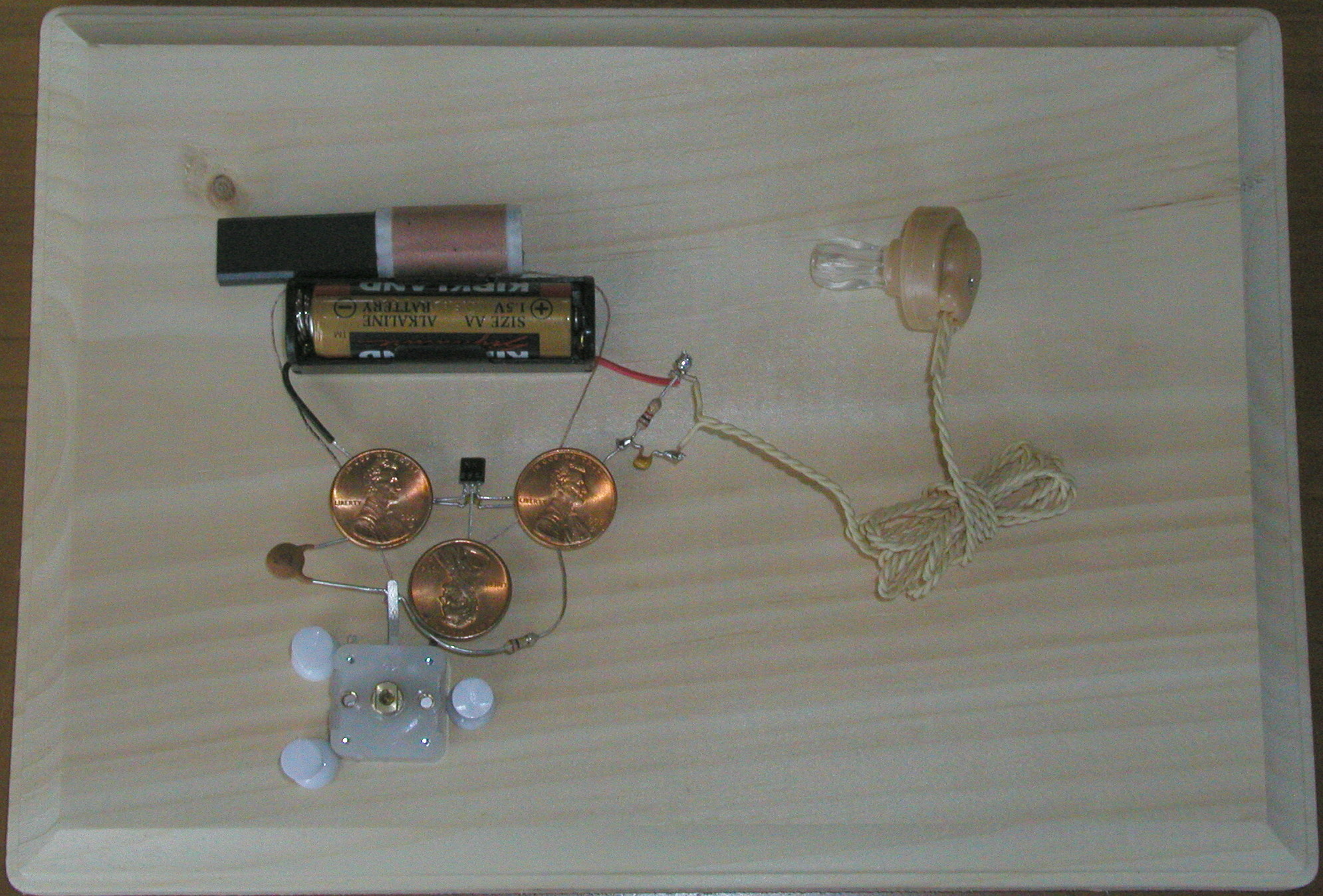
Completed radio without cabinetry
A simple crystal radio


A Three-penny radio

If you are more inclined to sniff binding glue rather than click mouse buttons, you can get your gadget groove on with his books:

Gonzo Gizmos, and Return of Gonzo Gizmos

Have fun!
-P


Release Your Inner Scientist

Many of you have probably heard me rant from time to time about the fact that science education in the US has become an exercise in endurance to survive boring history of science lectures and rote repetition of cookie-cutter "experiments." I'd even go so far as to call many of them little more than advanced games of Simon Says. "Simon says, now place the loop at the top of the ramp...hey, look at that! It did exactly what the workbook said it would do!"

math and science literacy tests for seniors

It is no wonder that US high school science literacy has fallen to the 20th percentile of industrialized nations. (2003 study, 2005 study, a REALLY scary 2006 report with graphs plotted below, and another summary of the same report.)

Senior high school physics

The solution to this problem, in my mind, is to make real tools, projects, parts, guidance and inspiration available to students in both supervised and unsupervised open access laboratories, for them to perform their own experiments, and build their own projects. In essence, we need to get our students to innovate themselves rather than strand them reading about how other people innovated. And the process needs to start early, in pre-school, through elementary and Jr. high, with increasing complexity and depth throught high school.

One of my favorite sources of inspiration for this type of explorations was the monthly "Amature Scientist" column that used to be a regular feature of Scientific American. Despite their recent decision to eliminated that column, you can still find the whole archive and a whole set of new projects from the fellow who wrote the column for the last six years here at Dr. Shaw's web page entitled, "The Best Tail-Kicking Science Projects Anywhere."


A couple of my favorites that just jumped off the page included:
  • Photograph an ant's brain and nervous system
  • Convert an old kitchen blender into a working centrifuge
  • Experiment with films only one molecule thick
  • Use a hot wire to study the crystal structure of steel
  • Measure the electric charge on raindrops
  • Study fluctuations in the earth's magnetic field
  • Build a video microscope for about $10
  • Learn all the secrets of grinding and testing telescope mirrors
  • Build, mount and use research-quality telescopes at home
  • Search for titanic galactic explosions
  • Learn six different ways to fabricate a laser at home
  • Make soap bubbles that last for months (or even years!)
  • Measure the energy drain on your car


The list just goes on and on. I think I'm going to purchase the latest set myself.

Of course it will help if we can somehow help teachers to become guides and mentors in exploration rather than just lecturers. More on that in later posts.

Some Nice Judo Ukemi Video


This is some nice video of a Korean Judo team demonstrating basic Judo techniques starting with Ukemi for a warm-up. It shows a wide range of skills across the team, with some of the advanced rank-holders showing decent technique. They are probably not as crisp in terms of technique as the more anal Japanese-style practitioners (some body positioning out of place, toes not pointed so power is limited, more lifting than timing...etc.) but there are great camera angles despite the hand-held aspects to show the protective power of Ukemi.

For a point of reference, judging from the relative skills demonstrated, the more advanced students in this video probably have about 10-15 years of practice under their belts (so-to-speak), while the newer students go all the way down to about 1 year or so.

Thursday, July 20, 2006

Physics in Martial Arts: Ukemi ("Accepting Falls")

After over 30 years of studying Judo with some Karate, Tae-Kwan-Do, and Aikido thrown in from time to time, I have finally come to conclude that I have never seen a decent technical description of the physical principles surrounding the very specialized and effective techniques that martial arts have evolved over the centuries to protect people from injury when falling. Many practitioners are quite expert in the practice, and can teach the techniques quite effectively, but traditionally do not speak in any real detail on the scientific aspects. Frankly, I have found that this is a good thing, as the technical descriptions, even to MIT undergrads, have little impact on student improvement. But the study of different refinements and variations across different martial arts could be instructive. So I guess I'll write it myself and invite comment.

In the interest of reaching the broadest possible audience, I will restrict this discourse to fundamental physical principles without any real mathematics, though possible later posts might go into specific numerical examples. In order to understand this discussion, readers should be, or make themselves, familiar with the basic physics surrounding velocity, acceleration, linear and angular momentum (and conservation thereof), work, energy (kinetic and potential), impulse, pressure, levers and leverage, springs, and collisions.

The very name Ukemi is often mistranslated as falling. A more correct translation takes into account the etymology of the root word Uke, or receiver. In Judo ( The Art or Way of Gentleness ) techniques are generally executed by Tori or the Giver and taken by the receiver, Uke. In that sense, a person who receives a technique must accept, and protect themselves from any attack or incident. The fundamental precept of Judo is: Maximum efficiency with minimum effort, for the mutual welfare and benefit of all. So the techniques surrounding the receipt of any technique is never to meet force with a directly opposing force, but rather to go with the incoming force, accept its energy to move in concert with it, and then deflect it in a more useful direction without harm to either party. By extension, Ukemi extends these same principles to protect a person physically from even brutal impacts with the ground. The basic goal, of course, is to be able to fall without injury, even under extreme conditions otherwise out of a person's control.

The efficacy of these techniques is truly awesome. They are, by far, the most useful and often-used aspects derived from my many years of martial arts training, and have helped me survive some potentially serious injuries. One particular incident comes to mind from when I was about 12 or 13 years old, with around 6 years of Judo training behind me at that point, when I was pushed off of a 3-meter diving board head first onto the concrete pool deck. You know, one of those "saved your life" kind of jokes gone bad. Net result was a slight road rash on one shoulder, but the look on the guy's face when I just dove of the board and rolled to my feet was priceless. Other examples in sports, and on Ithaca, NY ice are just too numerous to count. I just have absolutely no fear of falling anymore, and that is a very empowering thing.

The basic principals that can be used to describe the minute refinements that give Judo Ukemi its incredible protective power turn out to cover a very wide range of mechanisms.

  1. The area of the body impacting the ground in the instant when sensitive body parts strike is maximized in order to minimize the absolute force felt by any one part of the body.

  2. The duration of impact is maximized, so that the momentary impulse or force felt at any one instant is minimized.

  3. Tensioned, but not stiff or locked, muscles are used as springs, to absorb kinetic energy and dissipate it harmlessly, giving, but not breaking.

  4. The extension of arms and legs, and even bending of the waist are actively controlled so as to change the angular moments of inertia and thereby vary the rate of rotation of the body and guarantee a landing on a soft part of the body, just as a cat gyrates to land on its feet.

  5. The limbs are used to do work, and thereby affect relative rotational and linear velocities so that the body lands in a safe position.

  6. The Body is bent into wheel-like shapes in order to convert linear momentum in a fall, to controlled angular momentum of the body rolling along the ground in a wheel-shape, until the flexible muscles dissipate the energy of the fall with little or no actual impact.

  7. The limbs and joint angles are actively positioned so that no hard bones or joints (skull, knee, elbow, ankle bone, wrist bones) can possibly impact the ground directly, and so that no part of the body can be driven to strike another part of the body (as in one leg crossed over the other to slam together).

  8. The head is tucked, chin towards chest, and inside the circle of arms to protect it from any impact.

  9. The breath is exhaled smoothly and continuously (traditionally in a Kiai or shout, translated more literally as an expression of energy or self ) so that upon impact there is no sharp increase in blood pressure from the closed bag of water (your body) hitting the ground. (which in specially hard falls, can cause a person to black-out.)

  10. Fingers and toes are held together so that in a unit they are stronger than individual fingers that can catch on things and break.

  11. Any contact with the ground, or an attacker that exists at the beginning of a fall or throw, even if Uke is very off-balance, is used as something to push against in order to alter the body's trajectory towards a safer landing position.

Part 2 will begin by describing how each of these principals is applied to Mai Mawari Ukemi, or the receipt of Forward-rolling-falls.


If you would like to see some excellent examples of all types of Ukemi in action, check out this video.


One of my Favorite Aikido Demonstrations

One of O-Sensei's students and the current chair of the US Aikido Federation, Yamada sensei, shows flawless technique and timing.

The Difference Between Judo and Aikido Ukemi

The Difference Between Judo and Aikido Ukemi

Here is a nice demonstration of the classic Aikido form of Ukemi. Let me begin my comments with an admission that I am clearly biased, with over 30 years of Judo practice and only about 2 years of cumulative Aikido experience. That said, I have found the precise application of the Judo style to be more protective than that of Aikido. I have observed two fundamental differences, each of which is highlighted by comparing the various demo videos posted on this site.

First of all, the Aikido version has Uke tuck the off-direction leg under the other closer to the buttocks. This has the effect of somewhat facilitating a roll to a standing position, but it fails to protect either the ankle bone, or one leg from impacting the other upon significant impacts. This leg tuck also has the effect of decreasing the angular moment of inertia, and can do nothing to slow the rate of rotation and thus better control the landing position.

The other fundamental difference is that the Aikido style seems to rely on being relatively in control of the fall from the beginning with more use of hands for gentling the falls than does the Judo variation. Ultimately, I have found that the Judo techniques can protect a body from a wider range of falling situations that start out farther from control.

Those very minor details aside, it is clear that the fundamental principles are very similar, and it is very possible that there are larger differences from instructor to instructor than between the two arts.

Tuesday, July 18, 2006

Cloudy Night Number One.

And probably not the last.


Well gang, this is my innaugural post. For all you astronomy buffs, I've finally begun to get back into the obsession. The last couple of weeks have been taken up with a search for two or three different systems.

  1. (immediate) A nice airline-portable grab-and-go rig for our upcoming Maui vacation next week. Mainly for reasons of likely sand and child-induced wear, I ultimately settled on one of the William Optics Zenithstar 80 scopes. I considered some higher-end scopes but ultimately went portable and disposable, just in case.

  2. A not-so-portable high-end refractor on a stable and high-precision mount as a platform for medium to wide-field digital astrophotography. So Far I purchased a used Losmandy G11 mount and added the Gemini go-to system. Leading candidates for the initial scope are the new Takahashi TSA 102 APO, and the yet-to-be-seen William Optics TMB-designed Zenithstar 110 Triplet APO.

  3. NEW! LightBridge Truss Tube DobsoniansA big light-bucket Dobsonian for visual observing excitement. I recently saw one of the new Mead Lightbridge truss Dobs in a local retailer. Frankly, I was really impressed with the mechanical stability, smoothness of the bearings, focusser quality, and overall fit and finish. The jury is still out as far as the optics are concerned. They wanted about $1,200 for the 12" version. More investigation due here.

Software-wise, I've purchased both Starry Nights Pro and The Sky to see which one better integrates with the Gemini system. A little cable hacking will be necessary to couple my notebook's USB port through a USB-to-serial converter, and then through a custom DB9-to-RJ22 cable. I'll keep you posted how the interconnect effort goes.

Sunday, July 16, 2006

A Convenient Supposition

Or, how to confuse correlation with causality, part 34,289,767.

Some friends and I went to see Al Gores recent movie "An Inconvenient Truth" a few weeks ago. It was really quite a good show, in marked contrast to his political voice through the failed campaigns.

Let me start my review, lest my yelping liberal wife slay me out of hand, by saying that I DO believe that there should be serious and growing concern regarding global warming. I also believe that there should be more movement in federal policy circles to address these issues sooner rather than later. I also think that Gore put together a very approachable and emotionally effective presentation on why we should all take the global stakes of failing to act on such an awesome threat to our ecosystem much more seriously.

I even saw a news article briefly appear on Yahoo entitled something to the effect of "Gore gets science right in global warming movie." Unfortunately though, the blogosphere dug in over the next few days to discover that the reporter who wrote the article only contacted 35 scientists, only 5 of whom had actually seen the movie, none of whom were climatologists.

To Gore's and the movie producers' credit, they did get me to go and do a little technical research regarding the data presented in the movie. In the process, I had a vaguely familiar feeling that I was able to trace back to my distaste when watching the last round of presidential debates. It was the discomfort that came from only hearing a convenient part of the story while the rest was left out to spin it towards one side or the other.

I found the global warming link at Wikipedia to be very useful, as regardless of your affiliation in this so very politicized issue, all of the recent experimental data was readily accessible through compilations of web links. I found a couple of links to be quite interesting. Probably the biggest "oooh----ahhh" moment of the movie was around Gore's dramatized revelation of the historical atmospheric CO2 concentration data. It looked like a sexed-up version of the following chart:


Now this all looks pretty serious. Gore really hammers the point that nobody really disagrees that the industrialization of the world is causing the rather precipitous CO2 rise. He plots the CO2 levels on a chart just below a similar temperature chart and notes the obviously correlation. He is careful to say that they are correlated and the relationship is complex, but grim looks and head shaking abound. I then goes on to project what might happen to our CO2 rates over the next 100 years and then make some really fantastic predictions about melting ice caps and deluged and disappearing coast lines. All very dramatic, but a little misrepresentative.

When I went to dig in on the actual climatological data, I found that interesting things become apparent when you actually plot the CO2 variations against the temperature on the same chart and time scale.


Note, in particular that time runs backwards, with the present along the y-axis, going back in time towards the right. A closer look at this representation certainly supports the correlation argument. But the causality proposal that our increasing CO2 generation will undoubtedly cause global ruin if unchecked takes a real hit. Note that for most of recorded history, the temperature changes PRECEEDED the CO2 changes. Most likely this variation follows what we see seasonally, that when the temperatures get hotter, flora abounds, and increases CO2 respiration under photosynthesis, and likewise, when the earth cooled through periods of glaciation, flora died, and so did the CO2 respiration that went away as a result.

Also note, that there is clearly some sort of larger limiting effect which causes the temperature to plummet rather drastically even though the CO2 has rising to quite high levels, and then the CO2 levels descend in turn. So there was clearly SOMETHING that was causing the temperature to vary which then affected vegetation growth. A little more research into insolation and solar forcing functions offers the following support.


Note here that the eccentricity, precession, and obliquity of the earth's orbit combine in their effect to change the amount and duty-cycle of sunlight reaching the earth. And when you combine all of these into an effective "solar forcing function" it becomes pretty clear that we have found the zeroth-order temperature regulation mechanism for the Earth's surface which seems to override even the CO2 concentration levels. It's also worth noting that these rather drastic-looking temperature variations are charted in such a way that the approximately 1-2 degree variations around a mean temperature seems rather drastic, and it occurs to me that the likely thermal mass of the ENTIRE EARTH has to a significant damping influence on any atmospheric boundary effects on overall earth cooling.

So in short, yes there is more atmospheric CO2 than there has ever been, and that might actually raise the temperature a bit. But will it be a relevant forcing function relative to the insolation variations? I don't think we really have the foggiest clue. We would need to see the temperature rise to follow the CO2 variations, and meager increases to date are not particularly well correlated to the dramatic sudden and recent increases in greenhouse gasses.

Should we take the problem seriously and even take legislative and regulatory steps despite the uncertainty? Given the potential magnitude of loss in the event there really is a problem, I think we have a moral imperative to act. But let's make sure we keep track of what is causing what, rather than what is correlated with the other.