What a difference 20 Years Makes: 1GB Then and Now


Loading..




Loading..


Loading..
I just stumbled on a great post from Julieanne over at Cosmic Variance.
"My temporary officemate runs down to the vending machine and buys a bag of gummi bears. He dumps them on the desk, sorts them by color, and then proceeds to eat them in order of increasing bin size (i.e. the pile of 1 orange one, then the pile of 3 yellow ones, then the pile of 4 green ones, etc).
If I buy a bag of M&M’s, I sort them by color, then figure out a division that lets me arrange them in a triangle, with one color per horizontal row, but allowing colors to be repeated (i.e. it’s ok for 9 red M&M’s to show up as a row of 7, and then further up, a row of 2). I then eat off each diagonal, producing a progressively smaller triangle, but one that maintains the horizontal color structure till the tasty end.
My kids, who I suspect inherited a geek-streak a mile wide, also sort multicolored candy into patterns and make up an algorithm for eating it.
The non-scientists who I have asked about this habit look at me like I’m nuts. (So do people who grew up in large families, because someone was bound to snarf the candy before they could take the time to develop this particular neurosis.)"
One of my personal favorites on the candy consumption side is to conduct natural selection experiments with M&Ms. I like to take two M&M's and squeeze them together until one fails structurally, and then I eat the failure, setting aside the victor to participate in the next round of trials. The winner of the single elimination tournament is the most fit M&M prototype for future generations. The superior M&M is always the last to be eaten.
Loading..
Today [August 9, 2007], the Northern Hemisphere sea ice area broke the record for the lowest ice area in recorded history. The new record came a full month before the historic summer minimum typically occurs. There is still a month or more of melt likely this year. It is therefore almost certain that the previous 2005 record will be annihilated by the final 2007 annual minima closer to the end of this summer.


"Sea level is already rising at a moderate rate. In the past decade, it increased by 3 centimetres, about double the average rate during the preceding century. The rate of sea level rise over the 20th century was itself probably greater than the rate in the prior millennium, and this is due at least in part to human activity."Worse yet, is the very real possibility of runaway collapse.
"..the primary issue is whether global warming will reach a level such that ice sheets begin to disintegrate in a rapid, non-linear fashion on West Antarctica, Greenland or both. Once well under way, such a collapse might be impossible to stop, because there are multiple positive feedbacks. In that event, a sea level rise of several metres at least would be expected.Hansen seems convinced that the most recent data on historical temperatures is more accurate than earlier research, and places our current global temperature within 1 degree of its highest temperature in the past million years, making the horrific prospect of a 5 meter increase in sea levels seem much more ominous.As an example, let us say that ice sheet melting adds 1 centimetre to sea level for the decade 2005 to 2015, and that this doubles each decade until the West Antarctic ice sheet is largely depleted. This would yield a rise in sea level of more than 5 metres by 2095."
"The broader picture strongly indicates that ice sheets will respond in a non-linear fashion to global warming - and are already beginning to do so. There is enough information now, in my opinion, to make it a near certainty that business-as-usual scenarios will lead to disastrous multi-metre sea level rise on the century time scale."


Loading..
Update September 8, 2007:
Loading..
The title says it all. I almost couldn't stop laughing and crying at the same time.

Hat tip to The Giant Napkin.“First, I computed my annoyance ratio to determine the probability that each student would want to beat me up,” said Mosley. “Then I gauged that against the Beatings to Hand Raises Theory along with past historical data from my previous physical assaults.”
“The probability of me remaining this smart, let alone becoming slightly smarter, is very high,” said Mosley. “Given that, getting beat up within the month is an expected result. Furthermore, when taking into account my small stature proportional to the most likely inflictors of given beating, I’m estimating a 30 percent chance of a broken bone.”
Loading..
Usually when one of our model rockets went sideways in the teen years, it was a problem and we were diving for cover. Here's to making a problem an opportunity! Rocketcar day!


Loading..
Loading..
Apparently, all you need to really look your hottest is Photoshop. Check out this post from Jezebel.

Loading..
As most of you loyal readers are aware, one of my ongoing crusades is to transform k-12 science education from boring rote cookbook style exercises in contrived tedium into the interesting explorations they SHOULD be.


Loading..
Yun Seong Song and Metin Sitti from Carnegie Mellon University have created a water-strider robot based on the insect, which uses surface tension to literally walk on water.

(Left) Photo of the water strider insect. (Right) Photo of the 1-gram robot on the surface of the water. A, B, C, D: supporting legs; E and F: actuating legs; G: body with on-board electronics and power source; H: middle actuator; I and J: right and left actuators. Image credit: Yun Seong Song and Metin Sitti. ©IEEE 2007
"For locomotion, the water strider insect creates a sculling motion with specialized sculling legs. The robot functions the same way. Three piezoelectric actuators, when attached to the legs in a T shape, create both vertical and horizontal motion to cause the elliptical sculling motion required to move.
Because the piezoelectric actuators provided only a small deflection, an amplifier was needed to create large strokes. To achieve this, the researchers used a resonant frequency with a vibration mode favorable to generating the sculling motion to drive the actuators. While a water strider insect can move at speeds of up to 1.5 m/s, the first robot still achieved a forward speed of 3 cm/s, and could also turn, rotate and move backwards."
More details here.
Loading..
Here's an interesting chart via Ohm Malik's blog on the OECD telecommunications outlook report on the cost of broadband Internet in different countries. It's an interesting metric on industrialization. Sadly, we're not looking so good.

Loading..
All you Atlanta natives have no excuse for missing the 2007 Robocup competition, currently ongoing (July 1st-10th) at Georgia Tech. The official competition just began yesterday (Tuesday, July 3rd), but the event continues through finals on July 10th.
It's so cool I don't think I need to even say anything more about it other than check out these images and videos. And get over to GaTech and check it out!


Loading..
Another honorary 4th of July post I just can't resist. Normally, I'd say, "...kids, don't try this at home." All appropriate burn-your-house-down type disclaimers are hereby offered. But hey, if you can figure out a cooler way to cook a dog, let me know.


Loading..

From about.com:
What You Need:
- iron wires or wooden sticks
- 300 parts potassium chlorate
- 60 parts aluminum fines, flitter, or granules
- 2 parts charcoal
- 10% dextrin in water solution
- 500 parts strontium nitrate (optional, for red color)
- 60 parts barium nitrate (optional, for green color)All these ingredients are legal and can be ordered or bought at a chemical supply store like Science Stuff or Chem Bargains.
Mix the dry ingredients with enough dextrin solution to make a moist slurry. Include the strontium nitrate if you want a red sparkler or the barium nitrate if you want a green sparkler. Dip the wires or sticks in the sparkler mixture. Be sure to leave enough uncoated space at one end to safely grasp the finished sparkler. Allow the mixture to dry completely before igniting the sparkler. Store sparklers away from heat or flame, and protected from high humidity.
Loading..
Here's a very nice image from Steve Morris' airliners.net site showing the extent of the wingtip vortex generated by a wide-body jetliner (a Boeing 767 in this case).
Next time I am frustrated at taxi and runway delays, I'll try and remember this photo. Even though you can't ordinarily SEE the churning air behind a jumbo jet, it's still a good idea to wait a bit between take-offs.

Loading..

If you look at the spinning girl's silhouette below, you will think it is spinning clockwise, probably. When you check her shadow below, momentarily the spinning direction changes in your mind, and now the girl is spinning counter-clockwise. It can be quite hard at the beginning to notice switch of the spinning direction, but eventually you'll manage.
Loading..

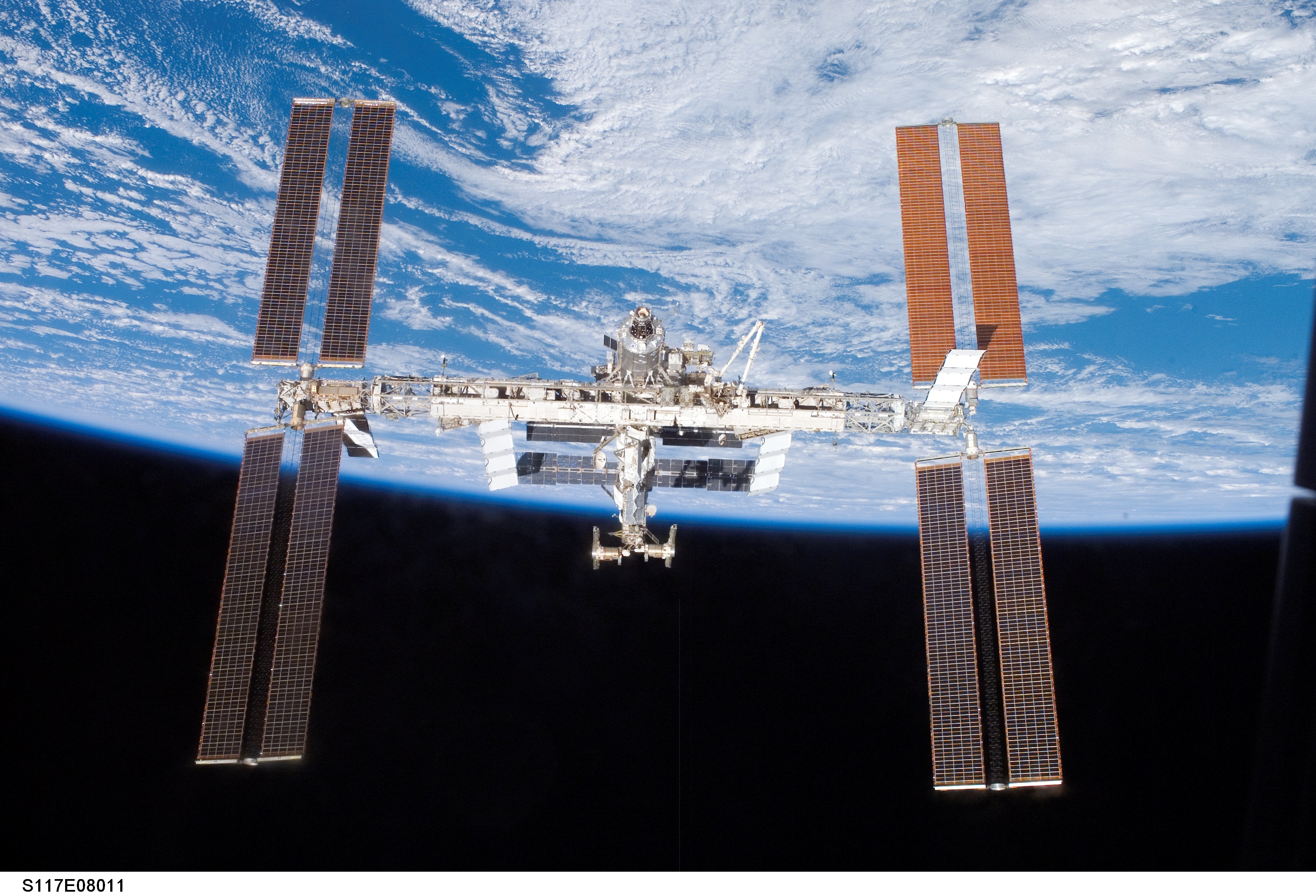
The International Space Station Expands Again
Credit: STS-117 Shuttle Crew, NASAExplanation: The developing International Space Station (ISS) has changed its appearance again. During the past week, the Space Shuttle Atlantis visited the ISS and added pieces of the Integrated Truss Structure that mirrored those added in September 2006, including a second impressively long array of solar panels. The entire array of expansive solar panels are visible at the edges of the above image taken by the Shuttle Atlantis Crew after leaving the ISS to return to Earth. The world's foremost space outpost can be seen developing over the past several years by comparing the above image to past images. Also visible above are many different types of modules, a robotic arm, another impressive set of solar panels, and a supply ship. Construction began on the ISS in 1998.
Loading..

 Posts
All Comments
Posts
All Comments
Add All the Best Bits to your favorite news reader: